Descriptive Summary |
|
| Creator: | Grant, Frances R. |
| Title: | Guide to the Frances R. Grant Papers 1897 (1917)-1986 |
| Dates: | 1897 (1917)-1986 |
| Quantity: | 78 cubic feet (66 records center cartons, 11 phase boxes, 3 newspaper boxes, 6 index card boxes, 1 oversize folder) |
| Collection No.: | MC 671 |
| Location: | Stored offsite: Advance notice required to consult these records. |
| Language | English. |
| Repository: | Special Collections and University Archives, Rutgers University Libraries |
Frances Ruth Grant (1896-1993), pioneer in U.S.-Latin American relations, was born in Abiquiu, a remote pueblo in the foothills of the Valle Grande mountains in what is today New Mexico on November 18, 1896. Her father was Henry Grant, a German-Jewish immigrant, who owned the general store in Abiquiu. Her mother, Sarah Spiro, was a remarkable woman who vaccinated the entire population of Abiquiu for smallpox with a serum she had sent from Johns Hopkins Hospital. (1) Frances was one of four children: Hylda (1893-1964), Joseph (1898-1976), and David E.(1889-1964). Growing up in Abiquiu, Grant absorbed Hispanic culture: "my first language was Spanish-- a felicitous circumstance which has afforded me one medium of intimate relationship with the Latin Americans." (2) During her early years, however, Grant commuted between Abiquiu and New York City; she was educated at Hunter College High School, and graduated from Barnard College and from Columbia University School of Journalism in 1918. Grant also studied music with Albert von Doenhoff, Ernest Bloch, and others. Following graduation, she became a music critic and associate editor for Musical America, as well as a contributor and correspondent for several other magazines and newspapers.
In 1920, Frances Grant met the Russian émigré painter and philosopher, Nicholas Roerich(1874-1947). She wrote general articles on his paintings (then on exhibit in New York), and on his decorations for ballet and opera. She became friends with the Roerich family, who visited her family in New Mexico. In 1921, Grant resigned from Musical America and became Executive Director of Roerich's new art school, the Master Institute of United Arts in New York. (3) At the Master Institute, Roerich tried to unite all the arts under one roof, offering classes in music, painting, sculpture, architecture, ballet, and drama, as well as lectures, concerts, and student exhibitions. The faculty included Russian émigrés Sina and Maurice Lichtmann, who taught piano; Deems Taylor, who taught musical theory and composition; Robert Edmund Jones and Lee Simonson, who taught theater design; and Mikhail Mordken and Mikhail Fokine, who taught ballet. Guest lecturers included artists George Bellows and Rockwell Kent. The Institute also offered classes in music and sculpture for the blind, a new idea at the time. As well as offering a well-rounded education in the arts, the Master Institute was designed to "open the gates to spiritual enlightenment" through culture. (4)
In 1922, Roerich founded an international art center, Corona Mundi, which opened with an exhibition of his paintings, and later showed art work from around the world. Frances Grant held numerous responsibilities at the Roerich institutions, including arranging exhibitions, lectures, musical programs, purchases of art work, overseeing publications of work by Roerich and his followers, and administering the classes offered by the Master Institute. Grant was made Vice-President and Trustee of the Museum, along with Sina and Maurice Lichtmann and several others. The President and chief benefactor was Louis Horch, a foreign exchange broker, who was an enthusiastic follower of Roerich, and whose wife, Nettie, was a school friend of Grant's. In 1923, Nicholas Roerich, his wife Helena and sons George and Svetoslav set off on what would be an almost five-year expedition to India and Central Asia, where Roerich painted and studied Eastern philosophy. (5) In 1928, Grant was given a rare opportunity: with Sina Lichtmann, she traveled to India to meet the Roerich expedition. In India, Grant discussed museum matters with the Roerichs, as well as traveling and pursuing her own interests in Eastern art and philosophy.
It was in India that Nicholas Roerich first told Grant that he wanted to send her to South America on a cultural exchange mission. Believing that North and South America were uniquely linked, Roerich sought to "better human relations through artistic and cultural understanding." (6) On what was to be the first of many trips to Latin America, Grant visited Peru, Chile, Argentina, Uruguay, and Brazil in the spring and summer of 1929. Her trip was a preliminary effort to explore the possibility of organizing exchanges of exhibitions, students, and scholarships. She visited museums, schools, universities, and other cultural institutions, and met with artists, writers, and musicians. Grant took a particular interest in indigenous culture as well as the role of women in Latin America, and met many women artists, including the Chilean poet Gabriela Mistral.
The following year, Grant made a more extensive trip to Latin America, adding to her itinerary Bolivia, Colombia, Cuba, Ecuador, and Mexico. Grant brought with her a traveling exhibition of 39 of Roerich's paintings, as well as additional paintings for loan to South American museums. She also gave lectures on Roerich and the work of the Roerich Museum to universities, museums, women's groups, and philosophical societies. Grant discussed the translation and distribution of Roerich Press books in Latin America, and helped arrange for several scholarships to the Master Institute. Her trip inspired the formation of Roerich societies in the countries she visited. As well as artists and writers, Grant met with several Latin American leaders during her visit, including President Carlos Ibáñez del Campo of Chile, and President Enrique Olaya Herrera and Minister of Foreign Affairs Eduardo Santos of Colombia. In Peru, she met with President Augusto Leguía, who was overthrown on the day of her departure. Upon Grant's return, in cooperation with the Brazilian Society of Friends of the Roerich Museum, the International Art Center sponsored an exhibition of almost 100 paintings by contemporary Brazilian artists, the first ever seen in the United States. In the early 1930s, Grant arranged lectures, programs, and exhibits of Latin American art at the museum, and undertook a lecture tour herself, speaking on Pan-Americanism.
During this period, Grant played an important role in Nicholas Roerich's crusade for the Roerich Pact and the Banner of Peace. (7) The Roerich Pact, written in 1928 by Georges Chklaver at the University of Paris under Roerich's supervision, was designed to protect and preserve cultural institutions and monuments in times of war. Designated buildings would fly the Banner of Peace, (designed by Roerich) which showed three red circles on a white background. From 1931 to 1933, three international conferences were held to promote the Roerich Pact and the Banner of Peace. In 1933, the Pact was endorsed by the member countries of the Pan-American Union in Montevideo. Frances Grant was an active participant in these events, meeting with officials in Washington, D.C., and corresponding with leaders in Latin America to promote the Pact. Her efforts were rewarded when the Roerich Pact was signed by the United States and 20 Latin American republics on April 15, 1935.
In spite of this triumph, in the hard times of the early 1930s, the Roerich Museum fell into financial difficulties. In 1929, the museum had moved into a new building: a 29-story "skyscraper" designed by Harvey Wiley Corbett. The first three floors were designated for the museum, the Master Institute and Corona Mundi. Most of the building, however, was designed as low-cost apartments for artists, musicians and scholars. (8) Grant and the other museum officers were also given apartments in the new building. With the financial crisis, however, the museum was no longer able to pay the mortgage on its new home. In 1932, the New York Supreme Court appointed a receiver and ordered an audit; on appeal, however, the receivership was voided, another bank took over the mortgage, and one thousand of Roerich's paintings were accepted as a guarantee.
The financial problems persisted, however, and precipitated a strange series of events which involved, among other individuals, future U.S. Vice-President Henry A. Wallace. Frances Grant had first met Wallace, who at that time was publisher of Wallace's Farmer, in 1928. (9) Wallace, who was greatly interested in all forms of religious experience, became impressed by Roerich's art work, pacifist religious philosophy, and scientific research. (10) In 1929, deciding to remain permanently in India, Roerich founded the Urusvati Research Institute in the Kulu Valley in the Himalayas. At Urusvati, Roerich and his sons George and Svetoslav conducted research on Eastern languages, art, religion, and medicine, compiling the world's first atlas of Tibetan medicinal herbs. (11) In April 1929, Wallace wrote to Grant: "Both in words and in painting, Roerich's mysticism is an adept [sic] in the use of symbols which have a power unknown to science, and yet Roerich's mysticism has a decidedly practical aspect and eventually significant [sic] to the scientific world." (12)
Henry Wallace corresponded with both Grant and Roerich during the early 1930s. In 1932, he was appointed Secretary of Agriculture by Franklin D. Roosevelt. In this capacity, Wallace invited Roerich to lead a botanical expedition to India and Northern China in 1934. The purpose of the expedition was to research drought-resistant seeds which might be useful in alleviating the conditions in the Dust Bowl. During the seventeen months of the expedition, the group researched over three-hundred plants and sent about two-thousand packets of seeds back to the United States. (13) Tensions developed, however, between the Roerichs and the two Department of Agriculture botanists accompanying the expedition. Wallace also began to fear that Roerich was pursuing his own personal political agenda, which ran contrary to U.S. interests. Indeed, Roerich met with the emperor of the Japanese puppet state of Manchukuo, and presented him with the Banner of Peace, which infuriated the State Department, since the U.S. did not recognize Manchukuo. The botanists also complained that Roerich was agitating among White Russian émigrés in Harbin, Manchuria. At first, Wallace did not believe the allegations, even to the extent of recalling the botanists, and dismissing their chief supporter, Knowles Ryerson, Chief of the Bureau of Plant Industry. (14)
In 1936, however, Wallace turned against Roerich and abruptly terminated the expedition. (15) In his Russian Art and American Money (1980), Robert Williams asserts that the botanical expedition was completely bogus. Undoubtedly, Roerich had a personal agenda: for instance, in Mongolia, he met with farmers with a view towards setting up agricultural cooperatives. Meanwhile, back in New York, Frances Grant had become involved in a power struggle over the fate of the Roerich Museum. At this point, President Louis Horch had assumed control of the museum's finances. Apparently, during the botanical expedition, Horch and Wallace were in secret communication. In spite of Grant's efforts to mediate, in July 1935, Louis Horch closed down the museum and its affiliated institutions, claiming that the Riverside Drive building and its contents belonged to him. (16) Grant and the other museum employees were given two days to evacuate their apartments. Horch later reopened the first floor as the Riverside Museum, and continued to run the rest of the building as an apartment complex, which it remains today. Grant and the Lichtmanns filed suit against Horch, but after protracted litigation, the court decided in Horch's favor in 1940. Sina Lichtmann (later Fosdick) and some of the original supporters reopened the museum as the Roerich Academy of Arts. It moved from one building to another until 1949, when it found a permanent home at 107th Street and Riverside Drive. (17) Frances Grant, however, fell out with Sina Lichtmann during the litigation, and was excluded from the museum, forcing her to turn to other areas of endeavor. (18)
After the disastrous conclusion of her relationship with the Roerich Museum, Frances Grant refocused her energies on her Latin-American interests, which she had been pursuing since her 1930 trip. In that year, Grant founded the Pan-American Women's Association in New York, originally known as the Pan-American Women's Society of the Roerich Museum. The Pan-American Women's Association (PAWA) was a volunteer, non-political, educational and cultural organization "for the purpose of uniting the women of the Americas in a common effort for the advancement and understanding of the peoples of this hemisphere." (19) For a small fee, it was open to both men and women who supported the objectives of the organization. The PAWA can be seen in the context of the Pan-American movement, or Pan-Americanism, the belief that the peoples of the Western hemisphere are bound by common cultural ties and mutual interests. Originating during Woodrow Wilson's administration, (20) the concept was further developed through Franklin D. Roosevelt's Good Neighbor policies, which had an important influence on Grant.
The PAWA's activities included sponsoring art exhibits, and musical, literary, and dance programs by Latin-American figures, who at the time were little known or understood in the United States. Among those hosted by the PAWA were the Figueroa Quartet, pianist Esperanza Pulido, Claudio Arrau, and soprano Bidu Sayão. In the educational sphere, the PAWA sponsored courses and lectures on Latin-America, Spanish language classes, and arranged activities for Latin-American exchange students, frequently cooperating with other organizations. Grant herself gave a series of short-wave radio broadcasts to Latin America in Spanish. Perhaps most importantly, through setting up branches, the PAWA fostered contacts among the women of the Americas.
In the early 1940s, faced with the threat of fascism in Latin America, the PAWA began to focus on human rights issues. In 1943, in conjunction with the National Council of Women, the PAWA sponsored a Pan-American Day Inter-Hemispheric Conference on "How Women of the Americas Can Help Keep their Countries United." In a speech entitled "The True Pan-Americanism," Grant outlined the belief that this hemisphere's women, because they have not historically been involved in wars and colonialism, present the best hope for future relations between North and South America. (21) In this year, the PAWA also sponsored a conference on inter-racial understanding, which addressed the issue of racism in both the United States and Latin America
In the late 1940s, when a number of Latin American countries were taken over by dictators, the PAWA joined other organizations in denouncing human rights abuses in those countries. As Grant wrote: The Pan-American Women's Association is guided by the conviction that true Inter-American understanding will be achieved upon this hemisphere when the peoples of the 21 American Republics--men and women alike--enjoy full civil and political liberties as well as those educational, social, and economic opportunities. (22) In subsequent years, the PAWA arranged programs by several Latin-American democratic leaders, including Rómulo Gallego, Rómulo Betancourt, Eduardo Frei, and Carlos Lleras Restrepo. In the 1940s, the PAWA also served as an organizational base for Frances Grant after her estrangement from the Roerich Museum. (At this time, she earned income by working as an editor for several publications owned by her brother-in-law, Max M. Zimmerman.) In 1941, Grant traveled to South-America, visiting every country except Venezuela, as a representative of the PAWA . She renewed many of the contacts she had made in 1929-1930, and gave lectures on "Inter-American Relations" and "Women's Work in the Western Hemisphere." During this trip, she also met with Latin-American leaders and wrote articles for the North American Newspaper Alliance and the New York Times.
In the 1960s, the PAWA became involved in several self-help efforts in Latin-America, most importantly a kindergarten in the slums of Lima, Peru, which it co-sponsored with a group of Westchester County teachers. The PAWA also collected money and supplies to help the victims of the devastating 1970 Peru earthquake. The Association continued to advocate women's and human rights during this period; for example, it was among the groups lobbying the United Nations for an Inter-American Covenant on the Rights of the Child in 1967. The PAWA continued its cultural and educational activities up to the mid-1980s, in spite of a dwindling and aging membership.
While pursuing the agenda of the Pan-American Women's Association, Frances Grant began to attend meetings of the International League for Human Rights, known until 1976 as the International League for the Rights of Man. The International League for Human Rights (ILHR) had its origins in the La Ligue Française pour la Défense de Droits de l'Homme et du Citoyen, founded in France in the late nineteenth century. The group was reconstituted in New York in 1942 by European refugees and Roger Baldwin, founder of the American Civil Liberties Union. (23) In 1947, the league was granted consultative status with the United Nations Economic and Social Council, giving it the right to testify before that body about human rights abuses. The International League for Human Rights is an independent, non-governmental organization dedicated to protecting human rights worldwide. In 1975, it had about 2,000 members and some thirty-five global affiliates. (24) Today it continues to be an active voice for human rights.
After 1948, upholding the principles set forth in the United Nations Declaration of Human Rights became the ILHR's mandate; to this end, it has: worked at the international level 1) by direct interventions with Governments accused of violating human rights; 2) by sending observers to political trials; 3) by dispatching special investigatory missions to areas where human rights conflicts exist; 4) by taking tape-recorded testimony from persons claiming to be victims of violations...5) by interventions at the United Nations, UNESCO, ILO, Council of Europe, Organization of American States and International Court of Justice both to call attention to human rights violations and to promote respect for and advance the development of international law. (25) Frances Grant served as secretary and vice-president of the league and head of its Latin-American Committee. As head of the Latin-American Committee, Grant reported on developments in Latin-America, handled relations with the league's Latin-American affiliates, and did translations. As secretary, she dealt with internal matters concerning the running of the league, working closely with Roger Baldwin.
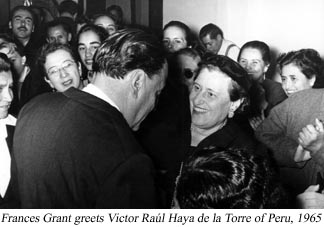
Frances Grant played an important role in bringing Latin America to the attention of the league. In the late 1940s, democratic regimes were overthrown in several Latin-American countries including Argentina, Colombia, Paraguay, Peru, and Venezuela. Grant spearheaded the ILHR's response to the crisis, testifying before the United Nations Commission on Human Rights about violations in Latin America in 1949. She helped secure safe conduct for former Acción Democrática leader Rómulo Betancourt--also a member of the Latin-American Committee-- from Venezuela and met with the Colombian ambassador in an attempt to obtain safe conduct for Aprista leader Victor Raúl Haya de la Torre, who had taken refuge in the Colombian embassy in Lima. (26) From this period dated a lifelong friendship between Grant and these two Latin-American leaders.
The depth of the crisis was such that in 1949, members of the Latin-American Committee formed a Liaison Committee to alert the democratic leaders of the hemisphere to the dangers menacing liberty and peace in the Americas. Under the sponsorship of the Liaison Committee, which included North and Latin Americans and representatives of the Junta Democrática of Uruguay, the first Inter-American Conference for Democracy and Freedom was held in Havana from May 12 to May 15, 1950. (27) Frances Grant continued to serve as an officer of the ILHR until the 1970s. After 1950, however, her primary organizational base became the Inter-American Association for Democracy and Freedom, which will be discussed below.
Among the organizers of the Havana Conference were Frances Grant; Rómulo Betancourt; Roger Baldwin; Serafino Romualdi, representative for the Latin American section of the AFL-CIO; Walter White, Secretary of the NAACP; and conference included Venezuelan writer and former president Rómulo Gallegos, Eleanor Roosevelt, Arthur Schlesinger, Jr., Hubert Humphrey, and Congressman Richard Nixon. In Latin America, conference planners included Senator Salvador Allende of Chile, Dominican writer Juan Bosch, and Costa Rican President José Figueres. Approximately 200 delegates from all parts of the hemisphere participated in the conference, including five members of congress from the U.S. Latin-American delegates, in addition to the organizers, included Senator Eduardo Frei of Chile, Carlos Andrés Pérez of Venezuela, and R. Germán Arciniegas, former Minister of Education of Colombia. The conference produced the Havana Declaration, which condemned the actions of the dictators and recommended conditions for diplomatic recognition based on respecting principles of human, civil, and political rights. It also advocated social and economic reforms which would strengthen the democratic forces in the hemisphere. (28) The major accomplishment of the conference was the founding of a permanent organization, the Inter-American Association for Democracy and Freedom (IADF).
The objectives of the IADF were 1) to create a democratic front in the Americas of individuals and organizations; 2) to fight totalitarianism in all its forms-communism, neo-fascism and caudillism-as enemies of hemispheric democracy; 3) to investigate, verify, and expose violations of civil and political liberties; 4) to protest such violations of human rights at the United Nations, Organizations of American States and other international bodies; 5) to assist, in every way feasible, democratic political prisoners and exiles, and 6) to support progressive political, social, and economic reforms in Latin America if they are effected by constitutional methods and without sacrifice of liberties. (29)
The IADF was initially designed as a transnational organization headquartered in Montevideo, Uruguay. At the first meeting of the executive committee, Dr. Emilio Frugoni of Uruguay was elected president. Aureliano Sánchez Arango, Minister of Education in Cuba, was elected Vice-President, and Frances Grant was elected Secretary-General. The Executive Council also included Roger Baldwin, Germán Arciniegas, Serafino Romualdi, Senator Juan Guichon of Uruguay, and Haya de la Torre, still confined to the Colombian embassy in Lima. In reality, however, the organization was dominated by its U.S. Committee, whose long-serving members included academics, political exiles, and U.S. congressmen, and run by Frances Grant from New York City. The IADF did, however, serve as a network for democratic leaders throughout the hemisphere. As secretary-general, Grant acted as editor and principal writer of the IADF's bilingual newsletter, Hemispherica, which had a circulation of two or three thousand, and was an important source of information about Latin-America.
In the 1950s, the IADF outspokenly opposed dictatorships in Argentina, Colombia, Cuba, the Dominican Republic, Haiti, Nicaragua, Paraguay, Peru, and Venezuela. The IADF documented hundreds of cases of torture of prisoners and other abuses by the Perón regime in Argentina. In association with the International League for Human Rights, the IADF testified about these crimes before the United Nations, (30) and held protest meetings against the U.S. government's rapprochement with the Perón regime. The IADF also protested arbitrary arrests, imprisonments, and violations of freedom of the press in Haiti after the Duvalier regime came to power through a controlled election in 1957. Grant assisted Haitian refugees in obtaining visas and worked closely with Haitian exile groups and individuals in the U.S., particularly Dr. Camille L'hérisson, former Minister of Health in Haiti. The IADF also denounced U.S. government aid to Haiti, which it felt was not being used to help those in need.
One of the IADF's most important campaigns was against the tyrant General Rafael Trujillo Molina, who ruled the Dominican Republic from 1930 to 1961. As in the case of Haiti and Argentina, the IADF petitioned the U.S. government and international organizations, publicized atrocities committed by the Trujillo regime in the press, aided refugees and exile groups, and denounced the support of Trujillo by the U.S. government, which valued his stance against communism. Trujillo was exceptional, however, in that his influence extended into the U.S. and neighboring Caribbean countries, even threatening Grant herself. (31) In 1956, Columbia University lecturer and IADF member Jésus de Galíndez disappeared under mysterious circumstances. Originally from the Basque country, Galíndez had lived some years in the Dominican Republic, and since moving to the U.S. in 1946, was a leader in the struggle to expose the evils of Trujillo's regime. Convinced that Galíndez had been kidnaped and murdered by Trujillo's agents in the U.S., the IADF, along with other organizations, undertook a massive publicity campaign, offering a reward for his return and holding memorial meetings. This campaign helped to counteract efforts by Trujillo's public relations machine to discredit Galíndez. With the cooperation of Charles O. Porter, U.S. Representative from Oregon, the case was brought to the attention of Congress. By 1960, when Trujillo was assassinated, U.S. support for the dictator had begun to wane.
During this period, the IADF also conducted a major campaign against Venezuelan dictator Marcos Pérez Jiménez, who had come to power in a military coup in 1948. The IADF had a special relationship with Venezuela because of Grant's friendship with Rómulo Betancourt and his support of the organization, which acted as a base for him during his exile and enabled him to maintain contacts with other governments. (32) The Venezuelan government helped support the IADF financially after Pérez Jiménez was overthrown and Betancourt was elected to the presidency in 1959. The principles of the IADF formulated at the Havana Conference in 1950 were embodied in the Betancourt Doctrine, which he introduced in his inaugural address on February 15, 1959. The Betancourt Doctrine called on other democratic governments in the Americas to join together to exclude regimes that did not respect human rights from membership and to impose diplomatic sanctions upon them. (33)
In celebration of the Acción Democrática victory, the IADF held its Second Inter-American Conference in Maracay, Venezuela in 1960. Betancourt reiterated his views in his opening address. Like the Havana conference ten years earlier, the Maracay meeting was attended by over 200 delegates from 21 American republics. Subjects discussed included problems with dictatorships, land reform, economic development, international organizations, human rights, and education. The conference approved a resolution condemning the remaining dictatorships in the Dominican Republic, Paraguay, Nicaragua, and Haiti, and pledged to work actively for their overthrow. Other resolutions included reducing military expenditures, strengthening the OAS, guaranteeing the rights and improving the conditions of free labor, supporting colonial struggles in the Panama Canal Zone and British Guiana, supporting democratically-executed land reforms, confiscating illicit earnings of former heads of state in exile, and an inter-American passport for political refugees. (34)
In the 1960s, the IADF became embroiled in the problem of Cuba. An outspoken critic of Cuban dictator Fulgencio Batista, Grant initially welcomed the Cuban Revolution of 1959. (35) After Fidel Castro's consolidation of power and move towards alliance with the Soviet Union, however, the IADF became a strong opponent of the Cuban regime in conformity with its usual anti-communist stance. Grant and the IADF opposed, however, the unsuccessful 1961 Bay of Pigs invasion of Cuba: "we condemn the United States' policy of armed intervention in the Cuban crisis, and particularly the role played by the Central Intelligence Agency, as a violation of our commitments to the international and Inter-American communities..." (36) Grant believed in using indirect means rather than force to unseat the Cuban regime. By the mid-1960s, the IADF was actively working to help political prisoners in Cuba. In cooperation with the Comité Internacional por Presos Politicos en Cuba, the IADF conducted a census of political prisoners in Cuba based on information from relatives in the United States.
By the late 1960s, the high point of the IADF's influence had passed. In 1969, the U.S. Committee discussed restructuring and Grant herself suggested stepping down. (37) In the end, however, she was unable to relinquish control of the IADF. Her failure to do so alienated some members of the committee, such as New School of Social Research professor Laurence Birns, who resigned, writing, "Unfortunately, you do not know when to let go, even if it means the destruction of the organization." (38) Particularly damaging to the image of the IADF was the stand which it took upon the overthrow of President Salvador Allende of Chile in 1973. Writing in Hemispherica, Grant expressed compassion for Allende's tragic end, but commented that he bore "his share of responsibility in the debacle of the country's constitutional order." (39) In a statement published in Hemispherica in 1974 and released to the press, the U.S. Committee deplored the takeover of Chile by a military regime, but once again blamed Allende for the tragedy. Such sentiments alienated left-wing intellectuals now prominent in the Latin-American field. Subsequent repression of human rights under Pinochet's dictatorship served to further discredit the IADF. In later years, however, Grant and the IADF sought to expose human rights violations in Chile and aid refugees.
In spite of internal problems, the IADF continued to campaign for human rights in Latin America through the 1970s. Although the IADF had been documenting human rights violations by the Stroessner regime in Paraguay since the 1950s, matters became particularly urgent in the early 1970s. In 1974, in conjunction with the International League for Human Rights, the IADF testified before the United Nations and the Organization of American States about the attempts to exterminate the Aché or Guayakaí Indians in Paraguay. It accused the Paraguayan government of tolerating the enslavement, torture, and killing of the Aché Indians in reservations in Eastern Paraguay, withholding food and medicine, selling children into slavery and girls into prostitution, and denying and destroying Aché cultural traditions. (40) Grant also contributed a chapter to Professor Richard Arens' influential book, Genocide in Paraguay, published by Temple University Press in 1977. On behalf of the International League for Human Rights, Rutgers University professor and IADF Chairman Robert J. Alexander went to Paraguay in 1976 to report on human rights abuses.
One of the last major campaigns undertaken by the IADF was against the Somoza dictatorship in Nicaragua. After the assassination of Grant's friend Pedro Joaquin Chamorro, the publisher of the Nicaraguan newspaper La Prensa, in 1978, the IADF formed an Ad Hoc Committee for the Freedom of Nicaragua, which petitioned the White House and international organizations, and sponsored a letter-writing campaign. Although she applauded the overthrow of Somoza in 1979, Grant was opposed to the communist FSLN (Sandinista National Liberation Front) which replaced him, and continued to expose human rights violations under the new regime.
In 1985, the IADF faced a crisis when the Wilkie Memorial Building on West 40th Street, where its office was located, was sold to the Republic National Bank. The building had belonged to Freedom House, the civil liberties organization, which had rented space at a low cost to non-profit groups which supported its agenda. When Freedom House decided to sell the building for financial reasons, the IADF and ten other displaced organizations filed suit and were awarded $700,000 for relocation. The loss of the building was, however, the end of the IADF.
In her last years, Grant continued to travel and write. She became particularly concerned with documenting her activities in Latin America and at the Roerich Museum, with which she renewed contact in the 1980s. After investigating several possibilities, Grant donated the records of the IADF to Rutgers University, where her old friend Robert Alexander was still teaching, in 1982. In that year, she was awarded the Rutgers Medal, as well as a special citation from the Trustees of Columbia University at the Maria Moors Cabot Prize Convocation for her contribution to Inter-American journalism. Grant added these honors to the numerous awards she had received from Latin American countries, most notably, a Special Gold Medal from the government of Costa Rica (1955), the Orden del Condor de los Andes from Bolivia (1956 and 1963), and the prestigious Orden del Libertador from Venezuela (1965). Grant remained active until the last months of her life. She died on July 21, 1993 at the age of ninety-six.
NOTES:
(1) Frances R. Grant, Pilgrimage of the Spirit (Beata Grant, 1997), p. 16.
(2) Frances R. Grant, "Some Biographical Notes Regarding my Latin American Interests," Box 17, Folder 13.
(3) Frances R. Grant Manuscript History of Roerich Museum p. 2, Box 14, Folder 74.
(4) Jacqueline Decter, Nicholas Roerich: The Life and Art of a Russian Master (London, 1989), p. 120-121.
(5) See George N. Roerich, Trails to Inmost Asia: Five Years of Exploration with the Roerich Central Asian Expedition (New Haven, 1931).
(6) Frances R. Grant, Trip to Latin America, 1929--Report Box 14, Folder 62.
(7) The Roerich Pact and the Banner of Peace, (New York, 1947), Box 15, Folder 8.
(9) Frances R. Grant to Henry Wallace (April 8, 1927), Box 15, Folder 8.
(10) Edward L. and Frederick H. Schapsmeier, Henry Wallace of Iowa: Agrarian Years, 1910-1940. (Ames, Iowa, 1968), p. 274.
(12) H.A. Wallace to F.R. Grant (April 15, 1929), Box 15, Folder 31.
(14) Samuel Walker, Henry A. Wallace and American Foreign Policy (Westport, Ct., 1976), p. 57-58.
(15) Telegram, Box 14, Folder 34.
(16) Grant, Manuscript History, p. 13.
(18) Conversation with Daniel Entin, Director of the Nicholas Roerich Museum (Jan. 6, 2000)
(19) PAWA Brochure, ca. 1945, Box 17, Folder 16.
(20) Mark Gilderhaus, Pan-American Visions (University of Arizon Press, 1986), p. x-xi.
(21) Frances Grant, "The True Pan-Americanism,"1943, Box 18, Folder 59.
(22) PAWA brochure, ca. 1945, Box 17, Folder 16.
(23) William Korey, NGOs and the Universal Declaration of Human Rights (New York, 1998), p. 100.
(24) Shirley M. Stewart, "The International League for the Rights of Man," Index (London: Spring 1975), p. 61.
(26) Minutes, 1949, Box 23, Folder 6.
(27) Michele Gisbert, "The Challenge to Tyranny in Latin America: the Work and Influence of Frances Grant, the Pan-American Women's Association, and the Inter-American Association for Democracy and Freedom" (Unpublished Undergraduate Thesis, Rutgers College, 1998), p. 26.
(28) Inter-American Association of Democracy and Freedom, Report of the Havana Conference (May 12-15, 1950).
(29) Inter-American Association for Democracy and Freedom, undated brochure, Box 63, Folder 30.
(30) International League for the Rights of Man, Press Release (February 13, 1952), Box 38, Folder 9.
(32) Sheldon B. Liss, Democracy & Dependency: Venezuela, the United states and the Americas(Salisbury, North Carolina, 1978), p. 178.
(34) Inter-American Association for Democracy and Freedom, Report of the Second Inter-American Congress. Venezuela (April 22-26, 1960).
(35) IADF Press Release (March 1959), Box 55, Folder 34.
(36) Hemispherica, 10(3), April-May 1961.
(37) Frances Grant to Patricia Bildner (January 13, 1970), Box 34, Folder 15.
(38) Laurence R. Birns to Frances Grant (February 16, 1970), Box 30, Folder 52.
(39) Hemispherica 22(7) (August-September 1973).
(40) Gerald Colby with Charlotte Dennett, Thy Will be Done: Nelson Rockefeller and Evangelism in the Age of Oil (New York, 1976), p. 778. I am indebted to Ron McGee for this reference.
The Frances R. Grant Papers span the period 1897 to 1986, with the bulk dating from 1920 to 1986. They comprise approximately 78 cubic feet of material (66 records center cartons, 11 phase boxes containing oversize scrapbooks, 3 newspaper boxes, 6 index card boxes, and 1 oversize folder). The Frances R. Grant Papers are divided into five sub-groups: Personal Papers, Roerich Museum, Pan-American Women's Association (PAWA), International League for Human Rights (ILHR) and Inter-American Association for Democracy and Freedom (IADF).
The Personal Papers sub-group (13 cubic feet) spans the period 1897 to 1986, with the bulk dating from 1917 to 1986. This sub-group includes material related to Frances Grant's life and activities not connected with her organizational affiliations. It documents her relationship with her family, particularly her sister and brother-in-law Hylda and Max Zimmerman; and her personal friendships with prominent individuals. The series also documents Grant's interests-religion, spirituality, astrology, music, art, and the Far East. Grant was an active participant in women's clubs, and frequently attended exhibitions and programs. The sub-group also documents Grant's travels, her journalism, and the many awards she received over her lifetime. Although primarily paper, the sub-group contains material in several other formats including photographs, phonograph discs, and ephemera such as ribbons and identification cards. Throughout the collection, brittle documents have been photocopied on to acid-free paper. The sub-group also includes five oil paintings and about three cubic feet of artifacts which Grant acquired in Latin America. An item-level list of these artifacts can be found in Appendix A. The oil paintings, which are oversize, are stored separately. Other oversize material in this sub-group are the phonograph discs, lithographs, and citations.
The Roerich Museum (4 cubic feet) sub-group spans the period 1920 to 1985. It documents Grant's service as executive director and vice-president of the museum from 1921 to 1937, as well as the later history of the museum. Events documented in this sub-group include the administration of the Roerich Museum and the Roerich Press; Nicholas Roerich's travels to India, Manchuria, and Mongolia; Frances Grant's travels to Latin America; and internal politics and financial difficulties at the museum. Subjects documented include spirituality, Pan-Americanism, the Roerich Pact, and the relationship between Roerich and Henry A. Wallace. Besides paper, formats include photographs, etchings and scrapbooks. Two oversize scrapbooks are stored separately.
The PAWA sub-group (7 cubic feet) spans the period 1928 to 1985. It documents the foundation and growth of the PAWA and its many activities, including sponsoring musical programs, art exhibits, readings, conferences, and fund-raisers. It shows the development of the PAWA from a strictly cultural to a politically active organization concerned with human rights and social conditions in Latin America. It also documents Latin American women artists and other prominent women. In addition to paper, formats include photographs, address cards and scrapbooks. Two oversize scrapbooks, photographs, a citation and a broadside are stored separately.
The ILHR sub-group (4 cubic feet) spans the period 1941 to 1985. It documents Grant's work as secretary and vice-president of the league, and chairman of its Latin-American Committee. As well as revealing the internal workings of the organization, this series shows the ILHR's attempts to document, publicize and protest human rights abuses throughout the world. These files particularly focus on Latin America. Includes address lists and an index to the BY-LAWS, MINUTES, and CORRESPONDENCE series on index cards. Two oversize broadsides are stored separately.
The IADF sub-group (approximately 44 cubic feet) spans the period 1929 to 1986, with the bulk dating from 1950 to 1985. By far the largest and most important sub-group in the collection, it primarily consists of the office files of the IADF from its foundation in 1950 to its demise in 1985. It also includes, however, some earlier materials which Grant added to the files. This sub-group documents the administration of the IADF, including conference and event planning, finances, and relations with other NGOs and international organizations. More importantly, the sub-group documents the IADF's response through protests and publicity campaigns to human rights violations in Latin-American countries, including Argentina, Bolivia, Brazil, Chile, Colombia, Cuba, the Dominican Republic, Haiti, Nicaragua, Paraguay, Peru and Venezuela. Of particular interest is correspondence with Latin-American political leaders and dissidents. It is also a rich source of information about political parties, labor movements, women's rights, and social and economic conditions in virtually every Latin American country. It also includes some information about human rights in other countries, particularly Spain, Portugal, and the English-speaking Caribbean.
Although primarily paper, other formats include photographs, photographic plates, scrapbooks, microfilm, a few audiotapes, a phonograph disc, and card files. Oversize items, including scrapbooks, broadsides, photographs, newspapers and magazines are stored separately. Also stored separately are card indexes to the PERSONALITY CORRESPONDENCE FILES, CONFERENCE MATERIALS, a partial index to the LATIN-AMERICAN COUNTRY FILES, and an index to the IADF's newsletter Hemispherica. An item-level list of the photographs in the IADF sub-group can be found in Appendix B.
Several sub-groups contain overlapping materials. In the Personal Papers sub-group, Frances Grant's diaries cover the last years of her work at the Roerich Museum, as well as her work with the PAWA, ILHR, and the IADF. The CORRESPONDENCE FILES also contain some letters from figures like Rómulo Betancourt and artist Julia Codesido, whom Grant considered as friends as well as colleagues. Similarly, documentation of honors Grant received is included in both the Personal Papers and IADF sub-groups. Essentially, Grant's personal and professional lives were interwoven. The ILHR and IADF sub-groups overlap because the two groups often worked together on the same cases.
Furthermore, within the large IADF sub-group, there is some overlap between series. For instance, the REFERENCE MATERIALS overlap with the LATIN-AMERICAN COUNTRY FILES because both series contain documentation of conditions within Latin-American countries; the REFERENCE FILES, however, contain very little correspondence. The PERSONALITY CORRESPONDENCE FILES, although primarily consisting of correspondence between Grant and the U.S. Committee of the IADF, overlaps somewhat with the LATIN-AMERICAN COUNTRY FILES; for instance, both series contain files on Jesús de Galíndez and on the Pérez Jiménez extradition case. Although the DOMESTIC AND FOREIGN CORRESPONDENCE, DOMESTIC CORRESPONDENCE AND MISCELLANY, and GENERAL FILES contain more routine material, they overlap to some degree with the LATIN-AMERICAN COUNTRY FILES.
Some of the overlap between sub-groups and series can be explained by the attempts by Frances Grant and her assistants to rearrange the collection before it was given to Rutgers. Grant occasionally moved items from their original files to files where she thought they would be more useful. (She documented these moves by leaving notes in the file in question.) She also may have tried to place duplicates in more than one place for cross-referencing. Her assistants also created the indexes which have been mentioned above, and may have moved some material in the course of indexing. Certainly some of the file headings were created while indexing. Apparently the indexers ran out of time while indexing the LATIN-AMERICAN COUNTRY FILES, so that Chile, parts of Cuba and Nicaragua, and of course, the second sub-series, are not included.
The Frances R. Grant Papers were received in two main accessions. The first accession consisted primarily of the ILHR, PAWA, and parts of the IADF sub-groups. This material was received in a much more organized state than the second accession, which consisted of the Personal Papers and Roerich Museum sub-groups, as well as later materials from the other sub-groups. The second accession was received when the IADF was forced to vacate its offices after the sale of the building in 1985. To an extent, later materials were integrated into the PAWA, ILHR, and IADF sub-groups. In some cases, material from the first accession which clearly belonged in the Personal Papers and Roerich Museum sub-groups was moved. The indexes, however, reflect the original arrangement of the material, and must be used with caution. Furthermore, some published material was removed from the collection for future cataloging.
Material about Frances Grant and the IADF can be found in several other collections in the United States. Special Collections and University Archives at Rutgers holds the papers of Professor Robert J. Alexander, Grant's friend and fellow officer of the IADF. Alexander attended both IADF conferences and was a regular contributor to Hemispherica.
Documentation of Frances Grant's work at the Nicholas Roerich Museum can be found in the museum's archives in New York City. The archives contain a long account of the litigation over the museum's original building, a copy of which is available at Special Collections and University Archives. The originals of the correspondence between Frances Grant and Henry Wallace can be found in the Samuel Rosenman Papers at the Franklin D. Roosevelt Library in Hyde Park, New York. The Roosevelt Library also hold the papers of IADF supporter Adolf A. Berle, Jr., which contains his correspondence with Frances Grant. Further correspondence between Grant and members of the U.S. government can be found in the U.S. Department of State, Record Group 59, National Archives II, College Park, Maryland. Finally, the records of the International League for Human Rights (ILHR) are held by the New York Public Library, and the records of Freedom House, with which the IADF collaborated in later years, are held by Princeton University.
No restrictions.
| I: Personal Papers | |||||||||||
| DIARIES, 1934-1985 (6 cubic feet) | |||||||||||
| Arrangement: Grouped by type of diary and arranged chronologically within each group | |||||||||||
| Diaries, appointment books, wall calendars and diary notes of Frances Grant. Invitations, correspondence and notes are attached to some pages. | |||||||||||
| The largest part of the series (5.4 cubic feet) consists of appointment books or daily records, spanning the period 1934 to 1985. Only 1936, 1940, 1946, 1952-1954, and 1984 are missing. Several years have more than one book covering the same dates, and in other cases Grant did not fill up the whole book. Although these books document Grant's daily schedule, they also include description and commentary on events or individuals. Grant marked with notes or clips the dates important events occurred. | |||||||||||
| The daily records from the 1930s and 1940s document Grant's work as vice president of the Roerich Museum and president of the Pan American Women's Association, while the volumes from the 1950s through the 1980s document her work as secretary general of the Inter American Association for Democracy and Freedom, as well as her continuing work with other organizations and personal life. | |||||||||||
| This series contains three other types of material: diary notes, wall calendars and travel diaries. The diary notes (1938-1977) consist of highlights from the diaries transcribed by Grant in preparation for a proposed autobiography. The calendars, which date from 1964, 1970, 1975, 1981, and 1983 are simply wall calendars recording Grant's appointments. Of particular interest are the travel diaries (1940-1980), which give detailed accounts of Grant's trips, primarily to Latin America, but also to Europe and to visit her family in New Mexico. | |||||||||||
| The oversize 1983 calendar is stored separately. | |||||||||||
| See also: newspaper box 85. | |||||||||||
| Box | Folder | ||||||||||
| 1 | 1-2 | 1934-1935 | |||||||||
| 3-4 | 1937-1938 | ||||||||||
| 5-12 | 1941-1948 | ||||||||||
| Box | Folder | ||||||||||
| 2 | 1-3 | 1949-1951 | |||||||||
| 4-13 | 1955-1961 | ||||||||||
| Box | Folder | ||||||||||
| 3 | 1-11 | 1962-1967 | |||||||||
| Box | Folder | ||||||||||
| 4 | 1-16 | 1968-1973 | |||||||||
| Box | Folder | ||||||||||
| 5 | 1-12 | 1974-1980 | |||||||||
| Box | Folder | ||||||||||
| 6 | 1-6 | 1981-1983 | |||||||||
| 7-9 | Diary Notes, 1938-1977 | ||||||||||
| 10 | Travel Diaries, 1940-1941 and 1947 | ||||||||||
| 11 | Travel Diaries, 1941 | ||||||||||
| 12-13 | Travel Diaries, 1948-1949 | ||||||||||
| 14-16 | Travel Diaries, 1951-1953 | ||||||||||
| 17-18 | Travel Diaries, 1956-1957 | ||||||||||
| 19 | Travel Diaries: Latin America, 1961-1962 | ||||||||||
| 20 | Travel Diaries: Latin America, 1967 | ||||||||||
| 21 | Travel Diaries: Latin America, 1971 | ||||||||||
| 22 | Travel Diaries: India and Santa Fe, 1971 | ||||||||||
| 23 | Travel Diaries: Santa Fe, 1976 | ||||||||||
| 24 | Travel Diaries: Costa Rica, 1980 | ||||||||||
| 25 | Calendars, 1964 | ||||||||||
| 26 | Calendars, 1970 | ||||||||||
| 27 | Calendars, 1975 | ||||||||||
| 28 | Calendars, 1981 and 1983 | ||||||||||
| CORRESPONDENCE AND MISCELLANY, 1917-1986 (1.6 cubic feet) | |||||||||||
| Arrangement: alphabetical by correspondent. | |||||||||||
| Primarily personal correspondence received by Frances Grant, as well as miscellaneous personal documents, such as address books, citations, biographical sketches, identification cards, personal financial records, lists, invitations, notes, ribbons, and a phonograph disc (33 rpm), presented to Grant by Rómulo Betancourt. Most of the correspondence is filed by names of individuals, but there are also some filed by place, or organization names including Rutgers University, the Nemi Foundation, Freedom House, the Metropolitan Opera, and the Religious of the Cenacle in Ronkonkoma, New York, a Catholic Order Retreat, which Grant visited. | |||||||||||
| Among the correspondents are members of Frances Grant's family, including her maternal aunt Mildred Spiro, her brothers David and Joseph, her sister and brother-in-law, Hylda and Max Zimmerman, and her nieces and nephews. Important correspondents include Grant's friend, the Peruvian painter Julia Codesido, the Italian socialist Angelica Balabanoff, Venezuelan President Rómulo Betancourt, Chilean poet Gabriela Mistral, Grant's neighbor in Abiquiu, Georgia O'Keeffe, and Dr. George Pack, who operated on Eva Perón. | |||||||||||
| Also of interest are several files of random notes consisting of Grant's musings on spirituality and the self. | |||||||||||
| Series includes several oversize items stored separately--a four phonograph disc set of speeches by Rómulo Betancourt, and numerous citations presented to Grant, most notably, the Orden de la Liberación de España (1955). | |||||||||||
| [See also: newspaper box 85] | |||||||||||
| Box | Folder | ||||||||||
| 7 | 1 | A (Miscellaneous), 1963-1984 | |||||||||
| 2 | Abiquiu, undated | ||||||||||
| 3 | Address Book, 1945 | ||||||||||
| 4 | B (Miscellaneous), 1931-1984 | ||||||||||
| 5 | Balabanoff, Angelica, 1952-1959 | ||||||||||
| 6 | Balakovic, Joyce, 1937-1957 | ||||||||||
| 7 | Betancourt, Rómulo, 1949-1978 | ||||||||||
| 8 | Biographical Materials, 1961-1982 | ||||||||||
| 9 | Bolivia, 1931-1940 | ||||||||||
| 10 | Brazil, 1951-1957 | ||||||||||
| 11 | Business and United Nations Identification Cards, 1921-1959 | ||||||||||
| 12 | C (Miscellaneous), 1931-1983 | ||||||||||
| 13 | Cenacle, 1937-1952 | ||||||||||
| 14-15 | Christmas Cards, 1929-1984 | ||||||||||
| 16 | Christmas Cards: Latin American Leaders, 1963-1964 | ||||||||||
| 17-18 | Clancy, Father John, 1948-1950 | ||||||||||
| 19 | Codesido, Julia, 1939-1964 | ||||||||||
| 20 | Contact Names, 1985 | ||||||||||
| 21 | D (Miscellaneous), 1924-1986 | ||||||||||
| 22 | Davis, Lillian, 1930-1963 | ||||||||||
| 23 | De Los Rios, Fernando, 1945-1947 | ||||||||||
| 24 | Desbouis, Marie, 1936-1958 | ||||||||||
| 25 | E (Miscellaneous), 1932-1982 | ||||||||||
| 26 | F (Miscellaneous), 1932-1980 | ||||||||||
| 27 | Family Members, 1939-1986 | ||||||||||
| 28 | Financial Records, 1967-1968 | ||||||||||
| 29-30 | Financial Records, 1980-1984 | ||||||||||
| 31 | Freedom House, 1985-1986 | ||||||||||
| 32 | Friends: India, 1948-1952 | ||||||||||
| 33 | Friends: Latin America, 1957-1985 | ||||||||||
| 34 | Friends: Special (Gabriela Mistral and Natalia Aróslegui de Suárez), undated | ||||||||||
| 35 | G (Miscellaneous), 1930-1948 | ||||||||||
| 36 | Giraldoni, Lily (née Schroeder), 1930-1970 | ||||||||||
| 37 | Glover, Nada, 1945-1947 | ||||||||||
| 38 | Grant, David A. (great-nephew), 1979-1985 | ||||||||||
| 39 | Grant, David Elias (brother), 1956 | ||||||||||
| 40 | Grant, David H. (nephew), 1956 | ||||||||||
| 41 | Grant, James A., 1984-1985 | ||||||||||
| 42-43 | Grant, Joseph B. (brother), 1947-1973 | ||||||||||
| 44 | Grant, Joseph B. (brother), death of, 1976-1977 | ||||||||||
| 45 | Grant, Robert Lewis and family, 1963-1984 | ||||||||||
| 46 | H (Miscellaneous), 1921-1983 | ||||||||||
| 47 | I (Miscellaneous), 1936-1958 | ||||||||||
| 48 | Inventories of Possessions, 1981 | ||||||||||
| 49 | Invitations, 1959-1975 | ||||||||||
| 49 | Invitations, 1959-1975 | ||||||||||
| 50 | Izaguirre, Virginia, 1964-1983 | ||||||||||
| 51 | J (Miscellaneous), 1978-1984 | ||||||||||
| 52 | K (Miscellaneous), 1947-1959 and undated | ||||||||||
| 53 | L (Miscellaneous), 1930-1984 | ||||||||||
| 54 | Laufman, Sidney and Beatrice, 1931-1933 | ||||||||||
| 55 | M (Miscellaneous), 1952-1984 | ||||||||||
| 56 | Metropolitan Opera, 1946-1971 | ||||||||||
| 57-58 | Miscellaneous Cards, 1947-1985 | ||||||||||
| 59 | Miscellaneous Cards: Latin America, 1967-1979 | ||||||||||
| 60 | Miscellaneous Correspondence, 1931-1983 | ||||||||||
| 61 | Miscellaneous Documents, 1941-1962 and 1984 | ||||||||||
| 62 | Morlas, Ximena and Carmen, 1930-1960 | ||||||||||
| 63 | Myers, Mrs. James, 1940 | ||||||||||
| Box | Folder | ||||||||||
| 8 | 1 | N (Miscellaneous), 1945-1985 | |||||||||
| 2 | Nemi Foundation, 1980-1985 | ||||||||||
| 3 | New Mexico Miscellaneous, 1950-1970 | ||||||||||
| 4 | O (Miscellaneous), 1930-1983 | ||||||||||
| 5 | O'Keeffe, Georgia, 1956 and undated | ||||||||||
| 6 | P (Miscellaneous), 1936-1980 | ||||||||||
| 7-8 | Pack, George T., 1936-1954 | ||||||||||
| 9 | Pedowitz, Eva, 1964-1977 | ||||||||||
| 10 | Peru: Early Personalities, 1929, 1942 | ||||||||||
| 11 | Q (Miscellaneous), 1982-1984 | ||||||||||
| 12 | R (Miscellaneous), 1930-1985 | ||||||||||
| 13-15 | Random Notes, 1958-1980 | ||||||||||
| 16 | Ratner, Blanche, 1940-1950 | ||||||||||
| 17 | Ribbons, 1960 | ||||||||||
| 18 | Rosemond, Henri - Wedding, 1952 | ||||||||||
| 19 | S (Miscellaneous), 1931-1982 | ||||||||||
| 20 | Spiro Family, 1931-1984 | ||||||||||
| 21 | Sporborg, Constance - National Federation of Women's Clubs, 1931-1934 | ||||||||||
| 22 | Stroud, Drew McCord, 1931-1983 | ||||||||||
| 23 | T (Miscellaneous), 1942-1986 | ||||||||||
| 24 | Taylor, Ariel - numerologist, 1935 | ||||||||||
| 25 | V (Miscellaneous), 1940-1986 | ||||||||||
| 26 | Venezuela, 1978-1983 | ||||||||||
| 27 | W (Miscellaneous), 1951-1984 | ||||||||||
| 28 | X, Y, Z (Miscellaneous), 1941-1985 | ||||||||||
| 29 | Zimmerman Family, 1941-1983 | ||||||||||
| 30 | Zimmerman, Hylda, 1940-1961 | ||||||||||
| 31 | Zimmerman, Max M., 1940-1957 | ||||||||||
| SUBJECT FILES, 1930-1985 (.6 cubic feet) | |||||||||||
| Arrangement: Subject files are arranged alphabetically. | |||||||||||
| Primarily documents personal activities and projects of Frances R. Grant which are outside the realm of her organizational ties. Subjects covered include art exhibitions, women's conferences, women's clubs, and conferences and awards ceremonies at Columbia and Rutgers universities. Document types include incoming and outgoing correspondence, manuscripts intended for publication, press releases, newspaper clippings, and unclassified Department of State documents. | |||||||||||
| Of particular interest is information regarding Miss Grant's book published by the Dial Press, Oriental Philosophy; her proposed book, Women of Latin America; and her attempted venture into magazine publication, Alcance. Alcance was intended to be a literary and cultural magazine reviewing North American life and thought, written in Spanish and directed to a Latin American audience. The extensive effort put into getting this magazine off the ground - solicitation of manuscripts, securing distribution agents, biographies of contributors, a pre-issue and critical opinions thereof--are all part of this series. Includes unpublished manuscripts and correspondence from leading literary and cultural figures such as John dos Passos, Upton Sinclair, Archibald MacLeish, and Frank Lloyd Wright, as well as correspondence from Thornton Wilder, Reinhold Niebuhr, H.L. Mencken, Thomas Mann, Lillian Hellman, and Aaron Copeland. | |||||||||||
| Also worthy of highlight is documentation of the 1982 election in El Salvador, which Grant attended as part of an international delegation of observers. | |||||||||||
| Box | Folder | ||||||||||
| 8 | 32 | Alcance Project: Biographies of Contributors, undated | |||||||||
| 33 | Alcance Project: Distribution, 1945 | ||||||||||
| 34 | Alcance Project: Greene, Philip, 1944-1945 | ||||||||||
| 35 | Alcance Project: Manuscripts and Correspondence - James T. Adams, Serge Koussevitzky, and Archibal MacLeish, 1945 | ||||||||||
| 36-37 | Alcance Project: Manuscripts and Correspondence - Authors A-Z, 1945 | ||||||||||
| 38 | Alcance Project: Opinion of, 1945 | ||||||||||
| 39 | Alcance Project: Pre-Issue, 1945 | ||||||||||
| 40 | Alcance Project: Presentation, 1945 | ||||||||||
| 41 | Alcance Project: Press Clipping Service, 1945 | ||||||||||
| 42 | Alcance Project: Press Releases, 1945 | ||||||||||
| 43 | Alcance Project: Rate Announcement, 1945 | ||||||||||
| 44 | Alcance Project: Regrets - Correspondence, 1945 | ||||||||||
| 45 | Alcance Project: Trademark, 1945 | ||||||||||
| 46 | Alcance Project: Wallace Thorsen Organization, 1945 | ||||||||||
| 47 | Argentine Journalism, 1941-1959 | ||||||||||
| 48 | Art Conference, 1939 | ||||||||||
| 49 | Brazil: Correspondence, 1945 and undated | ||||||||||
| 50 | Club Work, 1930-1934 | ||||||||||
| 51-53 | Columbia University Bicentennial Conference, 1954 | ||||||||||
| 54 | Columbia University: Maria Moors Cabot Award - Nomination of Miguel Albornoz, 1984 | ||||||||||
| 55 | Dalai Lama Visit, 1979 | ||||||||||
| 56 | Deeds, Tony, undated | ||||||||||
| 57 | Inter-American Commission on Women, 1942-1943 | ||||||||||
| 58 | International Rescue Committee, 1981-1983 | ||||||||||
| 59 | Izquierdo, Maria - Artist, ca. 1939 | ||||||||||
| 60 | Lister, George, 1985 | ||||||||||
| 61 | Mehta, Hansa, 1949 | ||||||||||
| 62 | Nabuco Case: Rebecca vs. A. Sucessora, 1941-1949 | ||||||||||
| 63 | Sussman, Leonard, 1985 | ||||||||||
| 64 | United States Embassy: El Salvador - Chronology of Events, 1979-1981 | ||||||||||
| 65 | United States Embassy: El Salvador - Decree # 914, 1981-1982 | ||||||||||
| 66 | United States Embassy: El Salvador - Election of 1982, 1981-1982 | ||||||||||
| 67 | United States Embassy: El Salvador - General Information, 1981 | ||||||||||
| 68 | Women in Latin America, 1942 | ||||||||||
| TRAVEL FILES, 1935-1984 (.7 cubic feet) | |||||||||||
| Arrangement: Grouped into two types of material: documentation of specific trips, arranged chronologically; and general travel materials, arranged alphabetically by subject. | |||||||||||
| Documentation of Frances Grant's trips, primarily to Latin America, but also to New Mexico, Europe, and India. Document types include correspondence, reports, manuscript articles, press releases, programs, exhibition catalogs, invitations, receipts, menus, tickets, business cards, identification and police documents, and notes. | |||||||||||
| During her 1941, 1951, and 1957 trips to Latin America, Grant kept copies of letters sent back to her family which serve as diaries. During her 1941 trip, Grant met with artist, educators, and women's groups, and established branches of the PAWA. She also sent back articles to the United States, some of which were published through the North American Newspaper Alliance. These articles document the tension and shifting alliances in Latin America during the World War II period. | |||||||||||
| Of interest in the files on Grant's 1951 trip is her meeting with Bolivian President Hugo Ballivián about political exiles, her meeting with Ecuadoran President Galo Plaza Lasso, and her reports on Lima, where APRA leader Victor Raúl Haya de la Torre had taken refuge in the Colombian embassy. In her 1957 trip, Grant describes the situation in Colombia directly after the overthrow of the dictator Gustavo Rojas Pinilla. On this trip, she met with a number of leaders including Eduardo Santos, former president of Colombia and publisher of El Tiempo, Colombian President Alberto Lleras Camargo, Chilean presidents Eduardo Frei and Gabriel González Videla, Bolivian president Hernán Siles Zuazo, former Venezuelan president Rómulo Gallegos, and former Cuban minister of education Aureliano Sánchez Arango, as well as labor leaders and Dominican exiles. | |||||||||||
| The files on Grant's later trips contain mostly letters that were sent to her from the United States, although the 1966 file does contain a description of the Dominican Republic six years after the fall of Trujillo. | |||||||||||
| The second part of the series includes correspondence from miscellaneous trips, and newspapers clippings, identification cards, police documents and notes. | |||||||||||
| Box | Folder | ||||||||||
| 9 | 1 | Latin America, 1941: Correspondence - Family | |||||||||
| 2-3 | Latin America, 1941: Correspondence - General | ||||||||||
| 4 | Latin America, 1941: Correspondence - Photocopies | ||||||||||
| 5 | Latin America, 1941: Expenses | ||||||||||
| 6 | Latin America, 1941: National Broadcasting Co. (NBC) | ||||||||||
| 7-8 | Latin America, 1941: North American Newspaper Alliance (NANA) - Articles sent by Frances R. Grant | ||||||||||
| 9 | Latin America, 1941: Programs and Exhibits | ||||||||||
| 10 | Latin America, 1941: Travel Arrangements | ||||||||||
| 11 | Latin America, 1946: Correspondence | ||||||||||
| 12 | Europe, 1947: Travel Arrangements | ||||||||||
| 13 | Latin America, 1951: Correspondence | ||||||||||
| 14 | Latin America, 1951: Travel Arrangements | ||||||||||
| 15 | Europe, 1952: Correspondence and Expenses | ||||||||||
| 16 | Latin America, 1957: Citations and Reports | ||||||||||
| 17 | Latin America, 1957: Correspondence | ||||||||||
| 18 | Latin America, 1957: Correspondence - Family (From) | ||||||||||
| 19-20 | Latin America, 1957: Correspondence - Family (To) | ||||||||||
| 21-22 | Latin America, 1957: Correspondence - Photocopies | ||||||||||
| 23 | Latin America, 1957: Danger in Travel Correspondence | ||||||||||
| 24 | Latin America, 1957: Press Releases | ||||||||||
| 25 | Latin America, 1957: Travel Arrangements | ||||||||||
| 26-27 | Latin America, 1961-1962: Correspondence | ||||||||||
| 28 | Europe, 1966: Expenses | ||||||||||
| 29-30 | Latin America, 1966-1967: Correspondence | ||||||||||
| 31 | Latin America, 1967: Travel Arrangements | ||||||||||
| 32 | Europe, 1968: Correspondence | ||||||||||
| 33 | Europe, 1969: Travel Arrangements | ||||||||||
| 34 | Latin America, 1969: Expenses | ||||||||||
| 35 | India, 1971: Schedule | ||||||||||
| 36 | Latin America, 1972: Correspondence | ||||||||||
| 37-38 | Latin America, 1972-1973: Travel Arrangements and Expenses | ||||||||||
| 39 | New Mexico, 1973: Correspondence | ||||||||||
| 40 | Latin America, 1973: Correspondence and Expenses | ||||||||||
| 41 | Latin America, 1976: Trip Cancelled | ||||||||||
| 42 | Calling Cards, 1960-1972 and undated | ||||||||||
| 43 | Identification Cards, 1946, 1952, 1960, and 1972 | ||||||||||
| 44 | Miscellaneous Trips: Correspondence, 1953-1983 | ||||||||||
| 45 | Newspaper Clippings, 1932-1976 | ||||||||||
| 46 | Notes of Frances R. Grant, 1941-1972 | ||||||||||
| 47 | Police Certificates, 1941-1949 | ||||||||||
| WRITINGS AND SPEECHES, 1926-1985. (.5 cubic feet). | |||||||||||
| Arrangement: Files are grouped alphabetically by subject. | |||||||||||
| Speeches and published and unpublished writings by Frances Grant. Subjects covered include the Roerich Museum, the Moguls, Latin-American politics and history, women in Latin America, Latin-American and Eastern art, and spirituality. Other document types include correspondence, notes, programs, press releases, manuscript poems, and advertisements, book reviews and royalty statements for Grant's Oriental Philosophy (Dial Press, 1935). | |||||||||||
| Includes sequence of correspondence regarding Frances Grant's lectures, many of which were given to women's clubs and organizations. This correspondence is arranged alphabetically by the name of the organization or the individual contact. | |||||||||||
| Box | Folder | ||||||||||
| 9 | 48 | Akbar/Babar, 1933 | |||||||||
| 49 | Articles about Frances R. Grant, 1929-1983 | ||||||||||
| 50 | Articles by Frances R. Grant, 1943-1975 and undated | ||||||||||
| 51 | Autobiography - Latin American Work, undated | ||||||||||
| 52 | Book Reviews, undated | ||||||||||
| 53 | Dial Press: Oriental Philosophy, 1935-1937 | ||||||||||
| 54 | Freedom House Articles, 1974-1976 | ||||||||||
| 55 | Illustrations for Lectures, 1930 | ||||||||||
| 56-59 | Lecture Correspondence: A-Z, 1929-1985 | ||||||||||
| 60 | Lectures - "Saint Teresa" and "Art in a Changing World," undated | ||||||||||
| 61 | Letters to the Editor, 1973 | ||||||||||
| 62 | Notes and Manuscripts, 1917-1926 and undated | ||||||||||
| 63 | Programs Including Frances R. Grant, 1931-1965 and undated | ||||||||||
| 64 | Published Works of Frances R. Grant, 1931-1960 | ||||||||||
| 65 | Roerich Manuscript and Correspondence, 1985 | ||||||||||
| 66 | Schedule of Lectures, 1931-1933 | ||||||||||
| 67 | Speeches, 1932-1961 and undated | ||||||||||
| 68 | Speeches and Notes in Spanish, undated | ||||||||||
| 69 | Women of Latin America: Muñoz, Inez de, undated | ||||||||||
| 70 | Colombia: Nariño and La Pola, undated | ||||||||||
| 71 | Paraguay: Press Conference and Book Contribution, 1976 | ||||||||||
| 72 | Venezuela: Book Project, 1978 | ||||||||||
| PHOTOGRAPHS AND ART WORK, 1897-1986 (.5 cubic feet) | |||||||||||
| Arrangement: alphabetically by subject. | |||||||||||
| Photographs relating to Frances Grant's personal relationships, interests, and activities. Subjects covered include Latin American art, Latin American scenes, portraits of Grant, her family and friends, and awards received by Grant. | |||||||||||
| Of particular interest are photographs assembled for the proposed Alcance magazine, including a photo essay on the indigenous people of Latin America (1945). Also of interest are a large group of undated photographs (possibly from the 1940s) of life at the Roffo nurses training center in Buenos Aires. | |||||||||||
| Many of the Latin American views are from Grant's various trips. Among these is a scrapbook of a social center for children in the slums of La Paz, sponsored by the Volunteers for Children's Cultural and Social Centers, whom Grant apparently met in Bolivia in 1972. Of particular interest in this group is a 1946 photograph of a typical dance by Bolivian indigenous women. Among the miscellaneous views, some of which are from the United States, is a photograph of Hampton Institute students repairing a log cabin, from Grant's writing on spirituals in the 1920s | |||||||||||
| The photographs of Grant's friends include portraits of Angelica Balabanoff, Dr. Angel Roffo, and Grassi Dias, director of the Teatro Colón in Buenos Aires. | |||||||||||
| Oversize items stored separately include a book of lithographs of Santiago, Chile, by Pablo Vidor; eleven photographs of citations awarded to Grant; and four prints. | |||||||||||
| See also: newspaper box 85. | |||||||||||
| Box | Folder | ||||||||||
| 10 | 1 | African Women, undated | |||||||||
| 2-3 | Alcance Project, 1945 | ||||||||||
| 4-6 | Argentina: Roffo Center Nurses' Training, undated | ||||||||||
| 7-8 | Art: Argentina - Stepan Erzia, 1928-1941 | ||||||||||
| 9 | Art: Brazil, undated | ||||||||||
| 10 | Art: Chile (Sculpture), ca. 1930 | ||||||||||
| 11 | Art: Chile, Colombia, Peru, undated | ||||||||||
| 12 | Art: Maria Izquierdo, 1938-1939 | ||||||||||
| 13 | Art: Unidentified, ca. 1920s | ||||||||||
| 14 | Bolivia, 1972 | ||||||||||
| 15 | Chile, University of: Art School, ca. 1941 | ||||||||||
| 16 | Family, ca. 1900-1940 | ||||||||||
| 17 | Family, ca. 1970-1985 | ||||||||||
| 18 | Friends, ca. 1932-1958 | ||||||||||
| 19 | Friends, ca. 1970-1986 | ||||||||||
| 20 | Giraldoni Wedding, 1949 | ||||||||||
| 21 | Grant, Frances R.- Portraits, 1897-1986 | ||||||||||
| 22 | Latin American Trip: Leaving Peru, 1951 | ||||||||||
| 23 | Latin American Trip: Artwork and Views, 1941-1946 | ||||||||||
| 24 | Maria Moors Cabot Convocation, 1982 | ||||||||||
| 25 | Marx, R. Burke - Paintings, 1941 | ||||||||||
| 26 | Miscellaneous Views, ca. 1920s | ||||||||||
| 27 | Rosemond, Henri - Wedding, 1952 | ||||||||||
| 28 | Rutgers Reception, 1982 | ||||||||||
| 29 | Views: Argentina and Brazil, 1929-1941 | ||||||||||
| 30 | Views: Colombia, 1940-1941 | ||||||||||
| 31 | Views: New Mexico, 1922, 1944 | ||||||||||
| ART AND ARTIFACTS, 1939-1984. (ca. 6 cubic feet) | |||||||||||
| Arrangement: grouped by size. | |||||||||||
| Primarily art and artifacts acquired by Frances Grant during her Latin American trips. Includes paintings, figurines, wooden and metal objects, jewelry, textiles, ceramics, political memorabilia, plaques, and miscellaneous objects. | |||||||||||
| Of particular importance are signed paintings by Peruvian artists Julia Codesido, who was a friend of Grant's, and José Sabogal. Also of interest is a Peruvian retablo, a wooden box, which opens to show an intricately carved Easter scene. The paintings, which are oversize, are stored separately. | |||||||||||
| Several items are inscribed to Frances Grant. Also includes wooden plaque citations received by her. | |||||||||||
| Box | |||||||||||
| 11-13 | Artifacts, 1939-1984 [See Appendix A for list of artifacts] | ||||||||||
| II: Roerich Museum | |||||||||||
| CORRESPONDENCE, 1921-1983 (.3 cubic feet) | |||||||||||
| Arrangement: coorespondence arranged alphabetically. | |||||||||||
| Letters received and copies of letters sent by Frances Grant in her capacity as vice president of the Roerich Museum from 1921 to 1937. Also includes some later correspondence referring to Nicholas Roerich and the Roerich Museum. | |||||||||||
| Subjects discussed include exchanges of art work, public cultural programs and publications of the museum, relations with Roerich societies abroad, particularly in France and Latvia, the museum's financial difficulties in the early 1930s, and Nicholas Roerich's tax difficulties. Important correspondents include Pearl Buck, for whom the museum organized a luncheon, Nicholas Roerich's son George, Grant's fellow museum trustees Louis H. Bean, Maurice and Sina Lichtmann, and museum director Louis H. Horch. | |||||||||||
| Of particular importance is correspondence with George Roerich while he was with his family in Urusvati, Kulu, India and on the botanical expedition in Manchuria and Mongolia in 1934-1935. Roerich describes his experiences, including his contacts with occupied Manchuria (Manchuoko) and the scientific work of the expedition. Grant describes events in the United States, including Henry A. Wallace's disillusionment with Roerich and the expedition, and the dispute over the ownership of the museum building and its eventual loss to Louis Horch in 1937. These events are also discussed in the Horch and Lichtmann correspondence. | |||||||||||
| Also of interest is correspondence between Grant and museum supporters James and Margaret Cousins (1932-1934). Margaret Cousins was jailed in India for protesting British rule. James Cousins was president of the Theosophical College in Madanapalle, Madras. | |||||||||||
| Box | Folder | ||||||||||
| 14 | 1 | Abroad, Letters Received from, 1930-1937 | |||||||||
| 2 | B (Miscellaneous), 1932-1937 | ||||||||||
| 3 | Bean, Louis and Dorothy, 1933-1936 | ||||||||||
| 4 | C (Miscellaneous), 1929-1941 | ||||||||||
| 5 | Campbell, Katherine - Roerich Museum Press, 1946-1948 | ||||||||||
| 6-7 | Cousins, James and Margaret, 1932-1983 | ||||||||||
| 8 | D (Miscellaneous), 1931-1936 | ||||||||||
| 9 | F (Miscellaneous), 1930-1941 | ||||||||||
| 10 | French Association, 1931-1934 | ||||||||||
| 11 | G (Miscellaneous), 1931-1937 | ||||||||||
| 12 | H (Miscellaneous), 1921-1986 | ||||||||||
| 13 | Horch, Louis L., 1926-1945 | ||||||||||
| 14 | K (Miscellaneous), 1931-1938 | ||||||||||
| 15 | L (Miscellaneous), 1928-1938 | ||||||||||
| 16-17 | Lichtmann/Lehtman Family, 1937-1949 | ||||||||||
| 18 | Lukins, Dr. H. - Riga, 1938-1939 | ||||||||||
| 19 | M (Miscellaneous), 1931-1937 | ||||||||||
| 20-21 | Miscellaneous, 1923-1937 and undated | ||||||||||
| 22 | Miscellaneous, 1976-1983 | ||||||||||
| 23 | Narodny, Ivan, 1935-1948 | ||||||||||
| 24 | P - R (Miscellaneous), 1931-1939 | ||||||||||
| 25-26 | Roerich, George, 1931-1936 and undated | ||||||||||
| 27 | S (Miscellaneous), 1931-1951 | ||||||||||
| 28 | T - V (Miscellaneous), 1930-1940 | ||||||||||
| 29 | W - Z (Miscellaneous), 1929-1936 | ||||||||||
| SUBJECT FILES, 1920-1985. (1.6 cubic feet). | |||||||||||
| Arrangement: alphabetically by subject. | |||||||||||
| Documents Grant's work at the Roerich Museum (1921-1937) and matters arising from this work. Document types include correspondence, reports, newspaper and magazine clippings, notes, fragmentary diary pages, programs, invitations, itineraries, press releases, financial documents, unpublished manuscripts, speeches, pamphlets, broadsides and resolutions. | |||||||||||
| Subjects include Grant's trip to India to meet Nicholas Roerich in 1928; her trips to Latin America in 1929 and 1930 under the auspices of the museum; her work as editor at the Roerich Museum Press; Henry A. Wallace's connection with Roerich and Grant; Roerich's botanical expedition (1934-1935); and the dispute over ownership of the Roerich Museum building, including Grant's later account. | |||||||||||
| Of particular interest are Grant's reports on her trips to Latin America, speeches about her experiences, programs of art exhibitions, and correspondence with important figures she met there such as Chilean poet Gabriela Mistral and Argentinian theosophist, socialist and feminist Victoria Gucovsky. Also of interest is documentation of the 1930 exhibition of Brazilian paintings, and other Latin American programming at the Roerich Museum. | |||||||||||
| Also of interest is material related to Grant's advocacy of the Roerich Pact (1931-1935); including documentation of fund-raising, letter-writing and publicity campaigns, as well as the three international conferences promoting the pact, and its ratification. | |||||||||||
| Of particular interest is documentation of the botanical expedition of 1934-1935, including a list of seeds Roerich sent back to the Department of Agriculture; and photocopies and photostats of correspondence from the Franklin Delano Roosevelt Library in Hyde Park, New York, documenting Wallace's initial interest in Roerich and support of the botanical expedition, and his later disillusionment and attempts to distance himself from the Roerichs. Some of the photocopies are duplicates of originals in this series. This material was assembled and indexed in 1976-1978, when professor Theodore A. Wilson of the University of Kansas consulted Grant about a possible biography of Wallace. | |||||||||||
| Box | Folder | ||||||||||
| 14 | 30-31 | Botanical Expedition, 1934-1935 | |||||||||
| 32-33 | Botanical Expedition: Correspondence, 1933-1935 | ||||||||||
| 34 | Botanical Expedition: Correspondence - Telegrams, 1935 | ||||||||||
| 35 | Botanical Expedition: Correspondence, undated | ||||||||||
| 36 | Building Ownership Dispute: Copies, 1935-1936 | ||||||||||
| 37-38 | Building Ownership Dispute: Correspondence and Notes, 1933-1935 | ||||||||||
| 39 | Building Ownership Dispute: Miscellany, 1936-1979 | ||||||||||
| 40 | Ernst, Morris, 1956, 1984 | ||||||||||
| 41 | Horch Family, 1920, 1975 | ||||||||||
| 42 | India Trip: Notes and Related Material, 1921-1929 | ||||||||||
| 43 | Latin America: Argentina, 1929-1936 | ||||||||||
| 44 | Latin America: Argentina - Correspondence about Exhibitions, 1929-1948 | ||||||||||
| 45-47 | Latin America: Argentina - Gucovsky, Victoria, 1930-1932 | ||||||||||
| 48 | Latin America: Argentina - Miscellany, 1929-1938 | ||||||||||
| 49 | Latin America: Brazil, 1929-1933 | ||||||||||
| 50 | Latin America: Brazil - Correspondence - A-Z, 1930-1941 | ||||||||||
| 51 | Latin America: Brazil - Correspondence - Edwin V. Morgan, 1930-1933 | ||||||||||
| 52 | Latin America: Brazilian Art Show - Program, 1930 | ||||||||||
| 53 | Latin America: Colombia, 1930-1933 | ||||||||||
| 54 | Latin America: General Correspondence, 1931-1939 | ||||||||||
| 55 | Latin America: Miscellany, 1931-1941 | ||||||||||
| 56 | Latin America: Peru, 1928-1950 | ||||||||||
| 57 | Latin America: Programs, 1932-1934 | ||||||||||
| 58 | Latin American Trip, 1929: Cables and Itinerary | ||||||||||
| 59 | Latin American Trip, 1929: Letters to Roerich Museum | ||||||||||
| 60 | Latin American Trip, 1929: Peru - Correspondence | ||||||||||
| 61 | Latin American Trip, 1929: Publicity | ||||||||||
| 62 | Latin American Trip, 1929: Report | ||||||||||
| 63 | Latin American Trip, 1930: Cables | ||||||||||
| 64 | Latin American Trip, 1930: Diary Pages | ||||||||||
| 65 | Latin American Trip, 1930: Related Correspondence | ||||||||||
| 69 | Latin American Trips, 1929-1930: Notes on Art Personalities | ||||||||||
| 70 | Latin American Work: New York, 1930-1940 | ||||||||||
| 71-72 | Lectures, 1930-1936 | ||||||||||
| 73 | Literary Luncheons, 1923-1937 | ||||||||||
| 74 | Miscellaneous Documents, 1931 and 1985 | ||||||||||
| 75 | Oglethorpe University Exhibition, 1935 | ||||||||||
| 76 | Pan-American Student League, 1931 | ||||||||||
| 77 | Pan-American Union, 1935 | ||||||||||
| 78 | Reports: Botanical Exhibition and Roerich Pact, undated | ||||||||||
| 79 | Roerich, Devika, 1963 | ||||||||||
| 80 | Roerich, George, 1936-1939 | ||||||||||
| 81 | Roerich, Nicholas, undated | ||||||||||
| 82 | Roerich, Nicholas and Asia - Materials for Book, 1925-1961 | ||||||||||
| 83 | Roerich, Svetoslav - Correspondence and Writings, 1965-1972 | ||||||||||
| 84 | Roerich, Svetoslav - Correspondence and Writings, 1981-1982 | ||||||||||
| 85 | Roerich Museum Press: Nicholas Golavin - Manuscript and Publication, 1934 | ||||||||||
| 86 | Roerich Museum Press: Archbishop Nestor - Manuscript and Publication, 1934 | ||||||||||
| 87 | Roerich Museum Press: Projected Manuscripts - "Flambeaux" by Frances R. Grant, undated | ||||||||||
| 88-90 | Roerich Pact, 1931-1935 | ||||||||||
| Box | Folder | ||||||||||
| 15 | 1 | Roerich Pact, 1935-1936 | |||||||||
| 2 | Roerich Pact, 1966-1968 | ||||||||||
| 3 | Roerich Pact: Correspondence, 1931-1944 | ||||||||||
| 4 | Roerich Pact: Hague Convention, 1954 | ||||||||||
| 5 | Roerich Pact: Miscellany, 1956, 1985 | ||||||||||
| 6 | Roerich Pact: Pan American Union, 1935 | ||||||||||
| 7 | Roerich Pact: Press and Publicity, 1930-1935 | ||||||||||
| 8 | Roerich Pact: Printed Materials, 1933-1947 | ||||||||||
| 9-10 | Roerich Pact: Signing and Ratification, 1933-1935 and 1966 | ||||||||||
| 11 | Roerich Pact: Speeches, 1931-1934 | ||||||||||
| 12 | Roerich Pact: Support from Other Organizations, 1934-1936 | ||||||||||
| 13 | Roerich Pact: Text, 1934-1936 | ||||||||||
| 14 | Roerich Pact: Third Convention - General Correspondence and Invitations, 1933 | ||||||||||
| 15 | Roerich Pact: Third Convention - Resolutions and Correspondence, 1933 | ||||||||||
| 16 | Roerich Pact: Henry A. Wallace Correspondence, 1933-1935 | ||||||||||
| 17 | Roerich Pact: Washington Trip - Correspondence, 1933 | ||||||||||
| 18 | Roerich Pact and the Banner of Peace (Photocopies), 1933-1936 | ||||||||||
| 19 | Roosevelt, Franklin Delano, 1934-1935, 1978 | ||||||||||
| 20 | Roosevelt, Franklin Delano - Library - Files on Roerich Pact and Banner of Peace, 1930-1933 | ||||||||||
| 21 | Roosevelt, Franklin Delano - Library: Photocopies about Roerich Museum and Banner of Peace, 1933-1943 | ||||||||||
| 22 | Roosevelt, Franklin Delano - Library: Photocopies of Letters from Helena Roerich to Roosevelt, 1933-1936 | ||||||||||
| 23-25 | Roosevelt, Franklin Delano - Library: Photocopies of Wallace/Grant/Roerich Letters, 1933-1934 and undated | ||||||||||
| 26 | Wallace, Henry A.: Annotated Lists of Letters from Theodore Wilson, ca. 1978 | ||||||||||
| 27 | Wallace, Henry A.: Astrological Chart, 1934 | ||||||||||
| 28 | Wallace, Henry A.: Botanical Expedition, 1935 | ||||||||||
| 29 | Wallace, Henry A.: Convention - Clippings, 1948 | ||||||||||
| 30 | Wallace, Henry A.: Copies and Excerpts of Letters Pertaining to, 1943 and undated | ||||||||||
| 31-33 | Wallace, Henry A.: Correspondence, 1927-1935 and undated | ||||||||||
| 34-38 | Wallace, Henry A.: Correspondence - Originals, 1930-1936 and undated | ||||||||||
| 39 | Wallace, Henry A.: Correspondence and Excerpts, 1935 | ||||||||||
| 40 | Wallace, Henry A.: Correspondence and Notes, 1939 and 1977 | ||||||||||
| 41 | Wallace, Henry A.: Correspondence and Reports, 1920-1934 | ||||||||||
| 42 | Wallace, Henry A.: Correspondence from Sina Fosdick about, 1977-1978 | ||||||||||
| 43 | Wallace, Henry A.: Correspondence with Theodore Wilson about Biography, 1976-1977 | ||||||||||
| 44-47 | Wallace, Henry A.: Indexed Correspondence - Photocopies, 1933-1935 and undated | ||||||||||
| 48 | Wallace, Henry A.: Notes and Articles by Frances R. Grant, 1978 | ||||||||||
| 49-55 | Wallace, Henry A.: Photocopies, 1929-1940 and undated | ||||||||||
| 56 | Wallace/Grant/Roerich Letters: Keys to Initials Used, 1976 | ||||||||||
| PUBLICATIONS, 1928-1983. (.1 cubic feet). | |||||||||||
| Arrangement: grouped alphabetically by type. | |||||||||||
| Primarily publications of the Roerich Museum. Also includes a few items referring to Nicholas Roerich. Document types include a book, cards, bulletins, brochures, and programs. | |||||||||||
| Of particular interest are brochures describing the museum from the late 1920s, programs from art exhibitions at the museum, the first issue of the Roerich Museum Bulletin (January 1931); a book of poetry, Beggar of Beauty, by Sundar Giffin, a sufi, published by the Roerich Museum Press in 1931; and a souvenir booklet (1974) commemorating the centenary of Roerich's birth, published in Bangalore, India. | |||||||||||
| Box | Folder | ||||||||||
| 15 | 57 | Christmas Cards, ca. 1930s | |||||||||
| 58 | Griffin, Sundar: Beggar of Beauty, 1931 | ||||||||||
| 59 | Miscellaneous, 1931-1937 | ||||||||||
| 60 | Miscellaneous Referring to Roerich, 1979-1986 | ||||||||||
| 61 | Programs and Brochures, ca. 1928-1932 | ||||||||||
| PHOTOGRAPHS AND ARTWORK, 1925-1934. (.25 cubic feet). | |||||||||||
| Arrangement: grouped alphabetically by subject. | |||||||||||
| Primarily photographs taken or acquired by Frances Grant during her tenure as vice president of the Roerich Museum. Also includes a set of etchings by Katherina Sresnevska, a pupil of Roerich, and a few exhibition programs. Most of the photographs are 4 x 5 or postcard format. Also includes larger formats and some negatives. | |||||||||||
| Important subjects include art work displayed in the exhibition of Brazilian painting curated by Grant (1930); Frances Grant and Sina Lichtmann in India (1928); scenes of the Kulu Valley, where Roerich's retreat and scientific institute Urusvati was located; and portraits and views from Grant's trips to Latin America in 1929 and 1930. | |||||||||||
| Of particular interest is a 1925 photograph, located in the "miscellaneous" file, of Adolf Bolm, principal dancer with Diaghilev's company, posing with Indian dancers while visiting Grant in Santa Fe, New Mexico. Many of the postcards depict art work and buildings, as well as rural scenes in India and Latin America. | |||||||||||
| Box | Folder | ||||||||||
| 16 | 1 | Botanical Expedition, 1934 | |||||||||
| 2 | Brazilian Art Show, 1930 | ||||||||||
| 3 | Church Interiors - Quito, Ecuador, ca. 1930 | ||||||||||
| 4 | Davila, Harminia and Carlos - Portraits, ca. 1930 | ||||||||||
| 5 | Exhibition: Colonial Painting in South America - Rosario, 1932 | ||||||||||
| 6 | Friends, 1930 | ||||||||||
| 7 | Hansgirg, Dr. Fritz - Photographs in Japan, ca. 1930 | ||||||||||
| 8 | India: Frances R. Grant and Sina Lichtmann, 1928 | ||||||||||
| 9 | India: Postcards, 1928 | ||||||||||
| 10 | India: Views and groups, 1930 and undated | ||||||||||
| 11 | Latin American Trip, 1929-1930: Artwork - Argentina, Mexico, and Peru | ||||||||||
| 12 | Latin American Trip, 1929-1930 : Artwork - Brazil | ||||||||||
| 13 | Latin American Trip, 1929-1930: Artwork - Unidentified Countries | ||||||||||
| 14 | Latin American Trip, 1929-1930: Negatives | ||||||||||
| 15 | Latin American Trip, 1929-1930: Portraits | ||||||||||
| 16 | Latin American Trip, 1929-1930: Views of Bolivia | ||||||||||
| 17 | Latin American Trip, 1929-1930: Views of Colombia and Ecuador | ||||||||||
| 18 | Latin American Trip, 1929-1930: Views of Peru | ||||||||||
| 19 | Latin American Trip, 1929-1930: Views of Unidentified Countries | ||||||||||
| 20 | Miscellaneous, 1925 and 1931 | ||||||||||
| 21 | Portraits: Louis Bean and Horch Children, undated | ||||||||||
| 22 | Sresnevska, Katherina - Prints of Guanaharo Bay, ca. 1930 | ||||||||||
| 23 | Watercolor, 1930 | ||||||||||
| SCRAPBOOKS AND CLIPPINGS, 1928-1980. (.5 cubic feet) | |||||||||||
| Arrangement: grouped alphabetically by subject. | |||||||||||
| Scrapbooks and newspaper and magazine clippings documenting Grant's tenure as vice president of the Roerich Museum, as well as individuals and activities associated with it. | |||||||||||
| The clippings, which date from 1928 to 1980, include publicity for the Roerich Museum, particularly Grant's trips to Latin America under its auspices; and articles about the Roerich Pact, Nicholas Roerich, Henry Wallace, Louis Horch, and other individuals associated with Nicholas Roerich and the museum. Also includes articles about what became of the original Roerich building, and copies of Westbrook Pegler's newspaper column, where Wallace's letters to Roerich were first exposed. | |||||||||||
| Of the three scrapbooks in this series, two are oversized. The standard size scrapbook documents Latin American programming at the Roerich Museum from 1929 to 1930. It consists of newspaper and magazine clippings, programs, invitations and a photograph of a performer, seventeen-year old Brazilian singer Abigail Parecis. The larger oversize scrapbook documents Grant's trips to Latin America in 1929 and 1930, and related activities. It consists chiefly of newspaper and magazine clippings, many of which are in Spanish. Also includes programs, invitations, art exhibit catalogs, and clippings about lectures and musical programs at the museum and Grant's activities after her return from Latin America. Of interest is a poem composed for Grant by Max Jiménez in 1933. | |||||||||||
| The third scrapbook documents Grant's trip to Peru in August 1930. Made up of photographs, it was presented to her by Juan Ríos, the mayor of Rimac, a section of Lima. It depicts the festival of San Juan, held annually in Pampas de Amancaes. Photographs show the region, traditional dances, and Grant attending the ceremonies along with Rios and Peruvian President Augusto B. Leguía. | |||||||||||
| [See also: phase boxes 73-74] | |||||||||||
| Box | Folder | ||||||||||
| 16 | 24 | Argentina: Recital in Honor of Frances R. Grant, 1930 | |||||||||
| 25 | Latin American Activities, 1929-1930 | ||||||||||
| 26 | Miscellany, 1928-1985 | ||||||||||
| 27 | Roerich Museum Publicity, 1929-1934 | ||||||||||
| 28-29 | Wallace, Henry A., 1929-1974 | ||||||||||
| III: Pan-American Women's Association | |||||||||||
| CERTIFICATE OF INCORPORATION AND BY-LAWS, 1965-1968 (1 folder) | |||||||||||
| Arrangement: chronological. | |||||||||||
| Documents include the original certificate of incorporation of the PAWA, when it was incorporated as a non-profit or membership corporation in 1965. Also includes minutes of the incorporators' meeting, by-laws, and a letter of receipt for the corporate seal (1968). | |||||||||||
| Box | Folder | ||||||||||
| 16 | 30 | Certification of Incorporation and By-laws, 1965-1968 | |||||||||
| MINUTES, 1931-1983. (.3 cubic feet) | |||||||||||
| Arrangement: grouped into three sub-series and arranged chronologically within each sub-series. | |||||||||||
| Minutes of the officers, board of directors and members of the PAWA. Other document types include correspondence, agendas, treasurer's reports, receipts, resolutions, lists, press releases and notices regarding meetings. Subjects discussed at the meetings include future programs, political action, fund-raising, membership, formation of committees, cooperation with other organizations, and charitable collections. | |||||||||||
| The first sub-series, General, includes minutes of meetings of various types. In 1931-1932, the group met interchangeably under the names Pan-American Woman's Association of the Roerich Museum, Pan-American Society for Women, and Pan-American Women's Association of the Roerich Society. Beginning in 1933, the group referred to itself as the Pan-American Women's Association or the PAWA, although it still met at the Roerich Museum. The types of meetings held during this period included general meetings, special meetings, open meetings (to attract members), work meetings, business meetings, and members meetings. Also includes a few sets of meetings of sub-committees, like the publicity committee. The PAWA was supposed to meet every month, but meetings were actually rather irregular. | |||||||||||
| In the early years, the meetings often included programs such as speakers or musical performances. A few of the early meeting minutes are written in Spanish. Committees for hospitality, receptions and programs and a Men's Advisory Committee were formed in 1939. In about 1945, the group assumed a more formal structure, electing officers, directors, and committees. | |||||||||||
| The second sub-series, Board of Directors(1948-1981) consists primarily of minutes of the board of directors, which began to hold monthly meetings in 1949. Also includes some sub-committee meeting minutes, such as the Task Force (1973) which presented recommendations on fund-raising and ways to improve attendance at meetings to the board of directors. | |||||||||||
| The third sub-series, Annual Meeting (1966-1983) consists of minutes of the yearly meeting of all members of the PAWA. Formal annual meetings date from incorporation in 1966, but similar meetings from earlier dates can be found in the General sub-series. The annual meeting minutes include a summary of the year's activities, appointments to committees, reports from committee chairmen, the treasurer's report, motions, and installations of officers. (Elections of officers were done by mail). No minutes are available for 1977-1981. | |||||||||||
| Box | Folder | ||||||||||
| 16 | 31-32 | General, 1931-1934 | |||||||||
| 33 | General, 1938-1939 | ||||||||||
| 34-36 | General, 1942-1955 | ||||||||||
| 37 | Board of Directors, 1948-1952 | ||||||||||
| 38-42 | Board of Directors, 1963-1981 | ||||||||||
| 43-45 | Annual Meeting, 1966-1979 | ||||||||||
| 46 | Annual Meeting, 1982-1983 | ||||||||||
| FINANCIAL RECORDS, 1933-1981. (.5 cubic feet) | |||||||||||
| Arrangement: grouped alphabetically by heading and therein chronologically. | |||||||||||
| Records of income and expenses of the PAWA. Document types include correspondence, financial statements, ledgers, ledger pages of receipts and disbursements, and a savings account passbook. | |||||||||||
| The ledgers and ledger pages recording receipts and disbursements are fairly complete, except for the periods 1934 to 1938, and 1961 to 1966. They are of interest because they show the budget, sources of income, and expenditures of the PAWA, and changes over time. | |||||||||||
| Box | Folder | ||||||||||
| 16 | 47 | Financial Statements, 1961-1980 | |||||||||
| 48 | Monthly Receipts, 1975-1978 | ||||||||||
| 49 | Receipts, 1977-1981 | ||||||||||
| 50 | Receipts and Disbursements, 1933 | ||||||||||
| 51 | Receipts and Disbursements, 1938-1942 | ||||||||||
| 52-54 | Receipts and Disbursements, 1944-1954 | ||||||||||
| 55 | Receipts and Disbursements, 1956-1960 | ||||||||||
| 56 | Receipts and Disbursements, 1967-1969 | ||||||||||
| Box | Folder | ||||||||||
| 17 | 1-4 | Receipts and Disbursements, 1970 | |||||||||
| 5 | Savings Passbook, 1965-1979 | ||||||||||
| GENERAL FILES, 1929-1985. (.5 cubic feet) | |||||||||||
| Arrangement: grouped in three sub-series: 1930-1949; 1950-1959; and 1960-1985. Arranged alphabetically by heading within each sub-series and thereunder chronologically. | |||||||||||
| Largely general correspondence, administrative, and programming records of the PAWA. Documents the PAWA's many activities, including sponsoring musical programs, art exhibitions, symposia, language classes, travel, receptions for foreign students, protests, and radio broadcasts, as well as the personal contacts between PAWA members and Latin-American women, and the day-to-day running of the organization. Also includes material about the artists and speakers at PAWA programs. Document types include correspondence, programs, notices of meetings, speeches, resolutions, newsletters, magazine articles, newspaper clippings, brochures, ballots, questionnaires, invitations, mailing lists, and a guest book. | |||||||||||
| Of particular interest is documentation of PAWA conferences, such as a 1943 conference on the topic "Inter-Racial Understanding: A Key to Inter-American Solidarity," including a speech by Maria Rosa Oliver, Member of the Argentine Committee against Racial Discrimination, who discussed the status of Indian peoples in Argentina, as well as racism in the United States. In the same year, the PAWA, in conjunction with the National Council of Women, sponsored a Pan-American Day Inter-Hemispheric Conference on "How Women of the Americas Can Help Keep their Countries United." Other activities documented are a one-day Inter-American Institute at the Museum of Natural History in 1944, featuring exhibitions of books and teaching materials, and discussion of attitudes toward Latin-America; and the Peoples Congresses, a series of ten weekly meetings on "World Stakes in Latin America," in conjunction with the East and West Association. | |||||||||||
| Also documents the PAWA's advocacy role, such as petitioning the U.N. Commission on the Status of Women to protect women's rights in the Americas, petitioning the U.N. Commission on Human Rights for an International Bill of Rights in the 1940s, and lobbying for an Inter-American Covenant on the Rights of the Child in 1967. In addition, documents the PAWA's charitable activities, such as raising money for children's centers and educational activities in Latin America, particularly the Milagros kindergarten in Lima, Peru, and donating blankets and money for building materials to victims of the 1970 Peruvian earthquake. | |||||||||||
| Also of interest are some transcripts of speeches, including an address by Serafino Romualdi of the U.S. Labor Delegation to Argentina about the exploitation of the labor movement by the Perón government; and a speech by Grant herself on Pan-American Day in 1943 entitled "The True Pan-Americanism." | |||||||||||
| Oversize items stored separately are a program from the PAWA's 25th anniversary dinner, and a citation given to Jacqueline Kennedy from a Bolivian women's group. | |||||||||||
| General Files, 1930-1939 | |||||||||||
| Box | Folder | ||||||||||
| 17 | 6 | A (Miscellaneous), 1942-1949 | |||||||||
| 7 | Activities, 1933-1948 | ||||||||||
| 8 | Announcements of Meetings, 1933-1934 | ||||||||||
| 9 | Argentina, 1929 and undated | ||||||||||
| 10 | Art - Photomechanicals, 1945 | ||||||||||
| 11 | Artes y Letras Bulletin, 1935, 1939 | ||||||||||
| 12 | B (Miscellaneous), 1941-1949 | ||||||||||
| 13 | Biography of Frances R. Grant, 1940-1950 | ||||||||||
| 14 | Bolivia, 1941-1945 | ||||||||||
| 15 | Brazil, 1930, 1945-1949 | ||||||||||
| 16 | Brochures, ca. 1930s and 1940s | ||||||||||
| 17 | C (Miscellaneous), 1934-1947 | ||||||||||
| 18 | Chile, 1933-1949 | ||||||||||
| 19 | Colombia, 1941-1949 | ||||||||||
| 20 | Committee for Inter-American Cooperation, 1940 | ||||||||||
| 21 | Conference - Pan-American Day, 1943 | ||||||||||
| 22 | Cooperation with Various Centers, 1942-1948 | ||||||||||
| 23-24 | Correspondence, 1929-1934 | ||||||||||
| 25-30 | Correspondence, 1936-1949 | ||||||||||
| 31 | Correspondence: Argentina, 1932-1938 | ||||||||||
| 32 | Correspondence about Programs, 1942-1948 | ||||||||||
| 33 | Costa Rica, 1935-1938 | ||||||||||
| 34 | Council for Pan-American Democracy: Addresses, 1939-1944 | ||||||||||
| 35 | Council for Pan-American Democracy: Brazil, 1941 | ||||||||||
| 36 | Council for Pan-American Democracy: Conferences, 1938-1941 | ||||||||||
| 37 | Council for Pan-American Democracy: Constitution and Minutes, 1939-1941 | ||||||||||
| 38-39 | Council for Pan-American Democracy: Correspondence, 1938-1943 | ||||||||||
| 40 | Council for Pan-American Democracy: Forum in Mexico, 1940 | ||||||||||
| 41 | Council for Pan-American Democracy: Miscellany, 1932-1941 | ||||||||||
| 42 | Council for Pan-American Democracy: Printed Materials, 1938-1940 | ||||||||||
| 43 | Cuba, 1929-1938 | ||||||||||
| 44 | Cuba, 1942, 1948 | ||||||||||
| 45 | D (Miscellaneous), 1930-1949 | ||||||||||
| 46 | De Hostos, Eugenio Maria, Centenary, 1939 | ||||||||||
| 47 | Dinner, 1942 | ||||||||||
| 48 | E (Miscellaneous), 1939-1946 | ||||||||||
| 49 | East and West Association, 1942-1949 | ||||||||||
| 50 | El Rito, New Mexico: Correspondence, 1943 | ||||||||||
| 51 | El Salvador, 1946 | ||||||||||
| 52 | Exhibition of Pre-Colombian Art, 1942 | ||||||||||
| 53 | F (Miscellaneous), 1940 | ||||||||||
| 54 | G (Miscellaneous), 1939-1949 | ||||||||||
| 55 | H (Miscellaneous), 1938-1949 | ||||||||||
| 56 | Haiti, 1946-1950 | ||||||||||
| 57 | History, 1938-1946 | ||||||||||
| 58 | I (Miscellaneous), 1946 | ||||||||||
| 59 | Inter-American Center, 1940-1943 | ||||||||||
| 60 | Inter-American Commission on Women, 1942-1944, 1949 | ||||||||||
| 61-62 | Inter-American Congress of Women, 1946-1947 | ||||||||||
| 63 | Inter-American Friendship Dinner, 1939 | ||||||||||
| 64-65 | Inter-American Institute, 1933-1944 | ||||||||||
| Box | Folder | ||||||||||
| 18 | 1-2 | "Inter-racial Understanding - A Key to Inter-American Unity" Conference, 1943 | |||||||||
| 3 | Invitations, 1933-1949 and undated | ||||||||||
| 4 | J (Miscellaneous), 1948 | ||||||||||
| 5 | K (Miscellaneous), 1943-1946 | ||||||||||
| 6 | L (Miscellaneous), 1940-1949 | ||||||||||
| 7-8 | Lectures, 1939-1949 | ||||||||||
| 9 | Lectures - Inquiries, 1942-1949 | ||||||||||
| 10 | Lee, Muna - State Department, 1941-1944 | ||||||||||
| 11 | Lleras Camargo, Alberto - Luncheon, 1942-1947 | ||||||||||
| 12 | Luchia Puig, M. Dora, 1945-1949 | ||||||||||
| 13 | Luncheon - Serafino Romualdi, 1948 | ||||||||||
| 14 | M (Miscellaneous), 1931-1948 | ||||||||||
| 15 | Mexican Dance (List of Actors), 1946-1948 | ||||||||||
| 16 | Mexico: Correspondence, 1945-1949 | ||||||||||
| 17 | Montecino and Orrego-Salas Concert, 1948 | ||||||||||
| 18 | Music, 1942-1943 | ||||||||||
| 19 | N (Miscellaneous), 1940-1949 | ||||||||||
| 20 | National Broadcasting Co. (NBC), 1942-1947 | ||||||||||
| 21 | National Council of Women: South American Broadcast, 1939-1940 | ||||||||||
| 22 | The New School for Social Research, 1947-1949 | ||||||||||
| 23 | The New School for Social Research: Correspondence, 1943-1948 | ||||||||||
| 24 | Newspaper Clippings, 1931-1944 | ||||||||||
| 25 | New York Board of Trade: Latin American Section, 1943 | ||||||||||
| 26 | O (Miscellaneous), 1943-1949 | ||||||||||
| 27 | P (Miscellaneous), 1939-1949 | ||||||||||
| 28 | Panama, 1945 | ||||||||||
| 29 | Pan-American League, 1944 | ||||||||||
| 30 | Pan-American Union, 1939-1949 | ||||||||||
| 31 | People's Congress, 1946 | ||||||||||
| 32 | People's Congress (Miscellaneous), 1946-1949 | ||||||||||
| 33 | Personal Correspondence, 1939-1948 | ||||||||||
| 34 | Peru, 1943-1953 | ||||||||||
| 35 | Press Releases, 1930-1947 | ||||||||||
| 36-42 | Programs, 1929-1949 and undated | ||||||||||
| 43 | Publications: Women in Latin America, 1942-1943 | ||||||||||
| 44-45 | Publicity, 1942-1949 | ||||||||||
| 46 | Puerto Rico, 1936 | ||||||||||
| 47 | R (Miscellaneous), 1941-1949 | ||||||||||
| 48-49 | Radio Broadcasts, 1938-1946 | ||||||||||
| 50 | Radio Talks: P.E.N. Club, 1942-1944 | ||||||||||
| 51 | Reception, 1942 | ||||||||||
| 52 | Reference Materials on Women and on Anti-Nazi Activity, 1941-1943 | ||||||||||
| 53 | Roosevelt, Eleanor and Franklin, 1937-1942 | ||||||||||
| 54-56 | S (Miscellaneous), 1930-1949 | ||||||||||
| 57-58 | Speakers, 1933-1945 | ||||||||||
| 59 | Speeches, 1933-1943 and undated | ||||||||||
| Box | Folder | ||||||||||
| 19 | 1-2 | Speeches, 1945-1949 | |||||||||
| 3 | Storni, Alfonsina - Broadcasts, 1938 | ||||||||||
| 4 | Student Programs, 1941-1942 | ||||||||||
| 5 | T (Miscellaneous), 1937-1949 | ||||||||||
| 6 | Theosophical Press, 1942-1943 | ||||||||||
| 7 | U (Miscellaneous), 1944 | ||||||||||
| 8 | United Nations, 1946-1950 | ||||||||||
| 9 | United Nations Commission on the Status of Women, 1945-1947 | ||||||||||
| 10 | United States State Department, 1939-1942 | ||||||||||
| 11 | Uruguay, 1940-1945 | ||||||||||
| 12 | V (Miscellaneous), 1940-1949 | ||||||||||
| 13 | W (Miscellaneous), 1940-1949 | ||||||||||
| 14 | Wershaw, James, 1942-1943 | ||||||||||
| 15 | Women's International Exposition, 1942-1945 | ||||||||||
| 16 | Women's Organizations, 1945 | ||||||||||
| 17 | Y-Z (Miscellaneous), 1941-1948 | ||||||||||
| General Files, 1950-1959 | |||||||||||
| Box | Folder | ||||||||||
| 19 | 18 | A (Miscellaneous), 1950-1954 | |||||||||
| 19 | Administrative Correspondence and Printed Materials, 1953-1955 | ||||||||||
| and [code "file" not found in ISO 639-2 list]. | |||||||||||
| 20 | B (Miscellaneous), 1950-1956 | ||||||||||
| and [code "file" not found in ISO 639-2 list]. | |||||||||||
| 21 | Benefit Card Party, 1954 | ||||||||||
| and [code "file" not found in ISO 639-2 list]. | |||||||||||
| 22 | Bolivia, 1952-1954 | ||||||||||
| and [code "file" not found in ISO 639-2 list]. | |||||||||||
| 23 | Brazil, 1950-1954 | ||||||||||
| and [code "file" not found in ISO 639-2 list]. | |||||||||||
| 24 | C (Miscellaneous), 1950-56 | ||||||||||
| and [code "file" not found in ISO 639-2 list]. | |||||||||||
| 25 | Cerra, Mirta - Exhibition, 1954 | ||||||||||
| and [code "file" not found in ISO 639-2 list]. | |||||||||||
| 26 | Chile, Homage to - Dinner, 1956 | ||||||||||
| and [code "file" not found in ISO 639-2 list]. | |||||||||||
| 27 | Christmas and Other Entertainment, 1950 | ||||||||||
| and [code "file" not found in ISO 639-2 list]. | |||||||||||
| 28-31 | Correspondence, 1950-1958 | ||||||||||
| and [code "file" not found in ISO 639-2 list]. | |||||||||||
| 32 | Correspondence: Argentina, 1952-1953 | ||||||||||
| and [code "file" not found in ISO 639-2 list]. | |||||||||||
| 33 | Correspondence: "B", 1950-1954 | ||||||||||
| and [code "file" not found in ISO 639-2 list]. | |||||||||||
| 34 | D (Miscellaneous), 1950-1957 | ||||||||||
| and [code "file" not found in ISO 639-2 list]. | |||||||||||
| 35 | Dance Recital - Program, 1950-1955 | ||||||||||
| and [code "file" not found in ISO 639-2 list]. | |||||||||||
| 36 | E (Miscellaneous), 1956 | ||||||||||
| and [code "file" not found in ISO 639-2 list]. | |||||||||||
| 37 | F (Miscellaneous), 1950-1953 | ||||||||||
| and [code "file" not found in ISO 639-2 list]. | |||||||||||
| 38 | G (Miscellaneous), 1951-1956 | ||||||||||
| and [code "file" not found in ISO 639-2 list]. | |||||||||||
| 39 | H (Miscellaneous), 1947-1954 | ||||||||||
| and [code "file" not found in ISO 639-2 list]. | |||||||||||
| 40 | Havana Conference - Report, 1950 | ||||||||||
| and [code "file" not found in ISO 639-2 list]. | |||||||||||
| 41 | I (Miscellaneous), 1953-1955 | ||||||||||
| and [code "file" not found in ISO 639-2 list]. | |||||||||||
| 42 | Incorporation, 1965 | ||||||||||
| and [code "file" not found in ISO 639-2 list]. | |||||||||||
| 43 | K (Miscellaneous), 1950-1956 | ||||||||||
| 44 | L (Miscellaneous), 1952-1956 | ||||||||||
| 45 | Lectures, 1952 and 1956 | ||||||||||
| 46 | M (Miscellaneous), 1950-1954 | ||||||||||
| 47 | Miscellaneous Documents, 1954 and undated | ||||||||||
| 48 | N (Miscellaneous), 1950 | ||||||||||
| 49 | Newspaper Clippings, 1951, 1955 and undated | ||||||||||
| 50 | O (Miscellaneous), 1949-1956 | ||||||||||
| 51 | P (Miscellaneous), 1950-1954 | ||||||||||
| 52 | Personal Correspondence, 1951-1957 | ||||||||||
| 53 | Press Releases, 1950s | ||||||||||
| 54 | Programs, Possible, 1954-1974 | ||||||||||
| 55 | Programs and Correspondence about Programs, 1950, 1957 and undated | ||||||||||
| 56-57 | Programs and Meeting Announcements, 1950-1957 and undated | ||||||||||
| 58 | Q (Miscellaneous), 1953 | ||||||||||
| 59 | R (Miscellaneous), 1950-1955 | ||||||||||
| 60 | S (Miscellaneous), 1950-1956 | ||||||||||
| 61 | Samples - Invitations, 1945 and 1954-1955 | ||||||||||
| 62 | Speeches, 1950-1954 | ||||||||||
| 63 | T (Miscellaneous), 1942-1955 | ||||||||||
| 64-68 | Testimonial Dinner, 1954-1955 | ||||||||||
| Box | Folder | ||||||||||
| 20 | 1 | Testimonial Dinner - Prospective Sponsors, 1955 | |||||||||
| 2 | U - V - W (Miscellaneous), 1947-1955 | ||||||||||
| 3 | Women's City Club, 1954 | ||||||||||
| 4 | X - Y - Z (Miscellaneous), 1952-1954 | ||||||||||
| General Files, 1960-1985 | |||||||||||
| Box | Folder | ||||||||||
| 20 | 5 | Alberlin, Dora - International Federation of Women Lawyers, 1969 | |||||||||
| 6 | Administrative Correspondence, 1960-1961 | ||||||||||
| 7 | Administrative Correspondence, 1968 | ||||||||||
| 8-9 | Administrative Correspondence, 1974 | ||||||||||
| 10 | Alliance for Progress, 1965 | ||||||||||
| 11 | Altchek, Caren Jane, 1972 | ||||||||||
| 12 | Anniversary Dinner, 1970 | ||||||||||
| 13 | Announcements and Guest Lists, 1969-1972 | ||||||||||
| 14 | Arias, Nestor, undated | ||||||||||
| 15 | Art and Artists, 1964-1976 | ||||||||||
| 16 | Bequests, 1964-1977 | ||||||||||
| 17 | Bolivia, undated | ||||||||||
| 18 | Bolivian Center Project, 1972 | ||||||||||
| 19 | Books to Learn Spanish or English, 1967-1970 | ||||||||||
| 20 | Brazilian Program, 1968 | ||||||||||
| 21 | British Broadcasting Company (BBC), 1967 | ||||||||||
| 22 | Brochures, 1965-1970 | ||||||||||
| 23 | Bulletins, 1967-1970 | ||||||||||
| 24 | Cards - Greeting, 1963-1976 | ||||||||||
| 25 | Center for Inter-American Relations, 1968 | ||||||||||
| 26 | Christmas Fashion Show, 1969-1970 | ||||||||||
| 27 | Churches and Projects, undated | ||||||||||
| 28 | Citations, 1963 | ||||||||||
| 29 | Colombia, 1967-1969 | ||||||||||
| 30 | Committee for the Americas, Inc., undated | ||||||||||
| 31 | Contributions, 1966 | ||||||||||
| 32-34 | Correspondence, 1960-1965 | ||||||||||
| 35 | Correspondence, 1969-1973 | ||||||||||
| 36-38 | Correspondence, 1975 | ||||||||||
| 39 | Correspondence, 1979-1981 | ||||||||||
| 40-42 | Correspondence and Mailings, 1976-1984 | ||||||||||
| 43-44 | Costa Rica - Seminar, 1973-1974 | ||||||||||
| 45 | Costa Rica - Seminar, 1973-1974 | ||||||||||
| 46 | Curriculum Vitae, undated | ||||||||||
| 47 | Distinguished Members, 1980 and undated | ||||||||||
| 48 | Dominican Republic, 1963 | ||||||||||
| 49 | Education: Colombia Anniversary, 1967-1969 | ||||||||||
| 50 | Education: Latin American, 1966-1967 | ||||||||||
| 51 | Education: United States, 1963-1965 | ||||||||||
| 52 | Elections, 1968-1974 | ||||||||||
| 53 | Elections - South America - Factsheets, 1965 | ||||||||||
| 54 | Embassy Replies to Invitations, 1964-1966 | ||||||||||
| 55 | Entertainers, 1964- 1969 | ||||||||||
| 56 | Flags, undated | ||||||||||
| 57 | Foreign Policy Association, 1965 | ||||||||||
| 58 | Frei, Dr. Eduardo - Luncheon, 1971 | ||||||||||
| 59 | G - Correspondence, 1960-1970 | ||||||||||
| 60 | Gallia, Jacques (Sheffield), 1966-1969 | ||||||||||
| 61 | Gina, Shrimathi, undated | ||||||||||
| 62 | Grant, Frances R. - Publicity and Honors, 1961-1973 | ||||||||||
| 63 | Grant, Frances R. - Radio Talks, 1964-1967 | ||||||||||
| 64 | Guestbook, 1980 | ||||||||||
| 65 | Haiti, 1966 | ||||||||||
| 66 | Health and Community Services, 1965-1967 | ||||||||||
| 67 | Host Country Advisory Committee, 1970-1972 | ||||||||||
| 68 | Immigration, 1966 | ||||||||||
| 69 | Indians: Aztecs - History, 1968 | ||||||||||
| 70 | Institute of International Education, 1968-1969 | ||||||||||
| 71 | International Federation of Women Lawyers, 1966 | ||||||||||
| 72 | Invitations, 1967 | ||||||||||
| 73 | Labor Laws, 1962 | ||||||||||
| 74 | Latin American Calendar, 1966-1967 | ||||||||||
| Box | Folder | ||||||||||
| 21 | 1 | Latin American Theater - Special Letters, 1967 | |||||||||
| 2 | Legal Purposes - Tax Exemption, 1965-1967 | ||||||||||
| 3 | Letters: Student Replies to Tea in their Honor, etc.,1966-1969 | ||||||||||
| 4 | Letters and Answers: Ambassadors, 1969-1970 | ||||||||||
| 5 | Letters and Answers: Guests and Speakers, 1967-1974 | ||||||||||
| 6 | Letters and Invitations: Performers, 1967-1970 | ||||||||||
| 7 | Letters in Appreciation of PAWA, 1966-1967 | ||||||||||
| 8 | Letters to and from Members, 1964-1977 | ||||||||||
| 9 | Ley, Salvador, 1969 | ||||||||||
| 10 | Lindsay, Mrs. John V., 1966 | ||||||||||
| 11 | Lists, 1965-1973 | ||||||||||
| 12 | Lists at Meetings - Costa Rican Seminar, 1972-1977 | ||||||||||
| 13 | Mailing List Additions, 1974-1983 | ||||||||||
| 14 | Meeting Halls, 1966 | ||||||||||
| 15 | Membership, 1969-1970 | ||||||||||
| 16 | Membership Lists, 1967-1970 | ||||||||||
| 17 | Men's Committee of PAWA, 1964 | ||||||||||
| 18 | Methodist Office for the United Nations, 1965 | ||||||||||
| 19 | Mexican Christmas Reception, 1971 | ||||||||||
| 20 | Mexico, 1971-1978 | ||||||||||
| 21-22 | Miscellaneous Correspondence, 1960-1982 | ||||||||||
| 23 | Miscellaneous Documents, 1982 and undated | ||||||||||
| 24 | Musicians, 1963-1969 | ||||||||||
| 25 | National Council of Women, 1966 | ||||||||||
| 26 | Newsletter, 1973-1974, 1977 | ||||||||||
| 27 | Newspaper Clippings, 1958-1983 | ||||||||||
| 28 | New York City, 1963-1971 | ||||||||||
| 29 | New York City Commission for the United Nations, 1970 | ||||||||||
| 30 | New York State Executive Mansion and Chambers - Women's Unit, 1968-1970 | ||||||||||
| 31 | New York Times Obituary, 1966 | ||||||||||
| 32 | North American Educational Council of IADF, 1972 | ||||||||||
| 33 | Obituary Replies, 1972 | ||||||||||
| 34 | Pan-American Development Foundation, 1966-1967 | ||||||||||
| 35 | Pan-American Union, undated | ||||||||||
| 36 | Pan-American Week - Program and Program Aid, 1969 | ||||||||||
| 37 | Peace Efforts, 1967 | ||||||||||
| 38 | Personal Correspondence, 1963, 1983-1984 | ||||||||||
| 39 | Peru, 1961-1973 | ||||||||||
| 40 | Philosophy - Excerpts, 1960's | ||||||||||
| 41-52 | Programs and Mailings, 1960-1985 | ||||||||||
| 53 | Promotional, 1964-1965 | ||||||||||
| 54 | Proposal for Renewing Organization, undated | ||||||||||
| 55 | Prospective PAWA Chapters, 1966 | ||||||||||
| 56 | Publicity: Artists' and Speakers' Backgrounds, 1941 and 1970-1984 | ||||||||||
| 57 | Publicity: News Releases, 1965 and undated | ||||||||||
| 58 | Public Schools - Pen Pals, 1963-1964 | ||||||||||
| 59 | Puerto Rico - Reception, March 10, 1973 | ||||||||||
| 60 | Raffle, 1972-1974 | ||||||||||
| 61 | Religion: Catholic and Other, 1963-1966 | ||||||||||
| 62 | Requests: for Help and Information, 1962-1963 | ||||||||||
| 63 | Requests: for Speakers, 1963 | ||||||||||
| 64 | Resignations, 1967-1971 | ||||||||||
| 65 | Sample Letters, 1962-1974 | ||||||||||
| 66-67 | Samples, 1942-1969 | ||||||||||
| 68 | Speakers at Meetings - Biographies, etc., 1966-1967 | ||||||||||
| 69 | Speeches and Messages, 1960-1963, 1971 | ||||||||||
| 70 | Students, Latin American - in the United States, 1964-1966 | ||||||||||
| 71 | Task Force, undated | ||||||||||
| 72 | Tax Exemption Status, 1967 | ||||||||||
| Box | Folder | ||||||||||
| 22 | 1 | "Throw Away Children" - Declaration of Rights of Children, 1959-1963 | |||||||||
| 2 | Tours of South America, 1969 | ||||||||||
| 3 | Travel - Brochures, 1964-1971 | ||||||||||
| 4-5 | Treen, Maria de Freitas, 1968-1977 | ||||||||||
| 6 | United Nations, 1965-1971 | ||||||||||
| 7 | Volio Reception, 1966 | ||||||||||
| 8 | Wilkie Memorial Building, 1966 | ||||||||||
| 9 | Women, 1966-1970 | ||||||||||
| 10 | Women, Governor's Conference on, 1966-1971 | ||||||||||
| 11 | Women's International League for Peace and Freedom, 1965 | ||||||||||
| 12 | Women's Pavilion - Hemisfair, Texas, 1967 | ||||||||||
| 13 | Women's Universal Movement, undated | ||||||||||
| 14 | Young People's Auxiliary, 1968 | ||||||||||
| ADDRESS LISTS, 1963-1979. (.25 cubic feet) | |||||||||||
| Arrangement: arranged alphabetically in several sequences. | |||||||||||
| Index cards listing names and addresses of people connected to the PAWA. Some index cards are actually membership applications and renewals. Includes several sequences listing members from various time periods, artists and speakers, prominent individuals, teachers who took in-service courses, people on the mailing list, and useful addresses such as consulates, hotels, and residences. | |||||||||||
| Cards include information on dues paid, donations, membership status, resignations, and organizational affiliation. | |||||||||||
| Box | |||||||||||
| 22 | Address Lists | ||||||||||
| PHOTOGRAPHS AND ART WORK, 1928-1932. (.5 cubic feet) | |||||||||||
| Arrangement: Grouped alphabetically by category. | |||||||||||
| Photographs of PAWA events, projects, art work, and artists who gave performances for the Association. Most of the photographs are in black and white, although there are a few color snapshots. Also includes portraits of Latin-American women leaders, a drawing by Roura Oxandaborre, and two small watercolors. | |||||||||||
| Of particular interest is a dinner the PAWA gave for former Colombian president Alberto Lleras Camargo in 1947, at which were present former president Alfonso López and Ambassador Spruille Braden. Also of interest are photographs of a kindergarten in the slum of Lima, Peru, supported by the PAWA in conjunction with the Mamaroneck Teachers' Association, and of the laying of the cornerstone for a children's center in La Paz, Bolivia, supported by the PAWA in the early 1970s. Oversize items, stored separately, include four photographs of PAWA events. | |||||||||||
| See also: newspaper box 84. | |||||||||||
| Box | Folder | ||||||||||
| 22 | 15 | Brazil: Mother's Home, undated | |||||||||
| 16 | De la Puente, Maria del Carmen and Gladys Quadros | ||||||||||
| 17 | Drawing - Oxandaborre, Reura, undated | ||||||||||
| 18 | Events: Christmas Bazaar, undated | ||||||||||
| 19 | Events: Dinner for Alberto Lleras Camargo, 1947 | ||||||||||
| 20 | Events: Mexican Christmas Party, 1947 | ||||||||||
| 21 | Events: Miscellaneous, 1950s and 1960s | ||||||||||
| 22 | Events: Protest, ca. 1950 | ||||||||||
| 23 | Events: Reception, 1942 | ||||||||||
| 24 | Events: Various, ca. 1945-1962 | ||||||||||
| 25 | Events: Various, 1969, 1982 and undated | ||||||||||
| 26 | Exhibitions and Roerich Museum, 1934 and undated | ||||||||||
| 27 | Group Portraits, 1953-1975 | ||||||||||
| 28 | Miscellaneous: Costa Rica - Independence Day Celebrations, 1935; View, 1949 | ||||||||||
| 29 | Performances: Dance, ca. 1970 | ||||||||||
| 30 | Performances: Various, ca. 1940s and 1950s | ||||||||||
| 31 | Performances: World Neighbors Through Dance Recital, ca. 1950's | ||||||||||
| 32 | Portraits: Inka Trio, 1940's | ||||||||||
| 33 | Portraits: Musicians, 1934 and 1965 | ||||||||||
| 34 | Portraits: Shrimathi Gina - Dance of India, ca. 1948 | ||||||||||
| 35 | Portraits: Portraits: Various, 1928-1949 | ||||||||||
| 36 | Projects: Children's Center - La Paz, Bolivia, 1972 | ||||||||||
| 37-39 | Projects: Kindergarten - Lima, Peru, ca. 1968 | ||||||||||
| 40 | Projects: Kindergarten - Lima, Peru, ca. 1968 [Slides] | ||||||||||
| 41 | Tupper, Maria - artwork, ca. 1930's | ||||||||||
| 42 | Watercolors, 1973 | ||||||||||
| SCRAPBOOKS, 1930-1950. (Approximately 1 cubic foot) | |||||||||||
| Arrangement: Grouped chronologically. | |||||||||||
| Three scrapbooks documenting the history of the PAWA. Scrapbooks consist mainly of newspaper clippings, but also include a few programs, press releases and magazine clippings. Many of the clippings are in Spanish. | |||||||||||
| The first oversize scrapbook (1930-1950) is the most comprehensive. It covers publicity for PAWA events during this period. Of particular interest is publicity for an art display arranged by the PAWA as part of the Women's International Exposition of Arts and Industries in 1942; a program of readings by Pablo Neruda in 1943: a luncheon and lecture program by Argentinian educator Dr. Sergio Bagu about fascism in Argentina in 1944; a reception honoring distinguished Latin American women including Brazilian soprano Bidu Sayão in 1945; a luncheon forum with guest Victor Raúl Haya de la Torre, leader of the the Aprista Party of Peru, in 1948; and a conference on Inter-Racial Problems in conjunction with the Spanish-American Youth Bureau in 1949. | |||||||||||
| Of particular interest in the second oversize scrapbook (1939-1948) is publicity concerning Frances Grant's trip to South America as a representative of the PAWA in 1941. Also of interest is an article written by Grant in the New York Times Book Review comparing Daphne du Maurier's novel Rebecca to the Brazilian novel A Sucesora written some years earlier by Carolina Nabuco. This scrapbook also contains several biographical articles about Frances Grant. | |||||||||||
| The third scrapbook (1934-1942) is letter-size and less extensive than the other two. Of interest is publicity covering the Inter-American Friendship dinner celebrating the tenth anniversary of the PAWA in 1939. Also includes publicity for the PAWA's monthly meetings and radio broadcasts. | |||||||||||
| See also: phase boxes 75-76. | |||||||||||
| Box | Folder | ||||||||||
| 22 | 43 | Scrapbook, 1934-1940 | |||||||||
| IV: International League for Human Rights | |||||||||||
| BY-LAWS, 1945-1972 (2 folders) | |||||||||||
| Arrangement: Arranged chronologically. | |||||||||||
| By-laws of the International League for Human Rights and the International League Defense and Education Fund. Document types include drafts, final copies and related correspondence. | |||||||||||
| By-laws of the International League for Human Rights and the International League Defense and Education Fund. Document types include drafts, final copies and related correspondence. | |||||||||||
| Box | Folder | ||||||||||
| 23 | 1 | By-laws, 1945-1969 | |||||||||
| 2 | By-laws, 1971-1972 | ||||||||||
| MINUTES, 1941-1984. (.9 cubic feet) | |||||||||||
| Arrangement: chronological. | |||||||||||
| Frances Grant's copies of the minutes of the ILHR board of directors, executive committee, and a few sub-committees and special meetings. Documents her service to the league as vice-president, secretary and head of the Latin American section. Document types include minutes, agendas, financial reports, correspondence, notices of meetings, and attendance sheets. | |||||||||||
| Minutes are in French until 1943. Early meetings concern the founding of the league, relations with the French league, fund raising, conference planning, nominations, and relations with other NGOs. Of particular interest during this period are the league's application to the United Nations for consultative status (1947); support for the Universal Declaration of Human Rights (1948); and the foundation of the Inter-American Association for Democracy and Freedom. Grant reported on events concerning Latin America, which she marked on the minutes. Subjects on which Grant reported included protest meetings against the Trujillo dictatorship in the Dominican Republic; and violations of human rights in Argentina, Colombia, Peru, Venezuela, and Paraguay. Other subjects discussed by the board included Jewish persecution in Europe, human rights campaigns in Palestine and Indo-China; self-determination in Indonesia; treatment of political prisoners in Greece and Eastern Europe; violations of human rights in Haiti; and the league's response to the Communist Control Bill (1950). | |||||||||||
| In the 1950s, subjects included efforts in Puerto Rico to bring human rights legislation into conformity with the Universal Declaration of Human Rights; the disappearance and murder of Jesús de Galíndez (1956); the situation in the former African colonies; and continued human rights violations in Haiti and Latin America. In 1969, the minutes document the challenge of the league's consultative status with the U.N. by the Soviet Union. Minutes from the 1970s include more discussion of internal matters, such as attempts to attract new members, finances, nominations, personnel policy, and the league's organization and purpose. Of particular interest, however, are the league's response to the situation in Northern Ireland and Cyprus, and to the persecution of the Aché Indians in Paraguay. | |||||||||||
| Box | Folder | ||||||||||
| 23 | 3-4 | Minutes, 1941-1945 | |||||||||
| 5-35 | Minutes, 1947-1984 | ||||||||||
| CORRESPONDENCE, 1945-1965. (.25 cubic feet) | |||||||||||
| Arrangement: chronological. | |||||||||||
| Chiefly letters received and copies of letters sent by Frances Grant in her capacity as secretary of the ILHR and chairman of the Latin-American section. Many of the letters were sent to Grant by ILHR chairman Roger Baldwin for translation into Spanish. Other document types include speeches, programs, memoranda, minutes, and newspaper clippings. | |||||||||||
| Subjects include violations of human rights in Peru, Venezuela, Argentina, Cuba, the Dominican Republic, Mexico and Haiti; relations with the United Nations; relations with affiliates, particularly the Frente Mexicano Pro Derechos Humanos; fund-raising; and internal problems. Many letters are letters of protest to the U.N., to ambassadors, government officials, and the press about particular cases. Of particular interest is correspondence about the Reverend Dr. Michael Scott, whom the league appointed as consultant for the ILHR to the U.N. Commission on Human Rights in 1949, enabling him to represent the Herero people of Southwest Africa. Also of interest are Grant's attempts to gather information and protest the treatment of Communist women in Chile (1948); a report of the activities of the Latin American Committee in 1949 concerning obtaining visas for political refugees; a presentation by Grant to a U.N. sub-commission on "The Right to Leave One's Own Country and Return to It" (1958); and correspondence concerning the deteriorating human rights situation in Cuba after the ascension of Fidel Castro. | |||||||||||
| Box | Folder | ||||||||||
| 23 | 36-45 | Correspondence, 1945-1958 | |||||||||
| Box | Folder | ||||||||||
| 24 | 1-5 | Correspondence, 1958-1965 | |||||||||
| GENERAL FILES, 1936-1985. (2.2 cubic feet) | |||||||||||
| Arrangement: grouped alphabetically by heading and thereunder chronologically. | |||||||||||
| Documents Frances Grant's role as secretary and vice-president of the ILHR and chairman of its Latin-American committee. Over half the series is general correspondence and supporting materials filed by date. Also included items filed by country (Argentina, Bolivia, Chile, Paraguay, and Yugoslavia) and by format (financial statements, grant proposals). Correspondents include league presidents Roger Baldwin, Jan Papanek, John Carey, and Jerome Shestack, and executive director Roberta Cohen. Document types include correspondence, minutes, financial statements, reports, publications, speeches, press releases, grant proposals, and unpublished papers. | |||||||||||
| Subjects covered include the league's attempt to document, publicize, and protest violations of civil and political rights in Argentina, Brazil, Burundi, Chile, China, Colombia, Cuba, Czechoslovakia, the Dominican Republic, Greece, Haiti, Honduras, India, Iran, Israel, Korea, Mexico, Nigeria, Namibia, Pakistan, Paraguay, Portugal, Northern Ireland, South Africa, Spain, Syria, Uganda, the U.S.S.R., Venezuela, Vietnam, Yugoslavia, and Zambia. General human rights issues addressed by the league included self-determination of colonial peoples, the rights of minorities, fair treatment of prisoners, freedom of speech, and freedom of the press. Also documents the league's relationship with the U.N., and with its affiliates and other human rights organizations such as Amnesty International and the International Commission of Jurists, with which it sponsored joint actions. Also includes documentation of internal issues concerning the league's structure, funding, staffing, and direction. | |||||||||||
| Of particular interest are correspondence about human rights violations under the Carías dictatorship in Honduras (1946); reports on the imprisonment of students in Mexico (1970); an investigation of the 1971 Bloody Sunday massacre in Northern Ireland by Samuel Dash, later Watergate counsel; documentation of attempts to help dissidents in the Soviet Union; reports on law, education, and women's rights in China (1974); correspondence and case histories concerning the disappearance of political dissidents in Argentina (1977); and an unpublished paper on the league's support for human rights in Namibia (1981). | |||||||||||
| Additional material in this series includes minutes of the Latin-American committee (1949-1951); materials related to the formation of the IADF in 1950; and financial statements and minutes of the International League Defense and Education Fund, the educational arm of the ILHR. The miscellaneous files consist primarily of publications and mailings from other human rights organizations. The reference files consist largely of documents and correspondence from the U.N., as well as some press releases and correspondence, generally not dealing with Latin America. | |||||||||||
| Oversize items stored separately include two broadsides. | |||||||||||
| See also: newspaper box 86 | |||||||||||
| Box | Folder | ||||||||||
| 24 | 6 | Affiliations - Proposed, 1979 | |||||||||
| 7 | Argentina, 1936 and 1945-1946 | ||||||||||
| 8 | Bolivia, 1945 | ||||||||||
| 9 | Chile, 1982 | ||||||||||
| 10 | Chile: Siloist Case - Correspondence, 1974 | ||||||||||
| 11 | Financial Statements, 1966-1972 | ||||||||||
| 12 | Financial Statements and Reports, 1978-1984 | ||||||||||
| 13-45 | General Correspondence, 1944-1978 and undated | ||||||||||
| Box | Folder | ||||||||||
| 25 | 1-4 | General Correspondence, 1978-1985 | |||||||||
| 5 | Grant Proposal, ca. 1974 | ||||||||||
| 6 | International League Defense and Education Fund, 1972-1977 | ||||||||||
| 7 | Latin America: Argentina, Brazil, and Cuba, 1946-1947 | ||||||||||
| 8 | Latin America: Human Rights Violations, 1948-1949 | ||||||||||
| 9 | Latin American Committee, 1948-1951 | ||||||||||
| 10 | Latin American Section: General Correspondence, 1948-1953 | ||||||||||
| 11 | Memoranda, 1969 | ||||||||||
| 12 | Memoranda, 1980-1982 | ||||||||||
| 13-16 | Miscellaneous, 1946-1953 | ||||||||||
| 17-20 | Miscellaneous, 1969-1972 | ||||||||||
| 21 | Miscellaneous, 1978-1980 | ||||||||||
| 22-24 | Nominating Committee, 1972-1975 and undated | ||||||||||
| 25 | Paraguay: Second Commission of Inquiry on Denial of Human Rights, 1977 | ||||||||||
| 26-29 | Reference Materials, 1946-1963 and undated | ||||||||||
| 30 | Reference Materials: League Contacts Abroad, undated | ||||||||||
| 31-32 | Regional Conference of Non-governmental Organizations of the United Nations, 1972 | ||||||||||
| 33 | Reorganization of League, 1945 | ||||||||||
| 34-36 | Reports, 1970-1973 and undated | ||||||||||
| 37 | Reports: Africa, 1981 | ||||||||||
| 38 | Reports: Burundi, Soviet Union, General, 1972-1973 | ||||||||||
| 39 | Reports: Casework, 1977 | ||||||||||
| 40 | Reports: China and Sri Lanka, 1974 | ||||||||||
| 41 | Reports: El Salvador, Poland, 1983 | ||||||||||
| 42 | Reports: Human Rights, 1979-1980 | ||||||||||
| 43 | Reports: Indigenous and Tribal Populations, 1973 | ||||||||||
| 44-45 | Reports: United Nations, 1972 AND 1979 | ||||||||||
| Box | Folder | ||||||||||
| 26 | 1 | Resolutions and Reports, 1972 | |||||||||
| 2 | South West Africa: Unpublished Report, 1981 | ||||||||||
| 3 | Soviet Dissidents, 1980-1984 and undated | ||||||||||
| 4 | Statements, 1979-1985 | ||||||||||
| 5 | Statements and Policies, 1968 | ||||||||||
| 6 | United Nations Observers - Reports on Human Rights, 1977 | ||||||||||
| 7 | Yugoslavia, 1947 | ||||||||||
| PUBLICATIONS, 1945-1984. (.2 cubic feet) | |||||||||||
| Arrangement: grouped alphabetically by heading and thereunder chronologically. | |||||||||||
| Publications of the ILHR. Document types include annual reports, brochures, bulletins, newsletters, and pamphlets. | |||||||||||
| Of particular interest are the annual reports, which contain annual summaries of the league's activities, divided by country, as well as lists of publications and affiliates. Also of interest is the monthly bulletin, which contains news of league activities, affiliates, and personnel. The bulletin, originally known as the International League for the Rights of Man Bulletin, became known as The Rights of Manin the late 1950s and the Human Rights Bulletin in 1976. Neither the runs of the annual report nor the bulletin are complete. The miscellaneous file contains a pamphlet Andrei Sakharov from Exile (1983) and two newsletters: Focus on Paraguay (1974) and Inside the International League (1979-1980). | |||||||||||
| Box | Folder | ||||||||||
| 26 | 8-9 | Annual Reports (with Gaps), 1957-1980 | |||||||||
| 10 | Brochures, 1949-1982 | ||||||||||
| 11-13 | Bulletin, 1945-1980 and 1984 | ||||||||||
| 14 | Miscellaneous, 1948-1984 | ||||||||||
| ADDRESS LISTS, 1942-1944. (.1 cubic feet) | |||||||||||
| Arrangement: alphabetical. | |||||||||||
| Card file listing addresses of ILHR members in New York during the early 1940s. At this time many members were exiles from occupied France. Includes names, addresses, level of membership, and date paid. | |||||||||||
| Box | |||||||||||
| 26 | Address List | ||||||||||
| INDEXES, 1935-1978. (.2 cubic feet) | |||||||||||
| Arrangement: grouped by series and thereunder chronologically. | |||||||||||
| Indexes to individual documents in the BY-LAWS, MINUTES, and CORRESPONDENCE series. | |||||||||||
| Each card includes titles, dates, summaries and in some cases excerpts from individual letters, meeting minutes, and other documents. | |||||||||||
| Box | |||||||||||
| 26 | Indexes | ||||||||||
| V: Inter-American Association for Democracy and Freedom | |||||||||||
| MINUTES, 1949-1985 (8 folders) | |||||||||||
| Arrangement: grouped alphabetically by heading and thereunder chronologically. | |||||||||||
| Primarily minutes of the United States (originally North American) Committee of the IADF and related materials. Also includes some minutes of other sub-committees of the IADF. Document types include minutes, agendas, attendance lists, financial statements, resolutions, press releases and newspaper clippings. | |||||||||||
| The U.S. Committee discussed human rights violations in various countries and planned interventions by the IADF. Other topics discussed included drafting of resolutions, planning of protests and conferences, immigration cases, the policy and future of the IADF, nominations, staffing, and finances. Of particular interest is a resolution condemning the U.S. armed intervention in Cuba (1961). The U.S. Committee only met sporadically and some minutes may be missing. | |||||||||||
| Also includes fragmentary minutes of the Planning Committee (1949-1950); the Executive Council (1950); the North American Educational Council (1969); and the planning committee for the Inter-University Students' Conference (1951). | |||||||||||
| Box | Folder | ||||||||||
| 27 | 1 | Executive Council, 1950 | |||||||||
| 2 | Inter-University Students' Conference, 1951 | ||||||||||
| 3 | North American Educational Council: Finance/Program Sub-Committees, 1968-1969 | ||||||||||
| 4 | North American-United States Committees, 1952-1961 | ||||||||||
| 5 | Planning Committee, 1949-1950 | ||||||||||
| 6 | United States Committee, 1964-1968 | ||||||||||
| 7 | United States Committee, 1972-1979 and 1985 | ||||||||||
| 8 | United States Committee - New York Members, 1969-1970 | ||||||||||
| CONFERENCE MATERIALS, 1949-1961. (.9 cubic feet) | |||||||||||
| Arrangement: grouped alphabetically by heading. | |||||||||||
| Primarily documentation of the first Inter-American Conference for Democracy and Freedom (1950) in Havana, Cuba, at which the IADF was founded, and of the second Inter-American Conference (1960) in Maracay, Venezuela. Document types include correspondence, minutes, agenda, resolutions, proceedings, telegrams, newspaper clippings, press releases, reports, speeches, and lists of attendees. | |||||||||||
| Subjects documented include conference planning, discussion of sponsorship, finances, attendance, drafting of resolutions, and reactions to the conferences. Important correspondents include Rómulo Betancourt, Raúl Leoni, Luis Muñoz Marín, Jesús de Galíndez, and Serafino Romualdi. | |||||||||||
| Of particular importance are minutes and resolutions documenting the founding of the IADF at the Havana conference. Also of interest is correspondence about the difficulty of finding a place to hold the second conference because of the tensions in various Latin American countries; and a letter from Frances Grant objecting to an article critical of the Maracay conference by U.S. Delegate Paul Hays. | |||||||||||
| Also includes an item-level card index to documents and correspondence (1951-1960), which is stored separately. Letters have been indexed by name of correspondent and recipient, while documents have been indexed by title. Cards include summary descriptions of the contents of each item. Letters and documents have been given numbers which refer to their position in the original order of the material, which, unfortunately, were not written on the actual items. | |||||||||||
| Box | Folder | ||||||||||
| 27 | 9-11 | Havana, 1950: Correspondence | |||||||||
| 12 | Havana, 1950: Declaration and Resolution | ||||||||||
| 13 | Havana, 1950: Messages | ||||||||||
| 14 | Havana, 1950: Minutes | ||||||||||
| 15-16 | Havana, 1950: Planning | ||||||||||
| 17 | Havana, 1950: Preliminary Correspondence, 1948-1950 | ||||||||||
| 18 | Havana, 1950: Proceedings - May 12, 1950 | ||||||||||
| 19 | Havana, 1950: Proceedings - May 13, 1950 | ||||||||||
| 20 | Havana, 1950: Proceedings - May 14, 1950 | ||||||||||
| 21-22 | Havana, 1950: Publicity | ||||||||||
| 23 | Havana, 1950: Resolutions - Miscellany | ||||||||||
| 24-25 | Havana, 1950: Speeches, A-Z | ||||||||||
| 26 | Maracay: Agenda and Papers, 1960 | ||||||||||
| 27 | Maracay: Committee Meetings, 1959-1960 | ||||||||||
| 28 | Maracay: Correspondence - Argentina, 1959-1960 | ||||||||||
| 29 | Maracay: Correspondence -César Rondón Lovera, 1959-1960 | ||||||||||
| 30 | Maracay: Correspondence - Serafino Romualdi, 1959-1960 | ||||||||||
| 31-38 | Maracay: Correspondence - A-Z, 1959-1960 | ||||||||||
| 39 | Maracay: List of Acceptances, 1960 | ||||||||||
| 40 | Maracay: Miscellaneous, 1960 | ||||||||||
| 41 | Maracay: Preliminary Meetings, 1959 | ||||||||||
| 42 | Maracay: Preparation, 1958-1960 | ||||||||||
| 43-44 | Maracay: Reports Sent, 1961 | ||||||||||
| 45 | Maracay: Requests for Material, 1958-1960 | ||||||||||
| 46 | Maracay: United States Delegates, 1960 | ||||||||||
| 47-50 | Maracay: United States Post-Conference Correspondence, 1960-1965 | ||||||||||
| 51 | Montevideo: Declaration, 1951 | ||||||||||
| 52 | Puerto Rico: Proposed Conference, 1956-1957 | ||||||||||
| FINANCIAL RECORDS, 1951-1984. (.9 cubic feet) | |||||||||||
| Arrangement: grouped alphabetically by heading and thereunder chronologically. | |||||||||||
| Financial records of the IADF. Document types include ledgers and receipt books for contributions. | |||||||||||
| Documents income and expenditures of the IADF. Receipts include contributions from organizations and individuals, and income from events. Expenditures include rent, salaries, and bills. These records clearly show the decline in the income of the IADF by the late 1970s. Of particular interest are contributions from prominent individuals, such as labor leader Serafino Romualdi and Assistant Secretary of State Adolf Berle, who donated $500 each in 1957. | |||||||||||
| Series also includes one ledger of receipts and disbursements from the North American Educational Council of the IADF and two receipt books for contributions. By the late 1970s, Frances Grant was making most of the contributions herself. | |||||||||||
| Box | Folder | ||||||||||
| 28 | 1-2 | North American Educational Conference: Contributions, 1969-1978 | |||||||||
| 3-4 | North American Educational Conference: Receipts and Disbursements, 1969-1978 | ||||||||||
| 5-16 | Receipts and Disbursements, 1951-1969 | ||||||||||
| 17 | Receipts and Disbursements, 1968 and 1970-1971 | ||||||||||
| 18-19 | Receipts and Disbursements, 1969-1971 | ||||||||||
| 20 | Receipts and Disbursements and Checkbook Recapitulation, 1972 and 1974 | ||||||||||
| 21 | Receipts and Disbursements, 1973-1974 | ||||||||||
| 22-23 | Receipts and Disbursements, 1976-1984 | ||||||||||
| 24 | Subscribers and Contributors, 1958-1959 | ||||||||||
| PERSONALITY CORRESPONDENCE FILES, 1942-1981. (2 cubic feet) | |||||||||||
| Arrangement: alphabetically by surname. | |||||||||||
| Letters and related documents received from prominent individuals associated with the IADF, and copies of letters sent by Frances Grant (or her assistants) in her capacity as secretary general. Correspondents include members of the IADF's U.S. Committee, as well as political figures, professors, donors, journalists, and leaders of organizations with which the IADF cooperated. Document types are mainly correspondence, but also include pamphlets, magazine and newspaper articles, manuscripts of articles, press releases, and newsletters. | |||||||||||
| Prominent correspondents include Presidents Eisenhower, Kennedy, Johnson, and Nixon, as well as Vice-President Hubert Humphrey. More detailed letters were received from Roger Baldwin, founder of the International League of Human Rights and the American Civil Liberties Union; socialist leader Norman Thomas in his capacity as Chairman of the Post War World Council; Adolf A. Berle, Assistant Secretary of State (1938-1944) and Ambassador to Brazil (1945-1946); and Serafino Romualdi, American Federation of Labor Deputy in charge of Latin America and founder of the Organización Regional Interamerica de Trabajadores (O.R.I.T.). | |||||||||||
| Subjects documented include human rights violations in Argentina, Brazil, Chile, Peru, and Venezuela during various periods; political prisoners in Cuba; the fascist dictatorships in Spain and Portugal; the U.S. government's support of Latin American dictatorships; the labor movement in Peru and Colombia; economic conditions in Latin America; the political situation in Jamaica in the early 1970s; the establishment of Puerto Rico as a commonwealth in 1952; the Puerto Rican community in New York; and many other subjects. Also documents discussion of the policy and strategies of the leaders of the IADF and the ILHR; and cooperation between the IADF and other groups including Amnesty International, the International Rescue Committee, the Center for Christian Democratic Action, and the Institute of International Labor Research. | |||||||||||
| Of particular interest are the Jesús de Galíndez files, which include letters and manuscripts written by him, as well as a number of files documenting the IADF's attempts to publicize his kidnapping and assassination in 1956. Also of interest are the Romualdi files, which document the efforts to organize anti-communist unions in Latin America during the late 1940s and 1950s, as well as cooperation with the IADF in exposing the terror of the Pérez Jiménez regime in Venezuela and the Perón regime in Argentina during the early 1950s. The Norman Thomas files include discussion of the IADF's protest against the U.S. involvement in the overthrow of the Arbenz government in Guatemala in 1954; the Pérez Jiménez extradition case in 1963; treatment of prisoners in Mexico; and Sacha Volman, Baldwin's associate suspected of being a CIA front. | |||||||||||
| Also includes an item-level index, 1950-1979, which is stored separately. Items are indexed by name of correspondent and recipient, and include short descriptions, and, in some cases, lengthy excerpts from each item. | |||||||||||
| Box | Folder | ||||||||||
| 28 | 25 | Alba, Victor, 1954-1959 | |||||||||
| 26-29 | Alexander, Dr. Robert J. - Rutgers University, 1950-1977 | ||||||||||
| 30-32 | Arens, Richard, 1973-1978 | ||||||||||
| 33 | Ascoli, Max, 1967-1978 | ||||||||||
| Box | Folder | ||||||||||
| 29 | 1-4 | Baldwin, Roger, 1947-1981 | |||||||||
| 5 | Beer, Max, 1955-1959 | ||||||||||
| 6 | Bender, Marilyn, 1959 | ||||||||||
| 7 | Benenson, Peter, 1962-1966 | ||||||||||
| 8 | Berle, Adolf, 1950-1974 | ||||||||||
| 9 | Butler, William T., 1970-1978 | ||||||||||
| 10 | Cabranos, José, 1971-1977 | ||||||||||
| 11-13 | Chang-Rodríguez, Eugenio, 1960-1977 | ||||||||||
| 14 | Clancy, John G., 1950-1953 and 1976-1977 | ||||||||||
| 15 | Crane, Louise, 1952-1977 | ||||||||||
| 16 | Delson, Robert, 1951-1977 | ||||||||||
| 17 | Doherty, William - American Institute for Free Labor Development, 1962-1965 | ||||||||||
| 18 | Drier, John C., 1962-1965 | ||||||||||
| 19 | Eisenhower, Dwight D., 1959-1960 | ||||||||||
| 20 | Farer, Tom, 1977 | ||||||||||
| 21 | Fitzgibbon, Alan L., 1979 | ||||||||||
| 22 | Fitzgibbon, Russell, 1960 and 1963-1965 | ||||||||||
| 23 | Fraser Daniel, 1976 | ||||||||||
| 24-33 | Galíndez, Jesús de - Kidnapping and Assassination, 1956-1962 | ||||||||||
| 34 | Hallett, Bob, 1952 | ||||||||||
| 35 | Hansen, Lorenz (Mrs.), 1955-1959 and 1974 | ||||||||||
| 36 | Hayes, Julian, 1972-1977 | ||||||||||
| 37 | Hays, Paul R., 1959 | ||||||||||
| 38 | Hopkins, Prynce, 1958-1964 | ||||||||||
| 39 | Humphrey, Hubert, 1960-1967 and 1977 | ||||||||||
| 40 | Johnson, Lyndon B., 1963-1965 | ||||||||||
| 41 | Kantor, Harry, 1961-1977 | ||||||||||
| 42 | Kennedy, Senator Edward, 1970 | ||||||||||
| 43 | Kennedy, Mr. and Mrs. John F., 1959-1965 | ||||||||||
| 44 | Kent, Victoria, 1956 | ||||||||||
| 45 | King, Colonel J. C., 1961 | ||||||||||
| 46 | Knaum, Carol, 1962-1963 | ||||||||||
| 47 | Kurihara, Kenneth, 1955-1956 | ||||||||||
| 48 | Landry, Walter, 1977 | ||||||||||
| 49 | Lehman, Herbert, 1956-1958 | ||||||||||
| 50-51 | Levine, John, 1973-1978 | ||||||||||
| 52 | Lewis, C. McKenzie, 1966 | ||||||||||
| 53 | Liskovsky, Sidney, 1975 | ||||||||||
| 54 | Loeb, James, 1950-1977 | ||||||||||
| 55 | Mann, Thomas C., 1963-1964 | ||||||||||
| 56 | Mathews, Herbert, 1955-1965 | ||||||||||
| 57 | Mederos de González, Mrs. Elena, 1967-1978 | ||||||||||
| 58 | Morse, F. Bradford, 1972-1973 | ||||||||||
| 59 | Morse, Senator Wayne, 1957-1965 | ||||||||||
| 60 | Most, Amicus, 1978 | ||||||||||
| 61 | Nason, Marshall, 1961-1964 | ||||||||||
| 62-63 | Nehemkis, Peter, 1960-1963 | ||||||||||
| 64 | Neier, Aryeh, 1960-1963 | ||||||||||
| 65 | Nixon, Richard, 1958 | ||||||||||
| Box | Folder | ||||||||||
| 30 | 1 | Peyev, Jordan, 1957 | |||||||||
| 2 | Plank, John, 1960-1967 | ||||||||||
| 3 | Porter, Charles, 1957-1975 | ||||||||||
| 4 | Prewett, Virginia, 1962-1969 | ||||||||||
| 5 | Rockefeller, Nelson, 1965 | ||||||||||
| 6-13 | Romualdi, Serafino, 1947-1967 | ||||||||||
| 14 | Roosevelt, Eleanor, 1960 | ||||||||||
| 15 | Ryan, William S., 1961-1964 | ||||||||||
| 16 | Santa Cruz, Herman, 1967 | ||||||||||
| 17 | Schlesinger, Dr. Arthur, 1961-1976 | ||||||||||
| 18 | Schreiber, Mark, 1977 | ||||||||||
| 19 | Scott, Michael, 1964 | ||||||||||
| 20-21 | Senior, Dr. Clarence, 1953-1974 | ||||||||||
| 22 | Silvent, Kalman, 1975 | ||||||||||
| 23 | Sleszynski, Dr. Janusz, 1963-1977 | ||||||||||
| 24 | Spencer, David, 1962-1965 | ||||||||||
| 25 | Stephansky, Ben, 1969-1977 | ||||||||||
| 26 | Stevenson, Adlai, 1960-1962 | ||||||||||
| 27-28 | Thomas, Norman, 1953-1975 | ||||||||||
| 29 | Todman, Terrence, 1977 | ||||||||||
| 30 | Volman, Sasha, 1959-1962 | ||||||||||
| 31 | White, Lyman, 1975-1978 | ||||||||||
| 32 | Wilder, Thornton, 1942-1975 | ||||||||||
| 33-34 | Young, Dr. Jordan, 1971-1977 | ||||||||||
| DOMESTIC AND FOREIGN CORRESPONDENCE, 1954-1983. (4.5 cubic feet) | |||||||||||
| Arrangement: grouped by sub-series, then alphabetically and chronologically respectively within each sub-series. | |||||||||||
| Primarily letters received by Frances Grant and copies of letters she or her secretaries sent to colleagues, friends, and family on a wide variety of subjects both professional and personal in nature. Additional document types include press releases, pamphlets and booklets, newsletters, and postcards. | |||||||||||
| Consists of two sub-series: Domestic and Foreign Correspondence Alphabetical File, 1954-1983 and Domestic and Foreign Correspondence Chronological File, 1967-1977. | |||||||||||
| Domestic and Foreign Correspondence Alphabetical File, 1954-1983 (3.5 cubic feet) consists primarily of letters arranged alphabetically by subject and name of correspondent. These letters, as well as pamphlets, booklets, and newsletters, pertain to IADF interests as well as some of Frances Grant's other interests and associations, including the Pan American Women's Association, Wilton Park, the Roerich Museum, and the Organization of American States. Of particular interest is a February, 1970, letter to Russell Fitzgibbon regarding the Galíndez case, in which Frances Grant states that one month before Galíndez's disappearance, she, along with Galíndez and another IADF member, Germán Arciniegas, received a threat. In February of 1971, she wrote to Roger Baldwin of monetary and other troublesome issues facing the IADF. Also of interest are letters written by IADF U.S. Committee member Laurence Birns to Frances Grant and other members, in which he lashes out at Frances Grant in her capacity as secretary general and calls for her to resign. Birns' letters stand in stark contrast to the multitude of letters in this series written by the citizens of the United States, Latin America, and numerous countries around the world, as well by major figures like Thornton Wilder (Quintero, José folder), that praise Frances Grant and her work. | |||||||||||
| Domestic and Foreign Correspondence Chronological File, 1967-1977 (1 cubic foot) consists of copies of letters arranged chronologically by year. Most of this sub-series contains copies of letters sent to IADF members regarding membership and contributions. Other correspondence concerns the IADF's proposed third conference and the organization's 1968 in-service course for teachers entitled Latin America in Crisis. This sub-series also includes a number of personal and professional letters written by Frances Grant to such figures of the day as Rómulo Betancourt, Georgia O'Keeffe, Arthur Schlesinger, Jr. and Archibald MacLeish. Of particular interest is a letter written to Patricia Bildner in 1970, in which Frances Grant expressed her concern for the future of the IADF, when she was trying to decide to whom she should pass on the responsibility of running the organization. | |||||||||||
| Box | Folder | ||||||||||
| 30 | 35-36 | A (Miscellaneous - Domestic), 1969-1982 | |||||||||
| 37 | AFL-CIO, 1963-1978 | ||||||||||
| 38 | Alvarez Calderón, Alfonso J., 1971 | ||||||||||
| 39 | American Jewish Committee, 1978-1980 | ||||||||||
| 40 | Appeals, 1981 | ||||||||||
| 41 | Aranibar, Ernesto/ ALDHV, 1981-1982 | ||||||||||
| 42-45 | Arens, Richard, 1974-1983 | ||||||||||
| 46-47 | B (Miscellaneous - Domestic), 1969-1982 | ||||||||||
| 48 | Baldwin, George, 1981 | ||||||||||
| 49 | Baldwin, Roger, 1963-1981 | ||||||||||
| 50 | Betancourt, Virginia, 1981 | ||||||||||
| 51 | Biographies, 1949-1975 | ||||||||||
| 52 | Birns, Laurence, 1969-1974 | ||||||||||
| 53 | Blaustein, Albert, 1974-1979 | ||||||||||
| 54-56 | C (Miscellaneous - Domestic), 1970-1981 | ||||||||||
| 57 | C (Miscellaneous - Foreign), 1978 | ||||||||||
| 58 | Calvert, Staunton, 1974-1976 | ||||||||||
| 59 | Cassin, René, 1974 | ||||||||||
| 60 | Chivas, Raúl, undated | ||||||||||
| 61 | Cincunequi, Michael - "Case for Latin America," undated | ||||||||||
| 62 | Cisneros, Gustavo, 1979-1982 | ||||||||||
| 63 | Council of Europe, 1959-1981 | ||||||||||
| Box | Folder | ||||||||||
| 31 | 1-3 | Council of Europe, 1981 | |||||||||
| 4 | Cox, Robert, 1980 | ||||||||||
| 5 | Cuba, 1978-1979 | ||||||||||
| 6 | Cultural Survival Inc., 1979-1981 | ||||||||||
| 7-8 | D (Miscellaneous - Domestic), 1950-1981 | ||||||||||
| 9 | Dekock, Jules, 1976-1978 | ||||||||||
| 10 | Derian, Patricia, 1981 | ||||||||||
| 11 | Draper, Thomas, 1978-1981 | ||||||||||
| 12 | E (Miscellaneous - Domestic), 1966-1980 | ||||||||||
| 13 | Eder, Maria and Richard, 1979 | ||||||||||
| 14 | Educational Materials, 1978-1980 | ||||||||||
| 15 | Educational Planning Institute, 1980-1981 | ||||||||||
| 16 | Eldridge, Joseph, 1979 | ||||||||||
| 17 | Elman, Lee, 1973 | ||||||||||
| 18 | Employment, 1978 | ||||||||||
| 19 | Events, Outline, 1978 | ||||||||||
| 20 | F (Miscellaneous - Domestic), 1967-1980 | ||||||||||
| 21 | Farley, Rawle, 1977 | ||||||||||
| 22 | Fitzgibbon, Russell and Alan, 1970-1979 | ||||||||||
| 23 | Fordham University: Third World Seminar, 1972 | ||||||||||
| 24 | Foundations, 1981 | ||||||||||
| 25-27 | Freedom House, 1964-1980 | ||||||||||
| 28-29 | G (Miscellaneous - Domestic), 1954-1981 | ||||||||||
| 30 | Gage-Colby, Ruth, 1976-1977 | ||||||||||
| 31 | George, Bryant - Ford Foundation, 1978 | ||||||||||
| 32 | Gottlieb, Edward P.- War Resister League, 1967-1971 | ||||||||||
| 33 | Grant, Frances, 1973-1980 | ||||||||||
| 34 | Grant Proposals, ca. 1980 | ||||||||||
| 35 | Grants, 1980 | ||||||||||
| 36-37 | H (Miscellaneous - Domestic), 1970-1982 | ||||||||||
| 38-39 | Haya de la Torre, Víctor Raúl, 1978-1979 | ||||||||||
| 40 | I (Miscellaneous - Domestic), 1975-1982 | ||||||||||
| 41-42 | India, 1969-1977 | ||||||||||
| 43 | Indigenous Population, 1972-1973 | ||||||||||
| 44 | Institute for World Order, 1976-1980 | ||||||||||
| 45 | Inter-American Foundation, 1974-1977 | ||||||||||
| 46-47 | Inter-American Press Association, 1970-1977 | ||||||||||
| 48 | Inter-American Protocol on the Rights of the Child, 1970 | ||||||||||
| 49 | Interbook, Inc. - Primrose, Theodore, 1972-1977 | ||||||||||
| 50-54 | International Rescue Committee, 1970-1980 | ||||||||||
| 55-56 | International University of America, 1960-1970 | ||||||||||
| 57 | J (Miscellaneous - Domestic), 1971-1979 | ||||||||||
| 58 | Jacqueney, Theodore, 1977-1978 | ||||||||||
| 59-60 | K (Miscellaneous - Domestic), 1970-1982 | ||||||||||
| 61-62 | Kingsley, Gloria, 1968-1978 | ||||||||||
| Box | Folder | ||||||||||
| 32 | 1 | Kissinger, Henry - Latin American Trip, 1976 | |||||||||
| 2 | Kosinski, Jerry 1973-1974 | ||||||||||
| 3 | L (Miscellaneous - Domestic), 1969-1973 | ||||||||||
| 4 | L (Miscellaneous - Domestic), 1974-1979 | ||||||||||
| 5-7 | Lacayo, Chester, 1960-1982 | ||||||||||
| 8 | Lee, John 1970-1977 | ||||||||||
| 9 | Letters to the Editor, 1955-1967 | ||||||||||
| 10 | Lister, George, 1966-1981 | ||||||||||
| 11 | Lists, 1965-1980 | ||||||||||
| 12 | Llona, Maria, 1981 | ||||||||||
| 13-14 | M (Miscellaneous - Domestic), 1968-1980 | ||||||||||
| 15 | Matos, Huber, 1979-1982 | ||||||||||
| 16 | Memoranda, 1958-1978 | ||||||||||
| 17 | Menon, P. K., 1972 | ||||||||||
| 18 | Military Regimes, 1971 | ||||||||||
| 19 | Mooring, Dana, 1978-1981 | ||||||||||
| 20-21 | N (Miscellaneous - Domestic), 1970-1982 | ||||||||||
| 22 | National Committee on Foreign Policy, 1974-1980 | ||||||||||
| 23 | National Maritime Union, 1973 | ||||||||||
| 24 | New School, 1972-1974 | ||||||||||
| 25 | New World Forum, 1977 | ||||||||||
| 26 | New York Times Letters, 1951-1971 | ||||||||||
| 27 | O (Miscellaneous - Domestic), 1970-1980 | ||||||||||
| 28 | Office Reports, 1971 | ||||||||||
| 29 | Of Human Rights, 1978 | ||||||||||
| 30-31 | Organization of American States (OAS), 1968-1977 | ||||||||||
| 32 | Organization of American States (OAS): Convention on Human Rights, 1969-1979 | ||||||||||
| 33 | Overseas Press Club, 1972-1976 | ||||||||||
| 34-36 | P (Miscellaneous - Domestic), 1970-1982 | ||||||||||
| 37 | Pan-American Development Fund, 1973-1976 | ||||||||||
| 38-39 | Pan-American Women's Association (PAWA), 1955-1974 | ||||||||||
| 40-41 | Pan-American Women's Association (PAWA), 1977-1981 | ||||||||||
| 42 | Pan-American Women's Association: Host Country Committee, 1971-1972 | ||||||||||
| 43-47 | Parlamento Latinoamericano, 1964-1977 | ||||||||||
| 48 | Parsh, Jerry - Young People's Socialists League, 1975-1977 | ||||||||||
| 49 | Pearson, Neale, 1974-1975 | ||||||||||
| 50 | P.E.N. Newsletter, 1973-1976 | ||||||||||
| 51 | Pittsburgh, University of - Center for Latin American Studies, 1981 | ||||||||||
| 52 | Plank, John M., 1970-1979 | ||||||||||
| 53 | Press on Hemispherica, 1975 | ||||||||||
| 54 | Q (Miscellaneous - Domestic), 1971-1980 | ||||||||||
| 55 | Quintero, José, 1975 | ||||||||||
| 56-57 | R (Miscellaneous - Domestic), 1970-1981 | ||||||||||
| 58-59 | Reque, Luis, 1958-1981 | ||||||||||
| 60 | Roberts, Warren, 1979-1980 | ||||||||||
| 61-62 | Roerich Pact, 1969-1980 | ||||||||||
| 63 | Roper, Christopher - Latin American Newsletter, 1978 | ||||||||||
| 64 | Rusch, Robert, 1974 | ||||||||||
| Box | Folder | ||||||||||
| 33 | 1-3 | S (Miscellaneous - Domestic), 1958-1980 | |||||||||
| 4 | Sayan de Vidaurre, Alberto, 1977 | ||||||||||
| 5 | Schlesinger, Arthur Jr., 1981-1982 | ||||||||||
| 6 | Schoultz, Lars, 1976-1977 | ||||||||||
| 7 | Schwartz, Bernard - New York City Board of Education, 1979 | ||||||||||
| 8 | Shestack, Jerome, 1978-1981 | ||||||||||
| 9 | Simon, Fanny, 1973-1978 | ||||||||||
| 10 | Smithsonian Institution, 1978 | ||||||||||
| 11 | Social Democrats, USA, 1975-1980 | ||||||||||
| 14 | Socialists, 1978-1981 | ||||||||||
| 15-16 | Stroud, Drew, 1975-1981 | ||||||||||
| 17 | Survival International, USA, 1980-1981 | ||||||||||
| 18 | Sussman, Leonard R., 1980-1981 | ||||||||||
| 19 | T (Miscellaneous - Domestic), 1969-1981 | ||||||||||
| 20 | Temple, Mary, 1980-1982 | ||||||||||
| 21 | Third World Organizations, 1976-1978 | ||||||||||
| 22 | Translations, 1967-1970 | ||||||||||
| 23 | U (Miscellaneous - Domestic), 1970-1981 | ||||||||||
| 24 | United Nations, 1977-1981 | ||||||||||
| 25 | United States Committee for Justice to Latin American Political Prisoners (USLA), 1972-1978 | ||||||||||
| 26 | United States Committee Meetings, 1968, 1978-1980 | ||||||||||
| 27 | United States Congress, 1979 | ||||||||||
| 28 | United States Department of Education Grant Applications, 1979 | ||||||||||
| 29 | United States Department of Labor Visitors' Program, 1978-1980 | ||||||||||
| 30 | United States Department of State, 1970-1980 | ||||||||||
| 31 | United States Department of State Visitors' Program Service, 1978-1979 | ||||||||||
| 32 | United States International Communication Agency (USICA): Grant Proposal, 1980 | ||||||||||
| 33 | United States Youth Council, 1965-1970 | ||||||||||
| 34-35 | Universal Women's Movement and Women's Groups, 1970-1977 | ||||||||||
| 36 | University Courses, 1973-1979 | ||||||||||
| 37 | V (Miscellaneous - Domestic), 1966-1981 | ||||||||||
| 38 | Valdivia, Alberto, 1977 | ||||||||||
| 39-40 | Venezuelan Mission and Consulate, 1971-1978 | ||||||||||
| 41-43 | W (Miscellaneous - Domestic), 1970-1981 | ||||||||||
| 44 | Washington Office on Latin America, 1977-1978 | ||||||||||
| 45 | Wilson, Theodore A., 1976-1978 | ||||||||||
| 46 | Wilton Park, 1961-1964 | ||||||||||
| 47-50 | Wilton Park, 1970-1974 | ||||||||||
| 51 | World Constituent Assembly - Emergency World Council, 1971-1977 | ||||||||||
| 52 | Z (Miscellaneous - Domestic), 1971-1972 | ||||||||||
| 53 | Contributions, 1968-1969 | ||||||||||
| 54 | Contributions and Subscriptions, 1972 | ||||||||||
| 55-68 | Domestic Letters, 1970-1972 | ||||||||||
| Box | Folder | ||||||||||
| 34 | 1-8 | Domestic Letters, 1973-1980 | |||||||||
| 9-32 | Foreign Letters, 1967-1980 | ||||||||||
| 33-44 | General Correspondence, 1967-1969 | ||||||||||
| 45 | "Latin America in Crisis" Course, 1969 | ||||||||||
| 46 | Miscellaneous, 1980 and undated | ||||||||||
| 47-48 | Third Conference, 1967-1968 | ||||||||||
| DOMESTIC CORRESPONDENCE AND MISCELLANY, 1939-1980. (3.25 cubic feet) | |||||||||||
| Arrangement: grouped chronologically by sub-series, then alphabetically within each sub-series. | |||||||||||
| Primarily letters received by Frances Grant and copies of letters she or her secretaries sent to IADF members regarding meetings, membership, subscriptions, involvement in human rights issues, sponsorship of events, and monitoring of cases. Includes some personal correspondence. Additional document types include press releases, pamphlets, and speeches. | |||||||||||
| Consists of two sub-series: Domestic Correspondence and Miscellany, 1939-1959 and Domestic Correspondence and Miscellany, 1960-1980. | |||||||||||
| Domestic Correspondence and Miscellany, 1939-1959 (1.25 cubic feet) consists of correspondence arranged by subject and name of correspondent. Most of this sub-series consists of letters to IADF members regarding meetings, memberships and Hemispherica subscriptions. Other correspondence concerns IADF activities such as involvement with the Galíndez case, political exiles, and students' and women's committees. Of particular interest are letters from United States senators and other government officials. These include letters from Hubert Humphrey and Jacob Javits regarding the immigration status of political refugees and a letter from Franklin D. Roosevelt, Jr. congratulating Frances Grant on the IADF's work. | |||||||||||
| Domestic Correspondence and Miscellany, 1960-1980 (2 cubic feet) also consists of correspondence arranged by subject and name of correspondent, and includes many copies of letters to IADF members. A large part of this sub-series concerns the IADF's U.S. Committee. Of particular interest in these folders is a letter from Edward Kennedy to Frances Grant regarding her views on human rights in Chile. Also prominent are letters and other materials documenting Frances Grant's and the IADF's relationships with the United Nations, Amnesty International, and various women's, student, and religious groups. | |||||||||||
| Domestic Correspondence and Miscellany, 1939-1959 | |||||||||||
| Box | Folder | ||||||||||
| 34 | 49 | A (Miscellaneous), 1945-1959 | |||||||||
| 50 | B (Miscellaneous), 1940-1959 | ||||||||||
| 51 | Budget and Financial Report, 1957-1959 | ||||||||||
| 52 | C (Miscellaneous), 1951-1959 | ||||||||||
| 53 | Catholic Groups, 1952-1958 | ||||||||||
| 54 | Clippings and Miscellany, 1951-1959 | ||||||||||
| 55 | Contributions: Acknowledgments, 1958-1959 | ||||||||||
| 56-57 | Contributions: Received, 1956-1959 | ||||||||||
| 58 | Contributions: Requests, 1955-1959 | ||||||||||
| 59 | Council for Pan-American Democracy, 1939-1956 | ||||||||||
| 60 | Crabs and Crackpots, 1939-1953 | ||||||||||
| 61 | Crassweller, undated | ||||||||||
| 62 | Cudworth, Helen, 1959 | ||||||||||
| Box | Folder | ||||||||||
| 35 | 1 | D (Miscellaneous), 1946-1959 | |||||||||
| 2 | Disarmament, 1953-1958 | ||||||||||
| 3 | E (Miscellaneous), 1952-1958 | ||||||||||
| 4 | Employment, 1957-1958 | ||||||||||
| 5 | Exchange of Persons, 1958 | ||||||||||
| 6 | F (Miscellaneous), 1955-1959 | ||||||||||
| 7 | Florida, University of, 1953 | ||||||||||
| 8 | Freeland League, 1956-1957 | ||||||||||
| 9 | G (Miscellaneous), 1950-1959 | ||||||||||
| 10 | H (Miscellaneous), 1943-1959 | ||||||||||
| 11 | I (Miscellaneous), 1953-1959 | ||||||||||
| 12 | Immigrant Matters, 1952-1953 | ||||||||||
| 13 | IADF: Materials, 1951-1953 | ||||||||||
| 14 | IADF: Materials for Distribution, 1955 | ||||||||||
| 15 | IADF: Statements, Press Releases, 1952-1958 | ||||||||||
| 16 | Inter-American Peace Committee, 1949 | ||||||||||
| 17 | Inter-American Press Association, 1955-1958 | ||||||||||
| 18 | International Labor Office, 1957-1958 | ||||||||||
| 19 | International League for the Rights of Man, 1941-1949 and undated | ||||||||||
| 20 | Institute on Our Stake in Latin American Democracy, 1956 | ||||||||||
| 21 | J (Miscellaneous), 1953-1958 | ||||||||||
| 22 | K (Miscellaneous), 1953-1959 | ||||||||||
| 23 | L (Miscellaneous), 1952-1959 | ||||||||||
| 24 | La Prensa, 1956-1959 | ||||||||||
| 25 | Liaison Committee, 1949 | ||||||||||
| 26-27 | M (Miscellaneous), 1954-1959 and undated | ||||||||||
| 28 | Meeting, April 7, 1956 | ||||||||||
| 29 | N (Miscellaneous), 1956-1959 | ||||||||||
| 30 | O (Miscellaneous), 1955-1958 | ||||||||||
| 31 | One Day Seminar, 1958 | ||||||||||
| 32 | Organization of American States (OAS)/Pan-American Union, 1954-1959 | ||||||||||
| 33 | Organizations, 1955 | ||||||||||
| 34-35 | P (Miscellaneous), 1953-1959 | ||||||||||
| 36 | Political Exiles, 1950-1959 | ||||||||||
| 37 | Political Refugees, 1949-1952 | ||||||||||
| 38 | Press Inquiries, 1950-1957 | ||||||||||
| 39 | Protests, 1953 | ||||||||||
| 40 | Protests to the United Nations, 1952 | ||||||||||
| 41 | Q (Miscellaneous), 1958-1959 | ||||||||||
| 42-43 | R (Miscellaneous), 1943-1959 | ||||||||||
| 44-45 | S (Miscellaneous), 1958-1959 | ||||||||||
| 46 | Sample Letters, 1950-1959 | ||||||||||
| 47 | Socialism, 1953, 1956 | ||||||||||
| 48 | Sociedades Hispanas Confederadas, 1959 | ||||||||||
| 49 | Status of Women, 1938-1948 | ||||||||||
| 50-52 | Status of Women, 1953-1958 | ||||||||||
| 53 | Student Committee, 1953-1957 | ||||||||||
| 54 | Student Committee Correspondence, 1955-1957 | ||||||||||
| 55 | Student Conference, 1951 | ||||||||||
| 56 | Student Conference Correspondence, 1951 | ||||||||||
| 57 | Student Material - Other, 1951-1955 | ||||||||||
| 58 | T (Miscellaneous), 1956-1959 | ||||||||||
| 59 | Testimonial Dinner, 1955 | ||||||||||
| 60 | U (Miscellaneous), 1958-1959 | ||||||||||
| 61 | Union of International Associations, 1951-1958 | ||||||||||
| 62 | United Nations Economic and Social Council (UNESCO), 1958 | ||||||||||
| 63 | United States Committee of IADF Meeting, 1957-1959 | ||||||||||
| 64 | United States Committee of IADF Meeting - Correspondence, 1956-1959 | ||||||||||
| 65 | V (Miscellaneous), 1950-1959 | ||||||||||
| 66 | W (Miscellaneous), 1952-1959 | ||||||||||
| 67 | Wetbacks, 1951-1955 | ||||||||||
| 68-70 | Women's Committee, 1957-1959 and undated | ||||||||||
| 71 | Women's Committee - Correspondence, 1958 | ||||||||||
| 72 | Worker's Defense League, 1958 | ||||||||||
| 73 | Young Christian Workers, 1958 | ||||||||||
| 74 | Youth and Student Committee, 1955 | ||||||||||
| 75 | Y-Z (Miscellaneous), 1958-1959 | ||||||||||
| Domestic Correspondence and Miscellany, 1960-1980 | |||||||||||
| Box | Folder | ||||||||||
| 35 | 76-78 | A (Miscellaneous), 1960-1965 | |||||||||
| Box | Folder | ||||||||||
| 36 | 1 | American Book Company, 1960-1961 | |||||||||
| 2 | Americans for Democratic Action, 1961-1963 | ||||||||||
| 3-4 | Americans for Democratic Action: Correspondence, 1960-1964 | ||||||||||
| 5 | American Friends Service Committee, 1961-1965 | ||||||||||
| 6-8 | American Jewish Committee, 1965-1975 and undated | ||||||||||
| 9 | American Newspaper Guild, 1960 | ||||||||||
| 10 | Amnesty International, 1964-1965 | ||||||||||
| 11-14 | Amnesty International: Correspondence, A-Z, 1964-1965 | ||||||||||
| 15-23 | Amnesty International (American Section), 1966-1971 | ||||||||||
| 24-26 | Amnesty International (American Section): Correspondence, A-Z,1966-1971 | ||||||||||
| 27 | Amnesty International (England), 1965-1966 | ||||||||||
| 28-29 | Amnesty International (England): Correspondence, A-Z, 1966-1969 | ||||||||||
| 30 | Aquillino, Frank, 1961-1964 | ||||||||||
| 31-33 | B (Miscellaneous), 1960-1965 | ||||||||||
| 34 | Biographies, 1962-1965 | ||||||||||
| 35 | Board of Education of New York, 1965 | ||||||||||
| 36 | Budget and Financial Report, 1960 | ||||||||||
| 37-39 | C (Miscellaneous), 1960-1965 | ||||||||||
| 40 | Catholic Inter-American Council, 1965 | ||||||||||
| 41 | Contributions: Acknowledgments, 1960-1963 | ||||||||||
| 42 | Contributions: Received, 1960-1964 | ||||||||||
| 43 | Contributions: Requests, 1960 | ||||||||||
| 44 | Crabs and Crackpots, 1960 | ||||||||||
| 45 | Cudworth, Helen, 1960-1963 | ||||||||||
| 46 | D (Miscellaneous), 1960-1965 | ||||||||||
| 47 | E (Miscellaneous), 1960-1965 | ||||||||||
| 48-49 | F (Miscellaneous), 1960-1965 | ||||||||||
| 50-51 | Freedom House, 1961-1975 | ||||||||||
| 52 | G (Miscellaneous), 1961 | ||||||||||
| 53-54 | H (Miscellaneous), 1960-1965 | ||||||||||
| 55 | Hemispherica Correspondence, 1960-1965 | ||||||||||
| 56 | Inter-American Council, 1963 | ||||||||||
| 57 | IADF: Board Reports, 1962 | ||||||||||
| 58 | IADF: Material for Distribution, 1965-1980 | ||||||||||
| 59 | IADF: Statements, Press Releases, 1960 and undated | ||||||||||
| 60 | International League for the Rights of Man, 1976 | ||||||||||
| 61 | J (Miscellaneous), 1960-1965 | ||||||||||
| 62 | Junta Meeting, 1961-1962 | ||||||||||
| 63 | Junta Meeting: Correspondence, 1961-1963 | ||||||||||
| Box | Folder | ||||||||||
| 37 | 1 | K (Miscellaneous), 1960-1965 | |||||||||
| 2 | L (Miscellaneous), 1960-1965 | ||||||||||
| 3 | Lane Bryant International Awards, 1964-1965 | ||||||||||
| 4 | League for Industrial Democracy, 1960-1963 | ||||||||||
| 5-6 | M (Miscellaneous), 1960-1965 | ||||||||||
| 7 | Memorandums, 1966-1967 | ||||||||||
| 8 | N (Miscellaneous), 1960-1965 | ||||||||||
| 9 | O (Miscellaneous), 1960-1964 | ||||||||||
| 10-11 | Organization of American States (OAS)/Pan-American Union, 1960-1965 and 1971 | ||||||||||
| 12 | P (Miscellaneous), 1960 | ||||||||||
| 13 | Political Exiles and Refugees, 1960-1965 | ||||||||||
| 14 | Press Releases, 1962-1965 and undated | ||||||||||
| 15 | R (Miscellaneous), 1960-1965, 1980 | ||||||||||
| 16 | Root-Jessup Public Affairs Council, 1964-1967 | ||||||||||
| 17-20 | S (Miscellaneous), 1965 | ||||||||||
| 21 | Sample Letters, 1960-1965 and undated | ||||||||||
| 22 | Schmidt, Ann, 1961-1963 | ||||||||||
| 23 | Socialism, 1961 | ||||||||||
| 24 | Sociedades Hispanas Confederadas, 1960 | ||||||||||
| 25 | Status of Women, 1960-1963 | ||||||||||
| 26 | Students Forum - United States National Student Association, 1960-1965 | ||||||||||
| 27 | T (Miscellaneous), 1960-1965 | ||||||||||
| 28 | U (Miscellaneous), 1960 | ||||||||||
| 29-30 | United Nations, 1963-1978 | ||||||||||
| 31 | United Nations: Commission on the Status of Women, 1978 | ||||||||||
| 32-43 | United States Committee, 1960-1974 | ||||||||||
| 44 | United States Committee, 1977 | ||||||||||
| 45 | United States Committee: Ad Hoc Committee, 1977-1978 | ||||||||||
| 46 | United States Committee: Betancourt Dinner, 1965 | ||||||||||
| 47 | United States Committee: Financial Material, 1968 | ||||||||||
| 48-49 | United States Committee: Washington Meetings, 1968 | ||||||||||
| 50 | V (Miscellaneous), 1960-1965 | ||||||||||
| 51-52 | W (Miscellaneous), 1960-1965 | ||||||||||
| 53 | Washington - Americans for Democratic Action Convention, 1965 | ||||||||||
| 54 | Washington Trip, 1979 | ||||||||||
| 55 | Women's Progress, 1961 | ||||||||||
| 56 | Women's Project, 1961-1962 | ||||||||||
| 57 | Y (Miscellaneous), 1960-1964 | ||||||||||
| 58 | Young Christian Workers, 1960 | ||||||||||
| 59 | Z (Miscellaneous), 1961-1965 | ||||||||||
| LATIN-AMERICAN COUNTRY FILES, 1930-1985. (15 cubic feet) | |||||||||||
| Arrangement: grouped chronologically into two sub-series and arranged alphabetically within each sub-series. | |||||||||||
| Primarily documents the IADF's involvement with various Latin-American countries. Subjects covered include documentation of human and civil rights violations within each country, subsequent protests, and publicity. Also includes files on prominent individuals with whom Grant corresponded as well as documentation of social and economic conditions and political and cultural life. Includes some items from earlier dates which Grant chose to file by country. Document types include correspondence, reports, press releases, publications and clippings. | |||||||||||
| Sub-series are Latin-American Country Files, 1930-1979 and Latin-American Country Files, 1970-1985. The bulk of the second sub-series dates from 1980 to 1985. Latin-American Country Files, 1930-1979 (11 cubic feet), which covers the most intense period of IADF activity, is by far the more important of the two sub-series. Countries documented in this sub-series include Argentina, Bolivia, Brazil, Chile, Colombia, Costa Rica, Cuba, the Dominican Republic, Ecuador, El Salvador, Guatemala, Haiti, Honduras, Mexico, Nicaragua, Panama, Paraguay, Peru, Puerto Rico, Uruguay, and Venezuela. | |||||||||||
| The Argentina files (1.2 cubic feet) document Anti-Semitism and other human rights abuses under the Perón regime in the 1950s and the military dictatorship of 1961-1963. Important correspondents include members of the Frondizi presidential family, politician and IADF member Ernesto Sammartino, and journalists Juan Antonio Solari and Silvano Santander. Of particular interest is the María Elena Sent case, a child custody case which came to Grant's attention. Mrs. Sent's correspondence includes detailed descriptions of the political situation in Argentina. | |||||||||||
| The Bolivia files (.2 cubic feet) include documentation of unlawful arrests and imprisonments and women's activism. Prominent correspondents include Presidents Víctor Paz Estenssoro, Hernán Siles Suazo, General Hugo Banzer Suárez; and women activists Dr. Rosa Lema Dolz de Lluch and María Teresa Valverde. Of particular interest is documentation of the case of Delfina Burgoa, the mother of author Ramiro Reynago Burgoa, whose books were banned by the Banzer government. Not a political activist herself, she disappeared in 1972 with no charges or trial. Also of interest is the case of Mary Elizabeth Harding (1972), a former nun accused of guerilla activities. The Brazil files (.25 cubic feet) include documentation of human rights abuses, particularly torture of prisoners during the period 1968-1972. Correspondents include Grant's friend and IADF member Patricia Bildner and artists Olga Mary Pedrosa, Misabel Pedrosa Xavier, and Carlos Lacerda. | |||||||||||
| A large part of the Chile files (1 cubic foot) consist of articles and reports pertaining to the 1973 military coup. Important correspondents include Christian Democratic president Eduardo Frei and IADF conference delegates Luis Bossay and Radomiro Tomic. Of particular interest is documentation of the case of Jaime Castillo Velasco, a lawyer who was forced into exile by the military regime; the case of María de Tapia Espinoza, whose husband disappeared after witnessing a shooting in 1973; and the arrests of the Siloists, a religious group, in 1974. The Colombia files (.4 cubic feet) include reports on the dictatorial regime of Mariano Ospina Pérez (1948-1949); reports on religious persecution by the Evangelical Confederation of Colombia (1952-1960) and documentation of political opposition by the newspaper El Tiempo (1951-1956). Important correspondents include Germán Arciniegas, journalist, academic and IADF member; Colombian presidents Eduardo Santos (1938-1942) and Carlos Lleras Restrepo; and woman activist Tina de Otero. The Costa Rican files (.7 cubic feet) include a large amount of correspondence between Grant's close friend and leader in the IADF José Figueres, President of Costa Rica from 1948-1949; 1953-1958 and 1970-1974. Other important correspondents include Figueres' wife Karen Olsen de Figueres, and Costa Rican presidents Daniel Oduber, Francisco Orlich, and Luis Alberto Monge. Subjects documented in these files include the Nicaraguan crisis (1954-1955) and anti-Castro movements in Costa Rica (1970-1976). | |||||||||||
| The Cuba files (1.6 cubic feet) include documentation of the political situation both before and after the 1959 revolution. Important correspondents include Aureliano Sánchez Arango, politician and exile activist; and Mirta Cerra, artist. Of particular interest is documentation of the case of Huber Matos, one of the leaders of the revolution whom Castro accused of treason and imprisoned for 20 years. A large part of the file consists of planillas (forms) from a survey of Cuban political prisoners conducted by Grant from 1965 to 1967. The Dominican Republic files (.25 cubic feet) include documentation of persecution under the regime of dictator Rafael Trujillo. Of particular interest are the cases of Tancredo Martínez, an activist who was shot while in exile in Mexico; and Gerald Murphy, the pilot who was murdered to hide his role in the kidnapping of activist and IADF member Jesús de Galíndez. Also includes documentation of Grant's trip to Santo Domingo in 1962. | |||||||||||
| The Ecuador, El Salvador, Guatemala, Haiti, Honduras, and Mexico files are all small and of lesser importance. Correspondents provided Grant with information about the political situation in each country. Of interest is correspondence with Ecuadoran artist Boanerges Mideros; Haitian political exile Camille L'hérisson, Honduran president Ramón Villeda Morales, and Mexican pianist Esperanza Pulido. Also of interest is documentation of the case of Mauricio Borgonova, a Salvadorian foreign minister who was kidnaped by left-wing terrorists in 1977. The Mexican files contain a large amount of material on the Inter-American Regional Organization of Workers (O.R.I.T.), including correspondence with Secretary General Arturo Jáuregui. | |||||||||||
| The Nicaragua files (.8 cubic feet) include documentation of protests against the Somoza dictatorship (1952-1959); and material relating to the IADF's campaign for democracy in Nicaragua (1978-1979). Important correspondents include journalist and politician Pedro Joaquín Chamorro; his wife and later president Violeta Chamorro; and Sandinista priest, poet and activist Ernesto Cardenal. The Paraguay files (.5 cubic feet) include documentation of human rights violations, political opposition, and protests against the Stroessner dictatorship, including reports and lists of political prisoners. Of particular interest are reports on the Aché Indians, including Richard Arens' Genocide in Paraguay. Important correspondents include human rights activists Carmen Casco de Lara Castro and Fr. Ramón Talavera. | |||||||||||
| The Peru files (1 cubic foot) contain a wide variety of information about Aprismo, the political philosophy of the APRA party, including correspondence and information about Aprismo founder Víctor Raúl Haya de la Torre, with whom Grant became close during his five-year exile in the Colombian embassy in Lima. Other important correspondents include president Fernando Belaunde Terry, diplomat and politician Andrés Townsend, and artist Julia Codesido. The Puerto Rico files (.2 cubic feet) are chiefly notable for the correspondence with Grant's friend, Governor Luis Muñoz Marín. | |||||||||||
| The largest group of files in this series is Venezuela (1.6 cubic feet). These files contain a great deal of information about Acción Democrática (AD), the political party founded by Rómulo Betancourt, and about the Movimiento Electoral del Pueblo, which broke away from AD. The most important correspondent is Venezuelan president and IADF founder and key member Rómulo Betancourt. Other important correspondents include presidents Rómulo Gallegos, Raúl Leoni, Carlos Andrés Pérez, and Jaime Lusinchi from Acción Democrática; president and founder of the Christian Democratic party (COPEI) Rafael Caldera; Jóvito Villalba, leader of the Republican Democratic Union (URD) party ; and AD activists Gonzalo Barrios, Luis Augusto Dubuc, César Rondón Lovera, and Augusto Malavé Villalba. Of particular interest are the cases of Alberto Carnevali, an AD activist who was imprisoned under the dictatorship of Marco Pérez Jiménez; and Eduardo Machado, a Communist who was imprisoned under the Leoni administration. The series most notably documents IADF participation in efforts to publicize human rights violations and help exiles during the dictatorship of Pérez Jiménez. | |||||||||||
| The second sub-series, Latin-American Country Files, 1970-1985(4 cubic feet), primarily dates from 1980 to1985, when the IADF was operating chiefly as an information bank. Sub-series document human rights and political and social conditions in Argentina, Bolivia, Brazil, Chile, Colombia, Costa Rica, Cuba, Curacao, the Dominican Republic, Ecuador, El Salvador, Grenada, Guatemala, Haiti, Honduras, Jamaica, Nicaragua, Paraguay, Uruguay, and Venezuela. Important correspondents include Bolivian President Walter Guevara Arce, Chilean President Eduardo Frei, Germán Arciniegas, Karen Olsen de Figureres, presidents Daniel Oduber and Luis Alberto Monge of Costa Rica, Venezuelan presidents Rómulo Betancourt, Luis Herrera Campins, and Carlos Andrés Pérez. | |||||||||||
| Of particular interest are human rights violations under the military dictatorship in Argentina in the 1970s, such as the case of Angela Auad de Genovés, who disappeared while attending a party at which were relatives of political prisoners. Also of interest is the case of Douglas Jones, an American living in Bolivia who was openly critical of the oil companies and was persecuted. The Chile file documents opposition to the military regime of Augusto Pinochet, including the case of Orlando Letelier, an official in the Allende administration who was killed in a terrorist attack in the United States in 1976. Of interest in the El Salvador files is material about Grant's trip to observe the elections in 1982. Of interest in the Paraguay files is the case of Joelito Filártigo, a teenager who was kidnaped, tortured, and killed in an attempt to extract information about his father. | |||||||||||
| The series includes two indexes. The main index is an item-level index to the first sub-series of the LATIN AMERICAN COUNTRY FILES (excluding Chile and some Cuba and Nicaragua material). Arranged by folder heading, the index is an item-by-item description of the contents of each folder, including names, dates and brief descriptions, or in some cases, excerpts from the contents. Items are classified as either letters or documents and are given numbers based on the original order of each folder. The Paraguay section of the index contains an additional index of political prisoners, divided between men and women, and then alphabetically by name. This index gives names, dates incarcerated, and keys the name to numbered lists of political prisoners in the Paraguay section. The second index is of correspondence up to 1959. This index is arranged by country, with individuals listed when there is no reference to a particular country. Most cards are for the Dominican Republic and Peru, and in some cases duplicate the material in the longer index. Found with these cards was a description of how the index was made. | |||||||||||
| Oversize items stored separately include four broadsides and an article. | |||||||||||
| See also: newspaper box 86. | |||||||||||
| LATIN AMERICAN COUNTRY FILES, 1930-1979 | |||||||||||
| Box | Folder | ||||||||||
| 38 | 1 | Argentina: Anti-Semitism, 1943-1972 | |||||||||
| 2-4 | Argentina: Correspondence - Personal and Miscellany, 1939-1975 | ||||||||||
| 5-7 | Argentina: Correspondence - Political, 1929-1980 | ||||||||||
| 8-10 | Argentina: Dictatorship Protests, 1941-1956 | ||||||||||
| 11 | Argentina: General, 1971-1979 | ||||||||||
| 12 | Argentina: Graiver Case, 1977 | ||||||||||
| 13 | Argentina: International League for the Rights of Man - Special Cases, 1945-1975 | ||||||||||
| 14 | Argentina: Meeting Protesting the Political Situation in Argentina, 1966 | ||||||||||
| 15-16 | Argentina: Miscellaneous Files, 1932-1968 | ||||||||||
| 17 | Argentina: Personalities - Samuel Allperin, 1956-1975 | ||||||||||
| 18 | Argentina: Personalities - Sergio Bagu, 1945-1949 | ||||||||||
| 19 | Argentina: Personalities - Pedro de Basaldua, 1957-1959 | ||||||||||
| 20 | Argentina: Personalities - Dr. Gregorio Bermann, 1945-1948 | ||||||||||
| 21 | Argentina: Personalities - Walter Beveraggi, 1947-1951 | ||||||||||
| 22 | Argentina: Personalities - Herminia Brumana, 1951-1957 | ||||||||||
| 23 | Argentina: Personalities - Dr. Luis Maria Boffi Boggero, 1927-1977 | ||||||||||
| 24 | Argentina: Personalities - Dr. Cupertino del Campo, 1929-1945 | ||||||||||
| 25 | Argentina: Personalities - Ofelia Carmen, 1956 | ||||||||||
| 26 | Argentina: Personalities - Pedro Cuperman, 1965-1967 | ||||||||||
| 27 | Argentina: Personalities - The Frondizi's, 1948-1960 | ||||||||||
| 28 | Argentina: Personalities - Alberto Gainza Paz, 1951-1958 | ||||||||||
| 29 | Argentina: Personalities - Eduardo García, 1947-1955 | ||||||||||
| 30-31 | Argentina: Personalities - Américo Ghioldi, 1952-1977 | ||||||||||
| 32 | Argentina: Personalities - Raúl Lamuraglia, 1955-1976 | ||||||||||
| 33 | Argentina: Personalities - Senator Luis A. León, 1974-1979 | ||||||||||
| 34 | Argentina: Personalities - Ricardo Lifsic, 1960-1963 | ||||||||||
| 35 | Argentina: Personalities - Raúl Migone, 1949-1964 | ||||||||||
| 36 | Argentina: Personalities - Santiago Nodelman, 1947-1961 | ||||||||||
| 37 | Argentina: Personalities - Luis Pan, 1957-1963 | ||||||||||
| 38 | Argentina: Personalities - Jorge Pochat, 1970-1972 | ||||||||||
| 39 | Argentina: Personalities - Dr. Humberto Quiroga Lavie, 1976-1977 | ||||||||||
| 40 | Argentina: Personalities - Dora Russo, 1952-1975 | ||||||||||
| 41-44 | Argentina: Personalities - Silvano Santander, 1953-1970 | ||||||||||
| 45-54 | Argentina: Personalities - Maria Elena Sent Case, 1952-1974 | ||||||||||
| Box | Folder | ||||||||||
| 39 | 1-6 | Argentina: Personalities - Maria Elena Sent Case, 1975-1981 | |||||||||
| 7 | Argentina: Personalities - José N. Sivori - Instituto de Historia "Leandro N. Alem," 1967-1968 | ||||||||||
| 8-9 | Argentina: Personalities - Juan A. Solari, 1953-1975 | ||||||||||
| 10 | Argentina: Personalities - Emilio A. Stevanovitch, 1946-1948 | ||||||||||
| 11 | Argentina: Personalities - Alfonsina Storni, 1930-1938 | ||||||||||
| 12 | Argentina: Personalities - Jorge A. Vanossi | ||||||||||
| 13 | Argentina: Protests, 1978 | ||||||||||
| 14 | Argentina: Protests in USA, 1977 | ||||||||||
| 15 | Bolivia: Cases - Delfina Burgoa/Donna Katzin, 1972 | ||||||||||
| 16-17 | Bolivia: Cases - Mary Elizabeth Harding/Gail T. Kelley, 1969-1973 | ||||||||||
| 18-19 | Bolivia: Correspondence and Miscellany, 1961-1976 | ||||||||||
| 20 | Bolivia: Human Rights since 1971, 1977 | ||||||||||
| 21-22 | Bolivia: Personalities - Víctor Andrade, 1951-1962 | ||||||||||
| 23 | Bolivia: Personalities - Hugo Banzer Suárez, 1972-1977 | ||||||||||
| 24 | Bolivia: Personalities - Ernesto Galarza, 1946 | ||||||||||
| 25-26 | Bolivia: Personalities - Maria Guzmán Galarza, 1964-1974 | ||||||||||
| 27 | Bolivia: Personalities - Enrique de Lozada, 1945-1964 | ||||||||||
| 28 | Bolivia: Personalities - Mario Montenegro, 1962 | ||||||||||
| 29 | Bolivia: Personalities - Víctor Paz Estenssoro, 1948-1978 | ||||||||||
| 30 | Bolivia: Personalities - Hernán Siles Zuazo, 1956-1957 | ||||||||||
| 31-32 | Bolivia: Special Political Correspondence, 1951-1961 | ||||||||||
| 33 | Bolivia: Women - Centro Cívico Cultural Voluntarias, P.C.C.S., 1972-1973 | ||||||||||
| 34 | Bolivia: Women - Dra. Rosa Lema Dulz de Leluch, 1962-1964 | ||||||||||
| 35 | Bolivia: Women - Maria Teresa de Valverde, 1963-1968 | ||||||||||
| 36-40 | Brazil: Correspondence - Miscellaneous, A-Z, 1946-1975 | ||||||||||
| 41-48 | Brazil: Personalities - Pat and Albert Bildner, 1956-1977 | ||||||||||
| 49 | Brazil: Personalities - Carlos Lacerda, 1963-1967 | ||||||||||
| 50 | Brazil: Personalities - Olga Mary Pedrose and Misabel Pedrosa Xavier, 1948-1976 | ||||||||||
| 51-52 | Brazil: Reports on Torture, 1970 and 1972 | ||||||||||
| 53 | Chile: 1978 | ||||||||||
| 54 | Chile: Addresses - Pinochet's Ministers, 1973 | ||||||||||
| 55 | Chile: Addresses - Pinochet's Ministers including Ismael Huerta's Statement, 1973 | ||||||||||
| 56 | Chile: Anteprojecto a una Nueva Constitución Politica, 1973 | ||||||||||
| 57 | Chile: Arrests of Siloists/Center of Inner Religion - Siloism, 1974 | ||||||||||
| 58 | Chile: Articles on the Revolution and Allende's Fall, 1973 | ||||||||||
| 59 | Chile: Asociación Nacional de Mujeres Periodistas, 1973 | ||||||||||
| 60 | Chile: Chilegrams, 1976 | ||||||||||
| 61 | Chile: Christian Democratic Letter - Krauss, Cummings, Donahue, 1971-1973 | ||||||||||
| 62 | Chile: Christian Democrats, 1976 | ||||||||||
| 63 | Chile: Clippings, 1950-1964 | ||||||||||
| 64-67 | Chile: Clippings after Coup, 1973 | ||||||||||
| Box | Folder | ||||||||||
| 40 | 1 | Chile: Clippings before Coup, 1973 | |||||||||
| 2 | Chile: Comments and Letters, 1974 | ||||||||||
| 3 | Chile: Commission of Jurists and Letter (IADF) to The New York Times, 1973-1974 | ||||||||||
| 4 | Chile: Correspondence - Diplomatic, 1973-1975 | ||||||||||
| 5 | Chile: Correspondence - Personal (John G. Lee), 1964-1973 | ||||||||||
| 6 | Chile: Correspondence - Political, 1941-1975 | ||||||||||
| 7 | Chile: Expulsion of Castillo and Velasco, 1976 | ||||||||||
| 8-9 | Chile: Grant's Personal Notes, Interviews, British Chamber of Commerce, etc.,1973 | ||||||||||
| 10 | Chile: Grant's Tribute, 1956 | ||||||||||
| 11 | Chile: Grant's Trips, 1973 | ||||||||||
| 12 | Chile: Maracay Conference, 1959-1960 | ||||||||||
| 13-15 | Chile: Miscellaneous Correspondence, 1941-1975 and undated | ||||||||||
| 16 | Chile: Mission of Chile to United Nations - Press Reports, 1973-1979 | ||||||||||
| 17 | Chile: Personalities - Nestor Arias, 1977-1978 | ||||||||||
| 18 | Chile: Personalities - Luis Bossay, 1974 | ||||||||||
| 19 | Chile: Personalities - Francisco Carajal and Sra., 1965-1966 | ||||||||||
| 20 | Chile: Personalities - Jaime Castillo Velasco, 1977 | ||||||||||
| 21-22 | Chile: Personalities - Eduardo Frei, 1951-1980 | ||||||||||
| 23 | Chile: Personalities - Eduardo Frei Dinner, 1971 | ||||||||||
| 24 | Chile: Personalities - Eduardo Frei Dinner and Political Writings, 1971 | ||||||||||
| 25 | Chile: Personalities - Raúl Hermosilla, 1972-1973 | ||||||||||
| 26 | Chile: Personalities - Berta Leuschener, 1972-1976 | ||||||||||
| 27-29 | Chile: Personalities - Maria Llona de Guzmán, 1937-1978 | ||||||||||
| 30 | Chile: Personalities - Mario Muñoz, 1976 | ||||||||||
| 31 | Chile: Personalities - Martin Poblete, 1977 | ||||||||||
| 32 | Chile: Personalities - Julia N. de Quenelle, 1943-1974 | ||||||||||
| 33 | Chile: Personalities - Sáenz de Phillips and Sáenz de Valdés, 1972-1974 | ||||||||||
| 34 | Chile: Personalities - Dra. Irma Salas and the Montaldos, 1961-1976 | ||||||||||
| 35 | Chile: Personalities - Monica de Tapia Espinosa Case, 1979 | ||||||||||
| 36 | Chile: Political Prisoners, Propaganda against Junta, ca., 1975 | ||||||||||
| 37 | Chile: Protests against Situation after Coup, 1973-1975 | ||||||||||
| 38-39 | Chile: Reports, Analyses, Articles, Protests, 1974-1975 | ||||||||||
| 40-41 | Chile: Situation before September, 1973 Revolution - the Allende Regime, 1973 | ||||||||||
| 42 | Chile: Statement on Chile Published in Hemispherica, 1973 | ||||||||||
| 43-44 | Colombia: Dictatorship, 1948-1953 | ||||||||||
| 45-49 | Colombia: Evangelical Confederation of Colombia, 1952-1960 | ||||||||||
| 50 | Colombia: National Committee of Youth in Bogota, 1968-1969 | ||||||||||
| 51 | Colombia: News Items, 1955 and undated | ||||||||||
| 52-54 | Colombia: Personal Correspondence, A-Z, 1930-1977 | ||||||||||
| 55-58 | Colombia: Personalities - Germán Arciniegas, 1948-1978 and undated | ||||||||||
| 59 | Colombia: Personalities - Roberto García-Peña, 1951-1956 | ||||||||||
| 60-61 | Colombia: Personalities - Carlos Lleras Restrepo, 1950-1969 | ||||||||||
| 62 | Colombia: Personalities - Alfonso López, 1942, 1953 | ||||||||||
| 63 | Colombia: Personalities - Tina de Otero, 1957-1975 | ||||||||||
| 64 | Colombia: Personalities - Alvaro Pineda de Castro, 1962-1975 | ||||||||||
| 65-66 | Colombia: Personalities - Jaime Posada, 1959-1967 | ||||||||||
| 67-70 | Colombia: Personalities - Eduardo Santos, 1948-1974 | ||||||||||
| 71 | Colombia: Personalities - Guillermo León Valencia, 1962 | ||||||||||
| 72-74 | Colombia: Personalities - Germán Zea, 1951-1977 | ||||||||||
| 75 | Colombia: Platform del Partido Socialista Colombia, 1973 | ||||||||||
| 76-78 | Colombia: Political Opposition Press - El Tiempo, 1951-1956 and undated | ||||||||||
| 79 | Colombia: Speeches and Resolutions, 1949 | ||||||||||
| Box | Folder | ||||||||||
| 41 | 1 | Costa Rica: Inauguration of President José Figueres, May 1970 | |||||||||
| 2 | Costa Rica: La Junta in San José, 1962 | ||||||||||
| 3-4 | Costa Rica: Miscellany, 1953-1978 and undated | ||||||||||
| 5-6 | Costa Rica: Movement against Castro, 1970-1976 | ||||||||||
| 7 | Costa Rica: Nicaraguan Crisis, 1954-1955 | ||||||||||
| 8 | Costa Rica: Partido Liberacíon Nacional - Juventud Liberacionista, 1969-1971 | ||||||||||
| 9-10 | Costa Rica: Personalities - Gonzalo Facio, 1951-1977 | ||||||||||
| 11-17 | Costa Rica: Personalities - José Figueres, 1950-1975 | ||||||||||
| 18 | Costa Rica: Personalities - José Figueres - Clippings, Lectures, 1950-1956 | ||||||||||
| 19-21 | Costa Rica: Personalities - José Figueres - United States Tour of Lectures, 1951 | ||||||||||
| 22-25 | Costa Rica: Personalities - Karen Figueres, 1955-1978 | ||||||||||
| 26 | Costa Rica: Personalities - José and Mercedes Guerrero, 1970-1979 | ||||||||||
| 27 | Costa Rica: Personalities - Ambassador José Molina, 1970 | ||||||||||
| 28-29 | Costa Rica: Personalities -Luis Alberto Monge (ORIT), 1953-1970 | ||||||||||
| 30-31 | Costa Rica: Personalities - Daniel and Marjorie Oduber, 1955-1977 | ||||||||||
| 32 | Costa Rica: Personalities - Francisco Orlich, 1962-1965 | ||||||||||
| 33 | Costa Rica: Personalities - Rafael Lucas Rodríguez, 1962-1979 | ||||||||||
| 34 | Costa Rica: Personalities - Dr. Fernando Volio, 1962-1966 | ||||||||||
| 35 | Costa Rica: San José Conference, November 1969 | ||||||||||
| 36 | Costa Rica: Seminar in Costa Rica, April 1974 | ||||||||||
| 37 | Cuba: ABDALA Cuban Movement, 1976 | ||||||||||
| 38-39 | Cuba: After 1959 Movements - Protests, 1959-1963 | ||||||||||
| 40-41 | Cuba: in Angola, 1976 | ||||||||||
| 42 | Cuba: Before 1959 and Prío Socarrás Case, 1957-1959 | ||||||||||
| 43-44 | Cuba: Citizens' Committee for a Free Cuba, 1963-1964 | ||||||||||
| 45-46 | Cuba: Data on Political Issues, 1965-1966 | ||||||||||
| 47 | Cuba: Diario Réplica, 1972-1973 | ||||||||||
| 48-49 | Cuba: Fifth Report on Human Rights in Cuba, 1976 | ||||||||||
| 50 | Cuba: Ford Foundation, 1951-1952 | ||||||||||
| Box | Folder | ||||||||||
| 42 | 1 | Cuba: Gould House Conference, 1963 | |||||||||
| 2-3 | Cuba: Literature, 1972-1977 | ||||||||||
| 4 | Cuba: Matos Case (Huber), 1959 | ||||||||||
| 5 | Cuba: Matos Case (Huber), 1962-1979 | ||||||||||
| 6-8 | Cuba: Miscellaneous after 1959, 1959-1977 | ||||||||||
| 9 | Cuba: Personalities - Mirta Cerra, 1955-1977 | ||||||||||
| 10 | Cuba: Personalities - Carlos Alberto Montaner, 1974 | ||||||||||
| 11 | Cuba: Personalities - Senator Claiborne Pell, 1974-1975 | ||||||||||
| 12 | Cuba: Personalities - Manuel Ray, 1961-1974 | ||||||||||
| 13 | Cuba: Personalities - Aureliano Sánchez Arango, 1961-1977 | ||||||||||
| 14 | Cuba: Personalities - Manuel Urrutia, 1958-1961 | ||||||||||
| 15-25 | Cuba: Planillas, 1965-1967 | ||||||||||
| 26-29 | Cuba: Planillas, 12-15 Years, 1966 | ||||||||||
| 30 | Cuba: Planillas, Due to be Released Before January 1, 1967 | ||||||||||
| 31 | Cuba: Planillas, Imprisoned, 1959 | ||||||||||
| 32-34 | Cuba: Planillas, Insufficient Information, undated | ||||||||||
| 35-38 | Cuba: Planillas, Miscellaneous, 1967-1968 and undated | ||||||||||
| 39 | Cuba: Planillas, Unfiled, undated | ||||||||||
| Box | Folder | ||||||||||
| 43 | 1-3 | Cuba: Political Prisoners, 1965-1966 | |||||||||
| 4-6 | Cuba: Protests - Amigo del Pueblo, RECE, and others, 1961-1978 | ||||||||||
| 7-12 | Cuba: Requests for Planillas, 1965 | ||||||||||
| 13 | Dominican Republic: Cases - Freddy D. Gómez, 1958 | ||||||||||
| 14 | Dominican Republic: Cases - Tancredo Martínez, 1954-1959 | ||||||||||
| 15 | Dominican Republic: Cases - Gerald Murphy, 1956-1959 | ||||||||||
| 16 | Dominican Republic: Grant's Itinerary and Reception, 1961, 1966 | ||||||||||
| 17 | Dominican Republic: Midlan, Angel - Partido Revolucionario Dominicano, 1951-1968 | ||||||||||
| 18 | Dominican Republic: Movimiento Centrista Dominicano, 1973 | ||||||||||
| 19-20 | Dominican Republic: Personalities - José Antonio Bonilla Atiles, 1949-1965 | ||||||||||
| 21 | Dominican Republic: Personalities - Carmen Natalia Martínez, 1962-1963 | ||||||||||
| 22 | Dominican Republic: Personalities - Pedro de Mesones, 1957-1968 | ||||||||||
| 23 | Dominican Republic: Personalities - Germán Ornes, 1954-1975 | ||||||||||
| 24 | Dominican Republic: Personalities - Gladys de los Santos, 1962-1972 | ||||||||||
| 25 | Dominican Republic: Personalities - Nicolás Silfa (PRD), 1953-1957 | ||||||||||
| 26-27 | Dominican Republic: Protests against Trujillo - Exiles, 1942-1962 | ||||||||||
| 28 | Dominican Republic: Trujillo, Rafael (son), 1960 | ||||||||||
| 29 | Dominican Republic: Unión Civica Nacional, 1956-1963 | ||||||||||
| 30 | Ecuador: Breilh, Germania de 1951-1963 | ||||||||||
| 31 | Ecuador: Correspondence - Lydia Henriques, 1935-1941 | ||||||||||
| 32 | Ecuador: Correspondence - Miscellaneous, 1932-1976 | ||||||||||
| 33 | Ecuador: Mideros, Boanerges, 1971 | ||||||||||
| 34 | Ecuador: Zavala-Ramírez, Arturo Gonzalo, 1972-1974 | ||||||||||
| 35 | El Salvador: Borgonovo-Pohl Kidnaping - San Salvador, 1976 | ||||||||||
| 36 | El Salvador: McAward, John - Unitarian Universalist Service Committee, 1973-1977 | ||||||||||
| 37 | El Salvador: Miscellaneous, 1960-1962 | ||||||||||
| 38-39 | Guatemala: Bulletins, Articles, etc., 1952-1954 | ||||||||||
| 40 | Guatemala: García-Bauer, Carlos, 1970-1976 | ||||||||||
| 41 | Guatemala: Miscellaneous Correspondence, 1948-1966 | ||||||||||
| 42 | Guatemala: Parlamento Latinoamericano, 1967-1972 | ||||||||||
| 43 | Haiti: Clippings and Bulletins, 1965-1974 | ||||||||||
| 44 | Haiti: Haitian Study Group - Fignole and Lhérisson, 1961 | ||||||||||
| 45 | Haiti: Miscellaneous, 1945-1949 | ||||||||||
| 46-48 | Haiti: Miscellaneous, 1959-1974 | ||||||||||
| 49 | Haiti: Personalities - Pierre Edouard Bellande, 1976-1977 | ||||||||||
| 50 | Haiti: Personalities - Hermann L. Désir, 1963-1971 | ||||||||||
| Box | Folder | ||||||||||
| 44 | 1 | Haiti: Personalities - Hermann L. Désir, 1972-1980 | |||||||||
| 2 | Haiti: Personalities -Gaston Jumelle, 1960-1976 | ||||||||||
| 3-4 | Haiti: Personalities - Dr. Camille L'hérisson, 1957-1966 | ||||||||||
| 5 | Haiti: Personalities -Pierre Rigaud, 1961 | ||||||||||
| 6-7 | Haiti: Political Correspondence - Committees, 1958-1962 | ||||||||||
| 8 | Haiti: White Paper, 1975-1977 | ||||||||||
| 9 | Honduras: Clippings, 1961-1964 | ||||||||||
| 10 | Honduras: Correspondence - Miscellaneous, 1948-1975 | ||||||||||
| 11 | Honduras: Miscellaneous, 1948-1975 | ||||||||||
| 12 | Honduras: Pearson, Neal - Study on Agrarian Reform in Honduras, 1974 | ||||||||||
| 13 | Honduras: Personalities - Jorge Fidel Durón, 1963-1969 | ||||||||||
| 14 | Honduras: Personalities - Roberto Martinez Ordonez, 1956-1967 | ||||||||||
| 15 | Honduras: Personalities - Gustavo A. Mille, 1970-1977 | ||||||||||
| 16 | Honduras: Personalities - Edgardo Paz Barnica, 1964-1967 | ||||||||||
| 17-19 | Honduras: Personalities - Dr. Ramón Villeda Morales, 1955-1972 | ||||||||||
| 20 | Honduras: Partido Liberal - Ramón Villeda Bermudez, 1974 | ||||||||||
| 21-22 | Mexico: Miscellaneous, 1946-1977 | ||||||||||
| 23-25 | Mexico: ORIT - Jáuregui, Paladino, et al, 1955-1973 | ||||||||||
| 26 | Mexico: ORIT - Simón, Quintana, et al, 1961-1965 | ||||||||||
| 27 | Mexico: Personalities - Helia de Calvo - Re: Cubanos and Dominicanos, 1957-1958 | ||||||||||
| 28-29 | Mexico: Personalities - Arturo Jáuregui, 1949-1963 | ||||||||||
| 30 | Mexico: Personalities - Esperanza Pulido, 1947-1979 | ||||||||||
| 31-32 | Nicaragua: Archives, 1978-1979 | ||||||||||
| 33-34 | Nicaragua: Ad Hoc Committee for Nicaraguan Democracy, 1978 | ||||||||||
| 35 | Nicaragua: Arellano, William - Nicaraguan Society, 1978 | ||||||||||
| 36 | Nicaragua: Articles in La Prensa, 1980 | ||||||||||
| 37 | Nicaragua: Campaign, 1978-1979 | ||||||||||
| 38 | Nicaragua: Campaign Letter, 1978 | ||||||||||
| 39 | Nicaragua: Campaign Letter to Government, 1978-1979 | ||||||||||
| 40 | Nicaragua: Campaign Lists, Study Missions, 1978-1980 | ||||||||||
| 41 | Nicaragua: Campaign Material, Drafts and Resolutions, 1979 | ||||||||||
| 42-44 | Nicaragua: Campaign and United Nations Plan, 1978-1979 | ||||||||||
| Box | Folder | ||||||||||
| 45 | 1 | Nicaragua: Centro Víctor Sanabria Research and Documentation, 1978 | |||||||||
| 2 | Nicaragua: Chamorro Memorial Meeting, March 1978 | ||||||||||
| 3 | Nicaragua: Chamorro Memorial Meeting - List of Participants, March 1978 | ||||||||||
| 4 | Nicaragua: Clippings, 1956 and undated | ||||||||||
| 5-7 | Nicaragua: Clippings, 1978-1979 | ||||||||||
| 8 | Nicaragua: Comité Central de Emergenciade la Col. Nicaraguense en México, 1973 | ||||||||||
| 9 | Nicaragua: Democratic Union of Liberation (UDEL), 1978 | ||||||||||
| 10 | Nicaragua: Foreign Letters, 1978 | ||||||||||
| 11 | Nicaragua: Junta, 1979 | ||||||||||
| 12 | Nicaragua: Maryknoll, 1978 | ||||||||||
| 13 | Nicaragua: Miscellaneous, 1960-1967 | ||||||||||
| 14 | Nicaragua: Miscellaneous, 1979 | ||||||||||
| 15-16 | Nicaragua: National Conference in Washington, 1979 | ||||||||||
| 17 | Nicaragua: Personalities - Fernando Aguero Rocha, 1965-1966 | ||||||||||
| 18 | Nicaragua: Personalities - The Arguellos, 1956-1967 | ||||||||||
| 19 | Nicaragua: Personalities - Father Ernesto Cardenal, 1978 | ||||||||||
| 20 | Nicaragua: Personalities - Pedro Joaquín Chamorro, 1957-1977 | ||||||||||
| 21 | Nicaragua: Personalities - Violeta and Xavier Chamorro, 1978-1979 | ||||||||||
| 22 | Nicaragua: Personalities - Edmundo Jarquin, 1978 | ||||||||||
| 23 | Nicaragua: Personalities - Chester Lacayo, 1978 | ||||||||||
| 24 | Nicaragua: Personalities - Enrique and Cristino Paguaga, 1978 | ||||||||||
| 25 | Nicaragua: Personalities - Alfonso Robelo, 1978-1979 | ||||||||||
| 26 | Nicaragua: Personalities - José M. Zelaya, 1978 | ||||||||||
| 27-28 | Nicaragua: Political Documents, Protests and Opposition, 1952-1965 | ||||||||||
| 29 | Nicaragua: Press Conference, June 1978 | ||||||||||
| 30 | Nicaragua: Publications, 1978 | ||||||||||
| 31 | Nicaragua: Sandinistas, 1978 | ||||||||||
| 32 | Nicaragua: Sandino Meeting and Related Material, 1979 | ||||||||||
| 33 | Nicaragua: Situations in Nicaragua, 1967-1974 | ||||||||||
| 34 | Nicaragua: United Nations and Related Protests, 1978 | ||||||||||
| 35 | Nicaragua: United States Committee - Fanny Simon, 1978 | ||||||||||
| 36 | Nicaragua: United States Committee Meeting, 1978 | ||||||||||
| 37 | Nicaragua: United States State Department - Washington Trip, 1978 | ||||||||||
| 38 | Panama: Committee for Human Rights, 1977 | ||||||||||
| 39 | Panama: Correspondence - Miscellaneous, 1959-1975 | ||||||||||
| 40 | Panama: General Information, 1975-1977 | ||||||||||
| 41 | Panama: Rosa, Diogenes de la, 1959-1974 | ||||||||||
| 42 | Paraguay: Agencia Noticiosa Paraguaya, 1975 | ||||||||||
| 43 | Paraguay: Association for the Defense of Human Rights - Luisa Esther de Ramos, 1958-1976 | ||||||||||
| 44 | Paraguay: Clippings, 1958-1973 | ||||||||||
| 45 | Paraguay: Committee for Campaigns, 1977-1978 | ||||||||||
| 46 | Paraguay: Consejo Indígena, 1976 | ||||||||||
| 47 | Paraguay: Essay on Paraguay - Temple University Press, 1975 | ||||||||||
| 48 | Paraguay: Lara Castro, Carmen de 1975-1978 | ||||||||||
| 49 | Paraguay: Lists of and about Political Prisoners, 1976-1977 | ||||||||||
| 50 | Paraguay: Lists of Political Prisoners - Luis Alberto Kallsen, 1972-1974 | ||||||||||
| 51 | Paraguay: Miscellaneous, 1950-1978 | ||||||||||
| 52-53 | Paraguay: Movimiento Populare Colorado - Beba Bertoni, 1962-1978 | ||||||||||
| 54 | Paraguay: Organization of American States (OAS), 1977 | ||||||||||
| 55-56 | Paraguay: Partido Liberal - Walterio Mercado Alder, 1958-1977 | ||||||||||
| 57 | Paraguay: Partido Liberal - Carlos Pastore, 1954-1962 | ||||||||||
| Box | Folder | ||||||||||
| 46 | 1-2 | Paraguay: Partido Revolucionario Febrerista - Elpidio Yegros, 1961-1977 | |||||||||
| 3 | Paraguay: Persecution of Aché Indians, 1971 | ||||||||||
| 4 | Paraguay: Personalities - Francisco B. Maffiodo, 1976-1977 | ||||||||||
| 5 | Paraguay: Personalities - Epifanio Méndez, 1970 | ||||||||||
| 6 | Paraguay: Personalities - Gilberto Olmedo Sánchez, 1975-1977 | ||||||||||
| 7 | Paraguay: Personalities - Manfredo Ramirez Russo, 1977 | ||||||||||
| 8-9 | Paraguay: Political Prisoners, 1968-1977 | ||||||||||
| 10 | Paraguay: Press Conferences - International League for the Rights of Man, 1976 | ||||||||||
| 11 | Paraguay: Protests, Reports and Impressions, 1946-1976 | ||||||||||
| 12 | Paraguay: Talavera, Father Ramón - Opposition, 1958-1960 | ||||||||||
| 13-14 | Peru: El Aprismo, 1949-1973 | ||||||||||
| 15 | Peru: Center for Inter-American Relations, 1970-1972 | ||||||||||
| 16-18 | Peru: Correspondence - Miscellaneous, 1941-1975 | ||||||||||
| 19 | Peru: General, 1977-1978 | ||||||||||
| 20-21 | Peru: Meeting of IADF in Lima, March 1962 | ||||||||||
| 22 | Peru: Newspapers, 1969-1975 | ||||||||||
| 23 | Peru: Observer to Lima Elections, 1962 | ||||||||||
| 24 | Peru: Personalities - Fernando Belaúnde Terry, 1968 | ||||||||||
| 25 | Peru: Personalities - Mario Cama Miranda, 1960-1962 | ||||||||||
| 26 | Peru: Personalities - Julia Codesido, 1941-1967 and undated | ||||||||||
| 27 | Peru: Personalities - Miguel and Augusta Estremadoyro, 1950-1958 | ||||||||||
| 28 | Peru: Personalities - Víctor Raúl Haya de la Torre - Clippings, 1948-1962 | ||||||||||
| 29 | Peru: Personalities - Víctor Raúl Haya de la Torre - Colombian Aspects, 1951-1955 | ||||||||||
| 30-32 | Peru: Personalities - Víctor Raúl Haya de la Torre - Correspondence Regarding Political Asylum, 1948-1956 | ||||||||||
| 33-34 | Peru: Personalities - Víctor Raúl Haya de la Torre - Documents, Interviews, etc., 1945-1972 | ||||||||||
| 35-36 | Peru: Personalities - Víctor Raúl Haya de la Torre - Personal Correspondence with Grant, 1955-1975 | ||||||||||
| 37 | Peru: Personalities - Víctor Raúl Haya de la Torre - Visit, 1977 | ||||||||||
| 38 | Peru: Personalities - Luis E. Heysen, 1953-1973 | ||||||||||
| 39-42 | Peru: Personalities - Virginia Izaguirre and Family, 1952-1979 | ||||||||||
| 43 | Peru: Personalities - Carlos Odiaga, 1962-1965 | ||||||||||
| 44 | Peru: Personalities - Maria de la Puente and Gladys Cuadros, 1966-1975 | ||||||||||
| 45 | Peru: Personalities - Luis Alberto Sánchez, 1949-1969 | ||||||||||
| Box | Folder | ||||||||||
| 47 | 1 | Peru: Personalities - Andrés Townsend Ezcurra, 1956-1976 | |||||||||
| 2 | Peru: Personalities - Alberto Valdivia Portugal, 1977 | ||||||||||
| 3 | Peru: Personalities - Armando Villanueva del Campo, 1965 | ||||||||||
| 4 | Peru: Personalities - Fernando León de Vivero, 1958-1977 | ||||||||||
| 5 | Peru: Personalities - Carmen Ortíz de Zevallos, 1927-1978 | ||||||||||
| 6 | Peru: Personalities - Javier Ortíz de Zevallos, 1960-1977 | ||||||||||
| 7 | Peru: Peruvian Ad Hoc Committee, 1968 | ||||||||||
| 8 | Peru: Political Situation, the Press, etc., 1949-1955 | ||||||||||
| 9 | Peru: Situation under Velasco Alvarado and After, 1968-1975 | ||||||||||
| 10 | Peru: United Nations - Division of Human Rights, 1952-1972 | ||||||||||
| 11 | Puerto Rico: Colloquium on Latin American Democracy, 1964 | ||||||||||
| 12-13 | Puerto Rico: Miscellaneous, 1950-1973 | ||||||||||
| 14 | Puerto Rico: Personalities - Earl Parker Hanson, 1954-1961 | ||||||||||
| 15 | Puerto Rico: Personalities - Angel Morales, 1955-1957 | ||||||||||
| 16 | Puerto Rico: Personalities - Arturo Morales Carrión, 1959-1970 | ||||||||||
| 17-18 | Puerto Rico: Personalities - Luis Muñoz Marín, 1951-1965 | ||||||||||
| 19 | Puerto Rico: Personalities - Dr. Santiago Polanco Abreu, 1960-1963 | ||||||||||
| 20 | Uruguay: Correspondence, 1940-1963 | ||||||||||
| 21 | Uruguay: Documents, 1972-1977 | ||||||||||
| 22 | Uruguay: Junta Americana de Defensa de la Democrática, 1949-1955 | ||||||||||
| 23 | Uruguay: Miscellaneous, 1951-1967 | ||||||||||
| 24 | Venezuela: Acción Democrática, 1959-1979 | ||||||||||
| 25-26 | Venezuela: Alphabetical Correspondence, A-Z, 1945-1971 | ||||||||||
| 27 | Venezuela: Articles, 1963 | ||||||||||
| 28 | Venezuela: Carnevali Case, Dr. Alberto, 1953 | ||||||||||
| 29 | Venezuela: Communist Party - Eduardo Machado Case, 1966 | ||||||||||
| 30 | Venezuela: Correspondence - Miscellaneous, 1963-1978 | ||||||||||
| 31 | Venezuela: Documentación Venezuela, 1976 | ||||||||||
| 32 | Venezuela: Letters to The New York Times, 1958-1966 | ||||||||||
| 33 | Venezuela: Moreno Case, Alfredo, 1953-1955 | ||||||||||
| 34 | Venezuela: Movimiento Electoral del Pueblo, 1972 | ||||||||||
| 35 | Venezuela: Personalities - Gonzalo Barrios, 1962-1969 | ||||||||||
| 36 | Venezuela: Personalities - Carmen Valverde de Betancourt, 1957-1977 | ||||||||||
| 37 | Venezuela: Personalities - Ligia Bello and Silvio Velandia, 1964-1968 | ||||||||||
| 38-39 | Venezuela: Personalities - Rómulo Betancourt, 1963 | ||||||||||
| 40 | Venezuela: Personalities - Rómulo Betancourt - Addresses and Miscellany, 1949-1964 | ||||||||||
| 41 | Venezuela: Personalities - Rómulo Betancourt - Articles, 1959-1962 | ||||||||||
| 42 | Venezuela: Personalities - Rómulo Betancourt - Booklet, 1963-1965 | ||||||||||
| 43-49 | Venezuela: Personalities - Rómulo Betancourt - Correspondence, 1949-1978 | ||||||||||
| Box | Folder | ||||||||||
| 48 | 1 | Venezuela: Personalities - Rómulo Betancourt - Dinner, 1958 | |||||||||
| 2-5 | Venezuela: Personalities - Rómulo Betancourt - Dinner, 1965 | ||||||||||
| 6 | Venezuela: Personalities - Rómulo Betancourt - Dinner - Messages, 1965 | ||||||||||
| 7 | Venezuela: Personalities - Rómulo Betancourt - Dinner - Publicity, 1965 | ||||||||||
| 8 | Venezuela: Personalities - Rómulo Betancourt - Dinner - Speeches, 1965 | ||||||||||
| 9-10 | Venezuela: Personalities - Rómulo Betancourt - Diverse Material, 1951-1967 | ||||||||||
| 11 | Venezuela: Personalities - Rómulo Betancourt - Fiftieth Anniversary of Political Life, 1977-1978 | ||||||||||
| 12 | Venezuela: Personalities - Rómulo Betancourt - Grant on Betancóurt, 1960-1964 | ||||||||||
| 13 | Venezuela: Personalities - Rómulo Betancourt - International Democratic Solidarity, 1976 | ||||||||||
| 14 | Venezuela: Personalities - Rómulo Betancourt - Letters of Appreciation, 1978 | ||||||||||
| 15 | Venezuela: Personalities - Rómulo Betancourt - Lunch, 1957 | ||||||||||
| 16 | Venezuela: Personalities - Rómulo Betancourt - Miscellaneous, 1977-1978 | ||||||||||
| 17 | Venezuela: Personalities - Rómulo Betancourt - Oppostion Pamphlets, 1959-1961 | ||||||||||
| 18 | Venezuela: Personalities - Rómulo Betancourt - Press, 1949-1977 | ||||||||||
| 19 | Venezuela: Personalities - Virginia Pérez de Betancourt, 1960-1986 | ||||||||||
| 20 | Venezuela: Personalities - Rafael Caldera, 1968-1973 | ||||||||||
| 21 | Venezuela: Personalities - Dr. Jesús and Adriana Chávez, 1960-1977 | ||||||||||
| 22-23 | Venezuela: Personalities - Luis Augusto Dubuc, 1949-1977 | ||||||||||
| 24 | Venezuela: Personalities - Dr. Guillermo Espinosa Fernández, 1973-1974 | ||||||||||
| 25 | Venezuela: Personalities - Dr. Marcos Falcón Briceño, 1959-1969 | ||||||||||
| 26 | Venezuela: Personalities - Dr. Rómulo Gallegos, 1932-1960 | ||||||||||
| 27-28 | Venezuela: Personalities - Dr. Rómulo Gallegos - Death, 1969 | ||||||||||
| 29 | Venezuela: Personalities - Gonzalo Garcia Bustillos, 1970-1973 | ||||||||||
| 30 | Venezuela: Personalities - Luis de Hurtado, 1960-1962 | ||||||||||
| 31-32 | Venezuela: Personalities - Raúl Leoni, 1964-1976 | ||||||||||
| 33 | Venezuela: Personalities - Raúl Leoni - Articles, 1972 | ||||||||||
| 34 | Venezuela: Personalities - Jaime Lusinchi, 1959-1968 | ||||||||||
| 35 | Venezuela: Personalities - Humberto Moncada, 1970-1977 | ||||||||||
| 36 | Venezuela: Personalities - Raúl Nass, 1960-1973 | ||||||||||
| 37 | Venezuela: Personalities - Luis Manuel Penalver, 1957-1971 | ||||||||||
| 38 | Venezuela: Personalities - Carlos Andrés Pérez, 1964-1977 | ||||||||||
| 39-40 | Venezuela: Personalities - Carlos Andrés Pérez - Clippings and Miscellany, 1973-1978 | ||||||||||
| 41 | Venezuela: Personalities - Manuel Pérez Guerrero, 1950 | ||||||||||
| 42 | Venezuela: Personalities - Marcos Pérez Jiménez - Extradition Case, 1963 | ||||||||||
| 43 | Venezuela: Personalities - Dr. Hugo Pérez la Salvia, 1971 | ||||||||||
| 44 | Venezuela: Personalities - Augusto and Isabel Malave Villalba, 1950-1978 | ||||||||||
| 45 | Venezuela: Personalities - Raquel Moreno de Roja, 1977 | ||||||||||
| 46-47 | Venezuela: Personalities - Francisco N. Poleo, 1963-1968 | ||||||||||
| Box | Folder | ||||||||||
| 49 | 1-3 | Venezuela: Personalities - César Rondón Lovera, 1959-1977 | |||||||||
| 4 | Venezuela: Personalities - Efrain Schacht Aristeguieta, 1974 | ||||||||||
| 5 | Venezuela: Personalities - Carlos Sosa Rodriguez, 1962-1965 | ||||||||||
| 6 | Venezuela: Personalities - Jovito Villalba, 1960 | ||||||||||
| 7 | Venezuela: Personalities - Alejandro Yabrudi Rojas, 1959-1964 | ||||||||||
| 8 | Venezuela: Primer Congreso Venezolano de Mujeres, 1975 | ||||||||||
| 9 | Venezuela: Protests, 1949-1967 | ||||||||||
| LATIN AMERICAN COUNTRY FILES, 1970-1985 | |||||||||||
| Box | Folder | ||||||||||
| 49 | 10 | Argentina: American Jewish Commission - Institute of Human Relations, 1979-1981 | |||||||||
| 11 | Argentina: Anti-Defamation League, 1981-1982 | ||||||||||
| 12 | Argentina: Case - Angela Auad de Genovés, 1978-1980 | ||||||||||
| 13 | Argentina: Center of Legal and Social Studies, 1980 | ||||||||||
| 14 | Argentina: Clippings, 1972-1982 | ||||||||||
| 15-16 | Argentina: Correspondence, 1976-1982 | ||||||||||
| 17 | Argentina: Denuncia, 1980-1982 | ||||||||||
| 18 | Argentina: Dictatorship and Human Rights, 1980 | ||||||||||
| 19 | Argentina: Disappearance of Political Prisoners, 1976-1980 | ||||||||||
| 20 | Argentina: El Radical, 1980 | ||||||||||
| 21 | Argentina: Forti, Alfredo W. - Juventud por la Integracíon Latinoamericano, 1982-1983 | ||||||||||
| 22 | Argentina: Forti, Nelida Azucena Sosa de Forti, 1979-1982 | ||||||||||
| 23 | Argentina: Human Rights in Argentina, 1979-1982 | ||||||||||
| 24 | Argentina: Information Service Center, 1978-1979 | ||||||||||
| 25-26 | Argentina: Liga Argentina por los Derechos del Hombre, 1982-1984 | ||||||||||
| 27-28 | Argentina: Miscellaneous Articles, 1977-1983 | ||||||||||
| 29 | Argentina: Mothers of Plaza de Mayo, 1982-1984 | ||||||||||
| 30 | Argentina: Noticiero Argentino, 1980-1981 | ||||||||||
| 31 | Argentina: Paz y Justicia en Americana Latina, 1980-1982 | ||||||||||
| 32 | Bolivia: Bulletins, 1980-1982 | ||||||||||
| 33 | Bolivia: Clippings, 1980-1982 | ||||||||||
| 34 | Bolivia: Correspondence, 1980-1982 | ||||||||||
| 35 | Bolivia: Guevara, Walter, 1979 and undated | ||||||||||
| 36 | Bolivia: International League for Human Rights, 1979-1980 | ||||||||||
| 37 | Bolivia: Jones Case - Correspondence - Oscar Garcia Suarez, 1982-1984 | ||||||||||
| 38 | Brazil: Correspondence, 1972-1975 | ||||||||||
| 39 | Brazil: Latin America Daily Post, 1978 | ||||||||||
| 40 | Brazil: Miscellaneous, 1980 | ||||||||||
| 41 | Brazil: Tax Incentives, 1982 | ||||||||||
| 42 | Central America: Miscellaneous, 1982-1984 | ||||||||||
| 43 | Central America: Newsletters, 1982-1985 | ||||||||||
| 44 | Central America: TV Programs on Central America, 1983-1984 | ||||||||||
| 45 | Chile: Archbishop of Santiago, 1981 | ||||||||||
| 46 | Chile: Commission for Human Rights, 1980-1982 | ||||||||||
| 47 | Chile: Committee for the Return of Families of Exiles, undated | ||||||||||
| 48 | Chile: Correspondence, 1974-1983 | ||||||||||
| 49 | Chile: Frei, Eduardo, 1979-1983 | ||||||||||
| 50 | Chile: Horman, Charles, 1980 | ||||||||||
| 51-52 | Chile: Human Rights, 1978-1984 | ||||||||||
| 53 | Chile: Human Rights - James Castillo, 1978-1984 | ||||||||||
| 54 | Chile: Letelier-Moffitt Case, 1980-1984 | ||||||||||
| 55 | Chile: Llona, Maria, 1979-1982 | ||||||||||
| 56-57 | Chile: Miscellaneous, 1976-1983 | ||||||||||
| 58 | Chile: News from Chile, 1980-1981 | ||||||||||
| 59 | Chile: Opposition in Chile, 1977-1982 | ||||||||||
| 60 | Chile: Petition to Supreme Court of Chile, 1979 | ||||||||||
| 61 | Chile: Pinochet Military Government, 1981-1982 | ||||||||||
| 62 | Colombia: Articles, 1972-1982 | ||||||||||
| 63 | Colombia: Centro de Estudios Colombianos - Vainas de Macondo, 1980-1981 | ||||||||||
| 64 | Colombia: Correspondence, 1976-1980 | ||||||||||
| Box | Folder | ||||||||||
| 50 | 1 | Colombia: Informe Colombiano, 1980-1984 | |||||||||
| 2 | Colombia: New Solidarity International Press, 1979-1980 | ||||||||||
| 3 | Colombia: Newsletters, 1984 | ||||||||||
| 4 | Colombia: Personalities - Germán Arciniegas and Others, 1982-1984 | ||||||||||
| 5 | Colombia: United States Labor Party - Labor Committee, 1977-1979 | ||||||||||
| 6-7 | Costa Rica: Albán, Laureano - Biographies of Terror, 1983 | ||||||||||
| 8 | Costa Rica: Clippings, 1982 | ||||||||||
| 9 | Costa Rica: Correspondence, 1974-1982 | ||||||||||
| 10 | Costa Rica: Human Rights, 1984 | ||||||||||
| 11-12 | Costa Rica: Interamerican Court of Human Rights, 1978-1982 | ||||||||||
| 13 | Costa Rica: Interamerican Institute for Human Rights, 1979-1982 | ||||||||||
| 14 | Costa Rica: Miscellaneous, 1982-1984 | ||||||||||
| 15 | Costa Rica: Miscellaneous Correspondence, 1982-1984 | ||||||||||
| 16 | Costa Rica: Personalities - Karen Olsen de Figueres, 1978-1982 | ||||||||||
| 17 | Costa Rica: Personalities - Luis Alberto Monge, 1982 | ||||||||||
| 18 | Costa Rica: Personalities - Luis Alberto Monge - Inauguration, 1982 | ||||||||||
| 19 | Costa Rica: Personalities - Luis Alberto Monge - Reception, 1982 | ||||||||||
| 20 | Costa Rica: Personalities - Bernd H. Niehaus, 1980 | ||||||||||
| 21 | Costa Rica: Personalities - Carazo Odio, 1980 | ||||||||||
| 22 | Costa Rica: Personalities - Daniel Oduber, 1980 | ||||||||||
| 23 | Costa Rica: Personalities - The Rodríguezes, 1972-1981 | ||||||||||
| 24 | Costa Rica: University for Peace, 1979-1981 | ||||||||||
| 25 | Cuba: Clippings, 1978-1982 | ||||||||||
| 26 | Cuba: Comisión Representativa de Exiliados Cubanos (CRE-C), 1979 | ||||||||||
| 27-28 | Cuba: Cuba Independiente y Democrática (CID), 1984 | ||||||||||
| 29 | Cuba: Cuba Independiente y Democrática (CID) - Huber Matos, 1983-1984 | ||||||||||
| 30 | Cuba: Cuba Independiente y Democrática (CID) - Second Congress, 1981-1982 | ||||||||||
| 31 | Cuba: Cuban American National Foundation, 1983-1984 | ||||||||||
| 32 | Cuba: Cuban Success Story - Congressional Record/Senate, 1979-1982 | ||||||||||
| 33 | Cuba: Federación Mundial de ex-PPC, 1984 | ||||||||||
| 34 | Cuba: Franqui, Carlos, 1979 | ||||||||||
| 35 | Cuba: "The Great Deception," 1982 | ||||||||||
| 36-38 | Cuba: Miscellaneous, 1973-1985 and undated | ||||||||||
| 39 | Cuba: Non-Governmental Organizations (NGO), 1983-1984 | ||||||||||
| 40 | Cuba: Of Human Rights (Georgetown University), 1978-1982 | ||||||||||
| 41 | Cuba: Piro, Roberto, 1979 | ||||||||||
| 42-43 | Cuba: Political Prisoners, 1983 | ||||||||||
| 44 | Cuba: Political Prisoners - Pedro Luis Boitel, 1981-1982 | ||||||||||
| 45 | Cuba: Political Prisoners - in Exile, 1979-1983 | ||||||||||
| 46-47 | Cuba: Political Prisoners - Miscellaneous Cases, 1983 | ||||||||||
| Box | Folder | ||||||||||
| 51 | 1 | Cuba: Representación Cubana del Exilio (RECE), 1979-1981 | |||||||||
| 2 | Cuba: Ripoll, Carlos, 1978-1979 | ||||||||||
| 3 | Cuba: Rodríguez, José Oscar - Napoleoncito, 1984 | ||||||||||
| 4 | Cuba: United States Radio Broadcasting, 1981 | ||||||||||
| 5 | Cuba: Valladares, Armando, 1977-1983 | ||||||||||
| 6 | Cuba: Valls Arango, Jorge, 1979-1984 | ||||||||||
| 7 | Cuba: Visa Petition, 1982 | ||||||||||
| 8 | Curacao: Elhage, Ricardo, 1978 | ||||||||||
| 9 | Dominican Republic: Clippings, 1982 | ||||||||||
| 10 | Dominican Republic: Correspondence and Miscellany, 1980-1984 | ||||||||||
| 11 | Dominican Republic: Dateline: Dominican Republic, 1979-1981 | ||||||||||
| 12 | Dominican Republic: Inauguration of President Salvador Jorge Blanco, 1982 | ||||||||||
| 13 | Dominican Republic: La Voz, 1981 | ||||||||||
| 14 | Dominican Republic: Partido Revolucionario Dominicano, 1978-1984 | ||||||||||
| 15 | Dominican Republic: Senate, 1978-1980 | ||||||||||
| 16 | Ecuador: Clippings, 1979-1981 | ||||||||||
| 17 | Ecuador: Correspondence, 1974-1983 | ||||||||||
| 18 | Ecuador: Frente Ecuatoriano Pro Defensa Voto en el Exterior, 1983 | ||||||||||
| 19 | Ecuador: Frente Ecuatoriano Pro Defensa Voto en el Exterior - Gonzalo Zavala Ramirez, 1983 | ||||||||||
| 20 | Ecuador: United Nations, 1976 | ||||||||||
| 21 | El Salvador: América Latina - Derechos Humanos (CENCOS), 1981 | ||||||||||
| 22 | El Salvador: Central Latinoamericano de Trabajadores (CLAT) Newsletter, 1982-1984 | ||||||||||
| 23 | El Salvador: The Church, 1980-1981 | ||||||||||
| 24 | El Salvador: Clippings, 1980-1983 and undated | ||||||||||
| 25 | El Salvador: Comisión Interamericana de Derechos Humanos, 1977-1979 | ||||||||||
| 26 | El Salvador: Elections in El Salvador, March 1982 | ||||||||||
| 27 | El Salvador: Freedom House, 1981-1982 | ||||||||||
| 28 | El Salvador: Medical Reports, 1980-1983 | ||||||||||
| 29 | El Salvador: Miscellaneous, 1980-1983 | ||||||||||
| 30 | El Salvador: Observations of the Elections - AIFLD Report - Aid to El Salvador, 1982-1983 | ||||||||||
| 31 | El Salvador: Rutgers - Professor Robert Alexander, 1980-1981 | ||||||||||
| 32 | Granada: Miscellaneous, 1983 | ||||||||||
| 33 | Guatemala: Clippings, 1982 | ||||||||||
| 34 | Guatemala: Delegación Unitaria Guatamalteca de Oposición, 1982 | ||||||||||
| 35 | Guatemala: Ejercito Guerrillero de los Pobres, 1980 | ||||||||||
| 36 | Guatemala: "Human Rights in Guatemala," 1981 | ||||||||||
| 37 | Guatemala: Miscellaneous, 1981-1983 | ||||||||||
| 38 | Guatemala: United Nations - Guatemalan Petition, 1982 | ||||||||||
| 39 | Guyana: Correspondence, 1975 | ||||||||||
| 40 | Haiti: Clippings, 1978-1980 | ||||||||||
| 41 | Haiti: Correspondence and Miscellany, 1978-1981 | ||||||||||
| 42 | Haiti: Democratic Haitian Conscience, 1979 | ||||||||||
| 43 | Haiti: Miscellaneous, 1982-1984 | ||||||||||
| 44 | Haiti: Movement Democratique de Libération d'Haiti, 1980 | ||||||||||
| 45 | Haiti: United Haitian Association of the United States of America, 1983 | ||||||||||
| 46 | Honduras: Clippings, 1982 | ||||||||||
| 47 | Honduras: Herrera Cáceres, Roberto, 1979-1980 | ||||||||||
| 48 | Honduras: Inauguration - Roberto Suazo Córdova, 1982 | ||||||||||
| 49 | Honduras: Gustavo Milla, 1978-1983 | ||||||||||
| 50 | Honduras: Nora Reyes de Milla, 1982-1984 | ||||||||||
| 51 | Honduras: Miscellaneous, 1979-1984 | ||||||||||
| 52 | Jamaica: Personalities - Michael Manley, 1977-1980 | ||||||||||
| 53 | Jamaica: Personalities - Edward Seaga, 1980 | ||||||||||
| 54 | Jamaica: Press Articles, 1980 | ||||||||||
| 55 | Latin America: Miscellaneous, 1982-1984 | ||||||||||
| 56 | Mexico: Centro Nacional Comunicación Social (CENCOS), 1982-1984 | ||||||||||
| 57 | Mexico: Various Organizations, 1977-1982 | ||||||||||
| 58 | Nicaragua: Allianza Revolucionaria Democrática (ARDE), 1982-1984 | ||||||||||
| 59 | Nicaragua: Articles Against Somoza, 1979-1981 | ||||||||||
| 60 | Nicaragua: Clippings, 1979-1982 | ||||||||||
| 61 | Nicaragua: Comisión Permanente de Derechos Humanos, 1980 | ||||||||||
| 62 | Nicaragua: Correspondence, 1979-1982 | ||||||||||
| 63 | Nicaragua: Exiles, 1983-1984 | ||||||||||
| 64 | Nicaragua: FSLN, Liberation, Theology, 1981 | ||||||||||
| Box | Folder | ||||||||||
| 52 | 1 | Nicaragua: General Situation, 1982-1985 | |||||||||
| 2 | Nicaragua: Government, 1983-1984 | ||||||||||
| 3 | Nicaragua: Groups (FDN, ANUDE, CTN, and MLC), 1982 | ||||||||||
| 4 | Nicaragua: IADF, 1985 | ||||||||||
| 5 | Nicaragua: Lacayo, Chester, 1983-1984 | ||||||||||
| 6 | Nicaragua: Palestine Liberation Organization (PLO) in Latin America, 1982 | ||||||||||
| 7 | Nicaragua: Pro/Con Sandinista, 1981-1983 | ||||||||||
| 8 | Nicaragua: Propaganda Barricada Internaciónal and Asociación Sandinista de Trabajadores de la Cultura, 1982-1984 | ||||||||||
| 9 | Nicaragua: Public Meeting on the Assault of Nicaragua's Indian People, 1982 | ||||||||||
| 10 | Panama: Miscellaneous, 1978-1981 | ||||||||||
| 11 | Paraguay: Case - Joelito Filartiga, 1976-1982 | ||||||||||
| 12 | Paraguay: Clippings, 1977-1980 | ||||||||||
| 13 | Paraguay: Correspondence - Ann Buttrick (Canada), 1978 | ||||||||||
| 14 | Paraguay: Correspondence - Elissa Kleinmann, 1979 | ||||||||||
| 15 | Paraguay: Correspondence - Lisandro Yegros, 1979-1982 | ||||||||||
| 16 | Paraguay: Exiles, 1979 | ||||||||||
| 17 | Paraguay: Indian People of Paraguay, 1974-1981 | ||||||||||
| 18 | Paraguay: Laino, Domingo - El General Comerciante, 1982 | ||||||||||
| 19 | Paraguay: Mengele, Josef, 1983-1984 | ||||||||||
| 20-21 | Paraguay: Miscellaneous, 1975-1985 | ||||||||||
| 22 | Paraguay: Partido Colorado, 1979 | ||||||||||
| 23 | Paraguay: Personalities - Lugia Pietro de Centurión, 1978-1980 | ||||||||||
| 24 | Paraguay: Personalities - Domingo Laino, 1978 | ||||||||||
| 25 | Paraguay: Personalities - Carmen de Lara Castro, 1980 | ||||||||||
| 26 | Paraguay: Personalities - Epifanio Méndez, 1979-1980 | ||||||||||
| 27 | Paraguay: Prisoners, 1977-1981 | ||||||||||
| 28 | Paraguay: Tetãguá Sapukái, 1981 | ||||||||||
| 29 | Peru: Clippings, 1981 | ||||||||||
| 30 | Peru: Instituto Libertad y Democracia, 1982 | ||||||||||
| 31-32 | Peru: Miscellaneous, 1973-1983 | ||||||||||
| 33 | Peru: Partido Aprista Peruano, 1976-1984 | ||||||||||
| 34 | Peru: Personalities - Víctor Raúl Haya de la Torre, 1978-1982 | ||||||||||
| 35 | Peru: Personalities - Virginia de Izaguirre, 1979-1984 | ||||||||||
| 36 | Peru: Personalities - Carmen Ortíz de Zevallos, 1980-1981 | ||||||||||
| 37 | Puerto Rico: Correspondence, 1973-1974 | ||||||||||
| 38 | Puerto Rico: Publications, 1981-1984 | ||||||||||
| 39 | Uruguay: Clippings, 1981 | ||||||||||
| 40 | Uruguay: Comité de Solidaridad con Uruguay (COSUR), 1982-1984 | ||||||||||
| 41 | Uruguay: Convergencia Democrática en Uruguay (CDU), 1982-1983 | ||||||||||
| 42 | Uruguay: International League for Human Rights, 1982 | ||||||||||
| 43 | Uruguay: Quinteros (Elena) Case, 1979 | ||||||||||
| 44 | Uruguay: Red Cross International Committee, 1980 | ||||||||||
| 45 | Uruguay: Sécrétariat Intérnational des Juristes Pour L'Amnistie en Uruguay (SIJAU), 1979-1985 | ||||||||||
| 46 | Uruguay: Uruguay Information Group, 1979-1985 | ||||||||||
| 47 | Venezuela: Congreso de la República, 1981 | ||||||||||
| 48 | Venezuela: "Convenezuela," 1978-1980 | ||||||||||
| 49 | Venezuela: Correspondence, 1978-1983 | ||||||||||
| 50-52 | Venezuela: Funding for the IADF, 1974-1979 | ||||||||||
| 53-54 | Venezuela: Human Rights Organizations, 1980-1982 | ||||||||||
| 55 | Venezuela: Lusinchi, Jaime - Election 1983 | ||||||||||
| 56 | Venezuela: Lusinchi, Jaime - Inauguration, 1984 | ||||||||||
| 57-58 | Venezuela: Miscellaneous, 1970-1984 | ||||||||||
| 59 | Venezuela: Personalities - Rómulo Betancourt, 1979-1983 | ||||||||||
| 60 | Venezuela: Personalities - Rómulo Betancourt - Articles, 1975 and undated | ||||||||||
| 61 | Venezuela: Personalities - Luis Augusto Dubuc, 1975 | ||||||||||
| 62 | Venezuela: Personalities - Luis Herrers Campins, 1979 | ||||||||||
| 63 | Venezuela: Personalities - Humberto Moncada, 1984 | ||||||||||
| 64 | Venezuela: Personalities - Carlos Andrés Pérez | ||||||||||
| 65-66 | Venezuela: Statistics, 1982-1983 and undated | ||||||||||
| Box | Folder | ||||||||||
| 53 | 1 | Venezuela: 25th Anniversary of Democracy, 1983 | |||||||||
| 2 | Venezuela: Visit, 1983-1984 | ||||||||||
| NON-LATIN-AMERICAN COUNTRY FILES, 1944-1985. (.8 cubic feet) | |||||||||||
| Arrangement: alphabetically by heading and thereunder chronologically. | |||||||||||
| IADF office files pertaining to countries other than those in the Hispanic Caribbean, Central and South America. Document types include correspondence, press releases, broadsides, manuscripts, memoranda, newspaper clippings and publications. | |||||||||||
| Countries and regions documented include British Guiana, the British West Indies, England, France, Israel, Japan, Korea, Portugal, Spain, Switzerland, Tibet, and the United States. The greatest amount of material refers to Portugal and Spain. It documents the IADF's efforts to publicize human rights violations and support democratic movements during the period of fascist dictatorships in these two countries (1938-1976). Of particular interest is Grant's correspondence with Dr. Antonio Sergio, writer and anti-fascist, who served as the corresponding member of the International League for Human Rights in Portugal during the 1950s. Also of interest is correspondence and press releases from opposition groups in Spain and Portugal, including the Frente Portugal Livre, the Oposicão Portuguesa, Sociedades Hispanas Confederadas and Ibérica, a New York-based Spanish-language journal of information about Spain and Portugal, for which Grant served as an advisor. The series also includes correspondence with dissidents such as Mario Méndez Fonseca, who led a Venezuela-based opposition movement, and information about Portugal's African colonies. | |||||||||||
| The files on European countries mostly document the IADF's participation, as a representative of the Latin-American region, in international human rights organizations such as the International Commission of Jurists, the International League for Human Rights, the Council of Europe, and the United Nations. | |||||||||||
| One oversize item stored separately is a broadside from the Frente Portugal Livre (1974). | |||||||||||
| Box | Folder | ||||||||||
| 53 | 3 | Africa, 1972 | |||||||||
| 4 | American Jewish Committee, 1982-1983 | ||||||||||
| 5 | America's Society Inc., 1980-1985 | ||||||||||
| 6 | British Guiana - Dr. Forbes Burnham, 1965 | ||||||||||
| 7 | Caribbean Islands, 1968 | ||||||||||
| 8 | England: General, 1980-1982 | ||||||||||
| 9 | England: Socialist Affairs, 1980-1982 | ||||||||||
| 10 | Europe, 1972-1978 | ||||||||||
| 11 | Europe: Miscellaneous, 1944-1945 | ||||||||||
| 12-15 | Europe: Miscellaneous, 1951-1967 | ||||||||||
| 16 | France, 1973-1982 | ||||||||||
| 17 | France: Dr. Arthur H. Robertson - Council of Europe, 1969-1970 | ||||||||||
| 18 | Germany: Fundación Friedrich Ebert, 1965-1966 | ||||||||||
| 19 | Hong Kong, Vietnam, Tibet, and Ceylon (Sri Lanka), 1972-1975 | ||||||||||
| 20 | Israel, 1973-1977 | ||||||||||
| 21-22 | Israel: Dr. Israel Charny, 1977-1982 | ||||||||||
| 23 | Italy: William C. Olson - Rockefeller Foundation, 1971 | ||||||||||
| 24 | Japan and China, 1976-1977 | ||||||||||
| 25 | Korea: Organization for Demilitarization and Neutralization of, 1982 | ||||||||||
| 26 | Korea and Japan, 1971-1975 | ||||||||||
| 27 | Miami, Florida, 1982 | ||||||||||
| 28-29 | New York, New York, 1972-1982 | ||||||||||
| 30 | Parliamentary Assembly of the Council of Europe, 1981 | ||||||||||
| 31 | Portugal, 1951-1955 | ||||||||||
| 32-36 | Portugal, 1961-1980 | ||||||||||
| 37 | Portugal: Movements - Venezuela, 1960-1976 | ||||||||||
| 38-39 | Spain, 1952-1981 | ||||||||||
| 40 | Switzerland: Comité Intérnational de la Croix-Rouge - Jacques Moreillon, 1968-1969 | ||||||||||
| 41 | Switzerland: International Commission of Jurists, 1969-1970 | ||||||||||
| 42 | Switzerland: World Peace through Law Center, 1965-1968 | ||||||||||
| 43 | United Nations: Decade for Women, 1982 | ||||||||||
| 44 | United States: Department of State, 1979-1982 | ||||||||||
| 45 | United States: Department of State - Conference on Free Elections, 1982 | ||||||||||
| 46 | United States Government, 1981-1984 | ||||||||||
| 47 | West Indies, 1961-1962 | ||||||||||
| GENERAL FILES, 1929-1986. (6 cubic feet) | |||||||||||
| Arrangement: alphabetical. | |||||||||||
| General IADF office files primarily documenting campaigns and programs, relations with other organizations, and the daily workings of the office. The records in this series primarily document Frances R. Grant's interaction with other organizations as relates to her role in the IADF. Subjects covered include efforts to combat human rights violations in Latin America, progress made, and recognition given to outstanding efforts by various groups and individuals. The organizations with which the IADF worked include the Alliance for Progress, Amnesty International, the International League for Human Rights, the United Nations, the Organization of American States, the Inter-American Press Association, and various governmental agencies such as the Department of State and the CIA. Countries documented are: Argentina, Bolivia, Brazil, Chile, Colombia, Costa Rica, Cuba, Dominican Republic, Guatemala, Haiti, Honduras, Jamaica, Mexico, Nicaragua, Paraguay, Peru, Puerto Rico, Uruguay, and Venezuela. Document types include incoming and outgoing correspondence, reports, press releases, newsletters, memoranda, speeches, clippings of newspaper and magazine articles, an audio tape and a phonograph disc. | |||||||||||
| Among the correspondents are Representative Franklin D. Roosevelt, Jr., presidential hopefuls Richard Nixon, Hubert Humphrey, and George Wallace, senators Edmund Muskie, Clifford Case, Robert McConnell, and William Fulbright and John Hopkins University President Milton Eisenhower. | |||||||||||
| Of particular interest in the Nicaragua files is information sent to Miss Grant by exiled contra leader Pedro Ortega who was dubbed "Juan Carlos" by his followers. Also of interest is a six-page undated history of the IADF. | |||||||||||
| Also documented are the many honors bestowed upon Frances R. Grant, such as a citation at the Maria Moors Cabot Awards, presented by her alma mater, Columbia University, in 1982. Also includes documentation of the IADF's recognition of human rights and Latin American leaders, such as the United Nations Secretary General U Thant, Puerto Rican Governor Luis Muñoz Marín, and Venezuelan President Rómulo Betancourt. | |||||||||||
| Oversize items stored separately include 14 citations (1951-1971). | |||||||||||
| See also: newspaper box 86. | |||||||||||
| Box | Folder | ||||||||||
| 53 | 48-49 | Alliance for Progress, 1969-1971 | |||||||||
| 50 | American Association for the International Commission of Jurists (AAICJ) - Newsletter, 1978 | ||||||||||
| 51 | American Committee for Democracy and Intellectual Freedom, 1939-1940 | ||||||||||
| 52 | American Jewish Committee, 1967-1969 and 1982-1984 | ||||||||||
| 53-54 | Americans for Democratic Action (Union for Democratic Action), 1952-1959 | ||||||||||
| 55 | Americans for Democratic Action (Union for Democratic Action), 1966 | ||||||||||
| 56 | Ameringer, Charles, 1963-1979 | ||||||||||
| 57 | Amnesty International: American Sector, 1960-1965 | ||||||||||
| 58-60 | Amnesty International: Correspondence and Miscellany, 1971-1972 | ||||||||||
| Box | Folder | ||||||||||
| 54 | 1-4 | Amnesty International: Correspondence and Miscellany, 1973-1978 | |||||||||
| 5 | Andrade, Víctor, 1951 | ||||||||||
| 6 | Archives, 1979-1982 | ||||||||||
| 7 | Argentina, 1976-1982 | ||||||||||
| 8 | Argentina: Correspondence, 1950-1962 | ||||||||||
| 9 | Argentina: Cuya University Library, A-J, 1970 | ||||||||||
| 10 | Argentina: Embassy Newsletter, 1969 | ||||||||||
| 11 | Argentina: Miscellaneous, 1939-1953 | ||||||||||
| 12 | Articles, Declarations, and Miscellaneous Documents, 1980-1982 and undated | ||||||||||
| 13 | Aspen Institute, 1977 | ||||||||||
| 14 | B (Miscellaneous), 1966-1968 | ||||||||||
| 15 | Berle, Adolf - Citation to, 1958 | ||||||||||
| 16 | Betancourt, Rómulo: Correspondence and Miscellany, 1978 | ||||||||||
| 17 | Betancourt, Rómulo: Dinner, 1965 | ||||||||||
| 18 | Betancourt, Rómulo: Dinner - Reel-to-Reel Audio Tape, 1965 | ||||||||||
| 19-20 | Betancourt, Rómulo: Writings about, 1964 and undated | ||||||||||
| 21 | Bills, 1941-1962 | ||||||||||
| 22 | Board Meetings, 1965 | ||||||||||
| 23 | Bolivia, 1984 | ||||||||||
| 24 | Bosch (Orlando) Case, 1976 | ||||||||||
| 25 | C (Miscellaneous), 1966-1969 | ||||||||||
| 26-27 | Cables, 1950-1969 | ||||||||||
| 28-29 | Center for Inter-American Relations, 1968-1969 | ||||||||||
| 30 | Center of American Living, 1967-1968 | ||||||||||
| 31 | Central Intelligence Agency (CIA), 1967 | ||||||||||
| 32 | Chile: Embassy Newsletter, 1964-1966 | ||||||||||
| 33 | Chile: Miscellaneous, 1961-1984 | ||||||||||
| 34 | Chile: Rights of Youth and Violations of Human Rights, 1978-1984 and undated | ||||||||||
| 35 | Citation: Colombia, 1954 | ||||||||||
| 36 | Citation: Dr. José Figueres, 1951 | ||||||||||
| 37-38 | Citation: Dr. José Antonio Mora, 1954-1957 | ||||||||||
| 39 | Citation: Don Luis Muñoz Márin, 1954 | ||||||||||
| 40 | Citation: Eduardo Santos, 1956 | ||||||||||
| 41 | Clippings, 1982-1985 | ||||||||||
| 42 | Colombia, 1948-1949 | ||||||||||
| 43 | Colombia: Correspondence, 1949-1950 | ||||||||||
| 44 | Columbia University: Maria Moors Cabot Award, 1982-1983 | ||||||||||
| 45 | Committee on Free Elections in the Dominican Republic, 1966 | ||||||||||
| 46 | Conferences: Montreal - Human Rights, Stockholm - Amnesty International, 1968 | ||||||||||
| 47 | Conferences: Other Organizations, 1949-1959 | ||||||||||
| 48 | Congressional Records: House of Representatives, 1960, 1967 and 1978 | ||||||||||
| 49 | Congress Union Interparlamentaria, 1965 | ||||||||||
| 50 | Contributions: Campaign, 1966-1969 | ||||||||||
| 51 | Correspondence: Argentina, 1959-1960 | ||||||||||
| 52 | Correspondence: Bolivia, 1956-1959 | ||||||||||
| 53 | Correspondence: Brazil, 1955-1962 | ||||||||||
| 54 | Correspondence: Chile, 1955-1959 | ||||||||||
| 55 | Correspondence: Colombia, 1949-1969 | ||||||||||
| 56 | Correspondence: Costa Rica, 1955-1956 and undated | ||||||||||
| 57 | Correspondence: Cuba, Mexico, and Puerto Rico, 1951-1968 | ||||||||||
| 58 | Correspondence: Dominican Republic includes Press Releases, 1946-1961 and undated | ||||||||||
| 59 | Correspondence: Haiti, 1958-1969 | ||||||||||
| 60 | Correspondence: Jamaica, 1953-1959 | ||||||||||
| 61 | Correspondence: Peru, 1952-1966 and undated | ||||||||||
| Box | Folder | ||||||||||
| 55 | 1-7 | Correspondence: A-Z, 1941-1984 | |||||||||
| 8 | Correspondence: Samuel Allperin, 1967-1968 | ||||||||||
| 9 | Correspondence: Eugenio Chang Rodríguez, 1961-1981 | ||||||||||
| 10 | Correspondence: Milton Eisenhower, 1959 | ||||||||||
| 11 | Correspondence: Roberto Esquenazi, 1958-1959 | ||||||||||
| 12 | Correspondence: John G. Lee, 1971 | ||||||||||
| 13 | Correspondence: Bradford Morse, 1969 | ||||||||||
| 14 | Correspondence: Galo Plaza, 1952-1956 | ||||||||||
| 15 | Correspondence: Esperanza Pulido, 1947-1955 | ||||||||||
| 16 | Correspondence: Fanny Simon, 1958 | ||||||||||
| 17 | Correspondence: Janusz Slezynski, 1983-1984 | ||||||||||
| 18 | Correspondence: Katherine Stibbe, 1967-1969 | ||||||||||
| 19 | Correspondence: Friede Zimmerman, 1970-1972 | ||||||||||
| 20-27 | Correspondence: Miscellaneous, 1954-1986 and undated | ||||||||||
| 28 | Costa Rica: Seminar and Trip, undated | ||||||||||
| 29-30 | Council for Pan-American Democracy, 1938-1944 and undated | ||||||||||
| 31 | Cuba: Constitution, 1976 | ||||||||||
| 32 | Cuba: Correspondence, 1950-1963 | ||||||||||
| 33 | Cuba: Miscellaneous, 1958-1962 and undated | ||||||||||
| 34 | Cuba: Press Releases, 1959-1960 and undated | ||||||||||
| 35 | Cuba: Prisoners, 1981 | ||||||||||
| 36 | D (Miscellaneous), 1966-1969 | ||||||||||
| 37 | Dominican Republic: Clippings, 1963-1968 | ||||||||||
| 38 | Dominican Republic: Correspondence and Miscellany, 1962-1963 | ||||||||||
| 39 | Dunlavy, Francine, 1953-1963 | ||||||||||
| 40 | E (Miscellaneous), 1968-1969 | ||||||||||
| 41 | El Salvador, 1983 | ||||||||||
| 42 | Encampment for Citizenship, 1966 | ||||||||||
| 43 | F (Miscellaneous), 1966-1970 | ||||||||||
| 44 | Federal Grant Application - Drafts and Related Material, 1979 | ||||||||||
| 45 | Federal Grant Application - Government Literature, 1979 | ||||||||||
| 46 | Form Letters, 1966-1969 | ||||||||||
| 47 | Foundations, 1978-1979 | ||||||||||
| 48 | Fund Raising, 1980-1981 | ||||||||||
| 49 | Fund Raising - Letters and Acknowledgments, 1980-1981 | ||||||||||
| 50 | G (Miscellaneous), 1966-1969 | ||||||||||
| 51 | Gaines, Thomas, 1966-1969 | ||||||||||
| 52 | Galíndez, Jésus de, 1956-1963 | ||||||||||
| 53 | Garcia Pérez, Alan - Campaign and Phonograph Disc (45 RPM), 1985 | ||||||||||
| 54 | Grant, Frances R.- Annual Article for Freedom at Issue, 1975-1976 | ||||||||||
| 55-56 | Grant, Frances R. - Biographical Material, 1929-1982 and undated | ||||||||||
| 57 | Grant, Frances R. - Notes for Possible Book, undated | ||||||||||
| 58 | Grant, Frances R. - Press Articles, 1955-1967 and undated | ||||||||||
| 59-60 | Grant, Frances R. - Press Articles, 1972-1984 and undated | ||||||||||
| 61 | Guatemala, 1949-1950, 1981 | ||||||||||
| 62 | H (Miscellaneous), 1966-1969 | ||||||||||
| 63 | Haiti: Correspondences and Press Releases, 1959-1969 and undated | ||||||||||
| 64 | Havana Conference: Correspondence, 1949 | ||||||||||
| 65 | Hemispherica - Address Lists, 1967-1969 | ||||||||||
| 66-67 | History of IADF, 1978-1981 and undated | ||||||||||
| 68 | Honduras: Correspondence, Press Releases, Miscellaneous, 1958-1982 and undated | ||||||||||
| 69 | Human Rights Associations, 1970-1971 | ||||||||||
| 70 | Human Rights Conference, 1966-1968 | ||||||||||
| 71 | Human Rights Conference, 1982-1983 | ||||||||||
| 72-73 | I (Miscellaneous), 1960-1965 | ||||||||||
| Box | Folder | ||||||||||
| 56 | 1 | Iberica Publishing Co., 1940, 1969 | |||||||||
| 2 | Immigration and Naturalization Act - F. D. Roosevelt, Jr., 1952 | ||||||||||
| 3-13 | In-Service Course, 1959-1977 | ||||||||||
| 14 | In-Service Course - Attendees, 1968-1969 | ||||||||||
| 15 | In-Service Course - Bibliography, 1964 | ||||||||||
| 16 | In-Service Course - Correspondence and Course Information, 1965-1968, 1979 | ||||||||||
| 17 | In-Service Course - Final Examination Samples and Certificates, 1969 | ||||||||||
| 18 | In-Service Course - Notes, 1967-1968 | ||||||||||
| 19-20 | In-Service Course - Program, 1963-1966 | ||||||||||
| 21 | In-Service Course - Registration, 1961-1963 | ||||||||||
| 22 | In-Service Course - Registration, 1972 | ||||||||||
| 23 | In-Service Course - School Lists, 1967 | ||||||||||
| 24 | Incorporation, 1957-1967 | ||||||||||
| 25 | Inquiries, 1967-1968 | ||||||||||
| 26-29 | Inter-American Forum: Authors' Papers - A-Z, 1969 | ||||||||||
| 30 | Inter-American Institute of Human Rights - Proposed Third Conference, 1980 | ||||||||||
| 31 | Inter-American Press Association (IAPA), 1967-1971 | ||||||||||
| 32 | Inter-American Press Association (IAPA): Correspondence and Membership Lists, 1971-1978 | ||||||||||
| 33 | Inter-American Press Association (IAPA): Miscellaneous, 1978 and undated | ||||||||||
| 34 | Inter-American Press Association (IAPA): Report, 1953 | ||||||||||
| 35 | Inter-American Press Association (IAPA): 34th Annual Meeting - Program and Final Reports, 1978 | ||||||||||
| 36 | Inter-American Press Association (IAPA): 34th Annual Meeting - Speeches in English, 1978 | ||||||||||
| 37 | Inter-American Press Association (IAPA): 34th Annual Meeting - Speeches in Spanish,1978 | ||||||||||
| 38 | Inter-American Study Center Inc., undated | ||||||||||
| 39 | International League for Human Rights, 1950-1980 and undated | ||||||||||
| 40-41 | International University in America, 1960-1964 | ||||||||||
| 42 | Invitations, 1951-1983 | ||||||||||
| 43 | J (Miscellaneous), 1968-1969 | ||||||||||
| Box | Folder | ||||||||||
| 57 | 1 | Junta Meeting - IADF Leadership in San José, Costa Rica, 1962 | |||||||||
| 2 | K (Miscellaneous - Domestic), 1966-1969 | ||||||||||
| 3 | L (Miscellaneous - Domestic), 1965-1969 | ||||||||||
| 4-5 | Labor Bulletins - ORIT's Noticiario Obrero Interamericano, 1952-1958 | ||||||||||
| 6 | Labor Organizations, 1969-1970 | ||||||||||
| 7 | Labor - ORIT Publications, 1951-1957 | ||||||||||
| 8 | Labor Publications, 1948-1958 | ||||||||||
| 9 | Latin America: General, 1958-1983 | ||||||||||
| 10 | League for Industrial Democracy - Correspondence and Educational Activities, 1953-1958 | ||||||||||
| 11 | League of Women Voters - Overseas Education Fund, 1968 | ||||||||||
| 12 | Lacayo, Chester, 1984 | ||||||||||
| 13 | Letters - Personal and Introductory, 1956-1959 | ||||||||||
| 14 | Linowitz, Sol, 1969 | ||||||||||
| 15 | Linowitz, Sol - Report, 1976 | ||||||||||
| 16-17 | Lists, 1961-1970 and undated | ||||||||||
| 18 | Lists - Corporations, 1964 | ||||||||||
| 19 | Lists - Membership, 1962-1978 and undated | ||||||||||
| 20 | Lists - Membership of Press, 1975 and undated | ||||||||||
| 21-23 | Lists - Miscellaneous, 1965-1969 | ||||||||||
| 24 | Lists - Organizations, 1966 and undated | ||||||||||
| 25 | M (Miscellaneous - Domestic), 1966-1979 | ||||||||||
| 26 | Maracay Conference, 1959-1961 | ||||||||||
| 27 | Maracay Conference - Bolivia, 1959-1960 | ||||||||||
| 28 | Maracay Conference - Colombia, 1959-1960 | ||||||||||
| 29 | Meeting - "Crisis of Democracy in Latin America," 1948-1949 | ||||||||||
| 30 | Meetings, 1966-1968 | ||||||||||
| 31 | Memoranda, 1962-1968 | ||||||||||
| 32 | Mengele, Josef, 1985 | ||||||||||
| 33 | Mexico: Correspondence, 1953-1959 | ||||||||||
| 34 | Mexico: Seminar, 1970 | ||||||||||
| 35 | Miscellaneous Announcements and Communications, 1984-1986 | ||||||||||
| 36 | Miscellaneous Articles and Programs, 1966-1979 | ||||||||||
| 37 | Miscellaneous Clippings, 1964-1983 | ||||||||||
| 38-41 | Miscellaneous Correspondence and Documents, 1940-1986 and undated | ||||||||||
| 42 | Miscellaneous Documents, 1949-1977 | ||||||||||
| 43-44 | Miscellaneous Domestic Publications, 1966-1972 | ||||||||||
| 45 | Miscellaneous Notes, 1980-1984 and undated | ||||||||||
| 46 | Monge, Luis Alberto - Speeches, 1982 | ||||||||||
| 47 | Movimiento Popular por la Unión Latinoamericana, 1985 | ||||||||||
| 48 | N (Miscellaneous - Domestic), 1966-1970 | ||||||||||
| 49 | Nemi Foundation, 1985 | ||||||||||
| 50-51 | Newspaper Clippings: by Country A-Z, 1960s | ||||||||||
| 52 | Newspaper Clippings: Miscellaneous, 1951-1977 | ||||||||||
| 53 | Nicaragua: Comisión Permanente de Derechos Humanos, 1985-1986 | ||||||||||
| 54-55 | Nicaragua: Correspondence and Articles by/from "Juan Carlos" (Pedro Ortega), 1980-1982 | ||||||||||
| Box | Folder | ||||||||||
| 58 | 1 | Nicaragua: Letter Campaign, 1978-1980 | |||||||||
| 2 | Nicaragua: Letter Campaign Responses, 1979-1980 | ||||||||||
| 3 | Nicaragua: Miscellaneous, 1952-1986 and undated | ||||||||||
| 4-5 | Nicaragua: Newspaper Articles, 1978-1980 | ||||||||||
| 6 | Nicaragua: Press Releases, 1978-1984 and undated | ||||||||||
| 7 | Nicaragua: Report on Human Rights Violations, 1979 | ||||||||||
| 8 | Nicaragua: Writings, 1978-1979 and undated | ||||||||||
| 9 | North American Educational Council, 1968-1980 | ||||||||||
| 10 | O (Miscellaneous - Domestic), 1967-1969 | ||||||||||
| 11 | Organization of American States (OAS): David Black, 1984 | ||||||||||
| 12 | Organization of American States (OAS): Correspondence, 1950-1981 and undated | ||||||||||
| 13 | Organization of American States (OAS): General Assembly, 1971 | ||||||||||
| 14 | Organization of American States (OAS): Programs and Miscellany, 1967-1974 and undated | ||||||||||
| 15-16 | P (Miscellaneous - Domestic), 1958-1970 | ||||||||||
| 17 | Pan-American Society of the United States, 1962-1970 | ||||||||||
| 18-19 | Pan-American Union, 1966-1970 | ||||||||||
| 20 | Paraguay: Miscellaneous, 1977 and undated | ||||||||||
| 21 | Parlamento Latinoamericano, 1964-1968 | ||||||||||
| 22 | Peace Corps, 1961 | ||||||||||
| 23 | Peru, 1938-1985 | ||||||||||
| 24 | Peru: Correspondence, 1950-1956 | ||||||||||
| 25 | Peru: Invitation to Presidental Inauguration, 1985 | ||||||||||
| 26 | Peru: Miscellaneous, 1948-1953 and undated | ||||||||||
| 27 | Peru: Nazi Propaganda, 1982 | ||||||||||
| 28 | Phone Books and Addresses, 1967 and undated | ||||||||||
| 29 | Political Prisoners, 1961 | ||||||||||
| 30 | Political Refugees in the Americas - Proposal, ca. 1976 | ||||||||||
| 31 | Posada, Jaime - Speech, 1962 | ||||||||||
| 32 | Position Papers, undated | ||||||||||
| 33 | Presidential Candidates - Correspondence and Press Releases, 1968 | ||||||||||
| 34 | President's Summit Meeting, 1967 | ||||||||||
| 35 | Press Releases, 1951-1961 | ||||||||||
| 36 | Press Releases, 1966-1968 | ||||||||||
| 37 | Press Releases, 1978-1982 | ||||||||||
| 38 | Press Releases and Memoranda, 1951-1957 | ||||||||||
| 39 | Press Releases and Memoranda, 1961-1970 and undated | ||||||||||
| 40 | Press Releases of other Organizations, 1939-1979 and undated | ||||||||||
| 41 | Programs, 1957-1982 | ||||||||||
| 42 | Programs - Attendance, 1957-1983 and undated | ||||||||||
| 43-44 | Protests, 1952-1968 and undated | ||||||||||
| 45 | Public Meetings, 1961-1979 | ||||||||||
| 46 | R (Miscellaneous - Domestic), 1966-1970 | ||||||||||
| 47 | Right of Asylum, Statements on, 1959 | ||||||||||
| 48 | Rutgers: Transfer of IADF Files - Correspondence and Planning, 1981-1982 | ||||||||||
| 49 | Rutgers: Transfer of IADF Files - Speeches, 1982 | ||||||||||
| 50 | S (Miscellaneous - Domestic), 1966-1970 | ||||||||||
| 51 | Socialist International - Lisbon, 1979 | ||||||||||
| 52-53 | Socialist International - Regional Conference for Latin America and the Caribbean, Santo Domingo, 1980 | ||||||||||
| 54 | Spain and Portugal, 1976-1981 | ||||||||||
| 55 | Student Requests, 1968-1969 | ||||||||||
| 56 | T (Miscellaneous - Domestic), 1967-1969 | ||||||||||
| Box | Folder | ||||||||||
| 59 | 1 | Third Conference: Agenda and Attendees, 1967 | |||||||||
| 2-5 | Third Conference: Correspondence, A-Z, 1966-1968 | ||||||||||
| 6 | Tishman Realty - Lease, 1957-1960 | ||||||||||
| 7 | U (Miscellaneous - Domestic), 1962-1967 | ||||||||||
| 8 | United Nations: Correspondence, 1978-1980 | ||||||||||
| 9 | United Nations: Miscellany, 1972-1978 | ||||||||||
| 10 | United Nations: United States Mission, 1977 | ||||||||||
| 11 | United States: Department of Justice/Labor, 1955, 1978 | ||||||||||
| 12-13 | United States: Department of State - Correspondence, 1951-1980 | ||||||||||
| 14 | United States: Department of State - Press Releases, 1961-1974 | ||||||||||
| 15 | United States: Department of State - Reports and Policy Statements, 1971-1974 | ||||||||||
| 16 | United States: Department of State - World Population Conference, 1974 | ||||||||||
| 17 | United States Government: Correspondence, 1960 | ||||||||||
| 18 | United States: A Memorandum on US-Latin-American Policy, ca. 1962 | ||||||||||
| 19 | United States: Secretary of State, 1953, 1968-1969 and 1975 | ||||||||||
| 20 | United States Senators, 1958-1965 | ||||||||||
| 21 | Uruguay: Miscellaneous, 1957 and undated | ||||||||||
| 22 | V (Miscellaneous - Domestic), 1966-1970 | ||||||||||
| 23 | Venezuela: Correspondence, 1950-1968 | ||||||||||
| 24 | Venezuela: LAV, 1958-1959 | ||||||||||
| 25 | Venezuela: Press Releases and Miscellany, 1950-1962 | ||||||||||
| 26 | Venezuela: Press Statements to the United Nations, 1975 | ||||||||||
| 27 | Venezuela: Publications Commission - Proposal to Reactivate, 1979 | ||||||||||
| 28 | W (Miscellaneous - Domestic), 1966-1969 | ||||||||||
| 29 | White, Lyman - United States Committee, 1969 | ||||||||||
| 30-32 | Wilton Park, 1964-1970 | ||||||||||
| 33 | Wilton Park, Friends of, 1967 | ||||||||||
| 34 | Wilton Park Luncheon, 1969-1970 | ||||||||||
| 35 | X, Y, Z (Miscellaneous - Domestic), 1967-1970 | ||||||||||
| REFERENCE MATERIALS, 1939-1979. (4.6 cubic feet) | |||||||||||
| Arrangement: alphabetically by country and thereunder alphabetically by heading. | |||||||||||
| Reference materials documenting Latin American countries, focusing on profiles of leaders, politics, political exiles, and human rights issues. Document types include newspaper and magazine clippings, press releases, pamphlets, bulletins, and correspondence. Contains some Latin American government publications as well as newspapers published by various revolutionary, pro-democracy and human rights groups. | |||||||||||
| Of particular interest is the case of Dr. Jesús de Galíndez, a prominent IADF member, which is documented in the Dominican Republic files. His 1956 disappearance and subsequent assassination by Trujillo, as well as memorial dinners in his honor, are documented here in news clippings, press releases and speeches. | |||||||||||
| A large portion of this series is devoted to Venezuela, with the focus on two periods, 1948-1958, under the regime of dictator Marcos Pérez Jiménez, and 1958-1969, under the constitutional governments of Rómulo Betancourt and Raúl Leoni. The first period includes various issues of clandestine newspapers (e.g. Venezuela Democrática and Informaciones Venezolanas) and publications, mainly produced by the Acción Democrática party in exile as well as publications from the later powerful Confederación de Trabajadores de Venezuela (C.T.V.), in exile. Key documents from this period include speeches and writings of Rómulo Gallegos and Rómulo Betancourt, correspondence between Frances Grant and politicians Luis Augusto Dubuc and Valmore Rodríguez, and material documenting an alleged terrorist plot against Pérez Jiménez by Acción Democrática. | |||||||||||
| The second period documents the post-dictatorship era in Venezuela. Of particular interest and importance are documentation of the second conference of the IADF, which took place in Maracay, Venezuela in 1960, and addresses and publications by Betancourt and his supporters. Included here also are issues of some publications of note, including a special issue of the popular magazine Elite, which discusses an assassination attempt against Betancourt in 1960, Confidencial, in which the government published confidential documents about the growing Communist guerrilla movement in Venezuela, and CARIB, a publication of the Caribbean Anti-Communist Research and Intelligence Bureau, essentially a piece of propaganda directed against Betancourt and his contacts in the IADF, including Frances Grant. | |||||||||||
| Oversize items stored separately include newspapers and magazines. | |||||||||||
| See also: newspaper box 86. | |||||||||||
| Box | Folder | ||||||||||
| 59 | 36 | Argentina: Argentine News, 1948-1949 | |||||||||
| 37-39 | Argentina: Clippings, 1951-1964 | ||||||||||
| 40 | Argentina: Information Bulletin of the Argentine Situation, 1948-1951 | ||||||||||
| 41 | Argentina: Press Releases, ca. 1952 | ||||||||||
| 42-43 | Bolivia: Clippings, 1951-1964 | ||||||||||
| 44 | Bolivia: Movimiento Nacionalista Revolucionario Autentico, 1960 | ||||||||||
| 45-46 | Brazil: Clippings, 1962-1964 | ||||||||||
| 47 | Brazil: Publications, 1956-1982 | ||||||||||
| 48-49 | Chile: American Chilean Council Publications, 1956-1982 | ||||||||||
| Box | Folder | ||||||||||
| 60 | 1 | Chile: Chile-gram, 1975-1978 | |||||||||
| 2 | Chile: Human Rights, 1978-1979 | ||||||||||
| 3-4 | Chile: Inter-American Commission on Human Rights,1978-1979 | ||||||||||
| 5 | Chile: Publications, 1978-1979 and undated | ||||||||||
| 6 | Chile: Situation after Revolution, 1973 | ||||||||||
| 7 | Colombia: History, 1938 | ||||||||||
| 8 | Colombia: Instituto de Credito Territorial, 1940 | ||||||||||
| 9 | Colombia: Publications, 1951-1955 | ||||||||||
| 10 | Costa Rica: Clippings, 1951-1963 | ||||||||||
| 11 | Costa Rica: Figueres, President José, 1953-1962 | ||||||||||
| 12 | Costa Rica: Miscellaneous, 1949, 1977 and undated | ||||||||||
| 13 | Cuba: Bulletin of the Democratic Christian Movement, undated | ||||||||||
| 14 | Cuba: Citizens for a Free Cuba, 1963 | ||||||||||
| 15-19 | Cuba: Clippings, 1952-1964 and undated | ||||||||||
| 20 | Cuba: Correspondence, A-M, 1952-1959 | ||||||||||
| 21 | Cuba: Cuba Libre!, 1957 | ||||||||||
| 22 | Cuba: Democratic Revolutionary Front Newsletter and Bulletin, 1960-1961 | ||||||||||
| 23 | Cuba: Government Publications, 1951- 1960 | ||||||||||
| 24 | Cuba: Miscellaneous, 1952-1961 | ||||||||||
| 25 | Cuba: National Democratic Front Triple A Delegation, 1960-1961 | ||||||||||
| 26 | Cuba: Newspapers, 1951-1968 | ||||||||||
| 27 | Cuba: Press Releases, 1958 and undated | ||||||||||
| 28 | Cuba: Publications, 1948-1958 and undated | ||||||||||
| 29 | Cuba: Publications, 1961 and undated | ||||||||||
| 30 | Cuba: Rasco, José Ignacio, Member of Democratic Revolutionary Front, undated | ||||||||||
| 31 | Cuba: Responsibility of Cuban Government for Increased International Tension, 1960 | ||||||||||
| 32 | Cuba: Statements and Speeches, 1956-1961 | ||||||||||
| 33 | Cuba: 26th of July Movement, 1957-1960 | ||||||||||
| 34 | Dominican Republic: Associación Reivindicadora Dominicana del Exilo (ARDE), 1947 | ||||||||||
| 35 | Dominican Republic: Bosch, Juan, 1962-1966 | ||||||||||
| 36 | Dominican Republic: Bosch, Juan - Clippings, 1960-1964 | ||||||||||
| 37 | Dominican Republic: Bulletins, 1946-1947 | ||||||||||
| 38-39 | Dominican Republic: Clippings, 1951-1962 | ||||||||||
| Box | Folder | ||||||||||
| 61 | 1 | Dominican Republic: Clippings, 1963-1965 | |||||||||
| 2-4 | Dominican Republic: Correspondence, A-T, 1953-1970 | ||||||||||
| 5 | Dominican Republic: Dominican Liberation Movement/Miscellaneous Organizations, 1950-1961 and undated | ||||||||||
| 6 | Dominican Republic: Galíndez Case, 1956-1961 and undated | ||||||||||
| 7 | Dominican Republic: Galíndez Case - Clippings, 1956-1964 | ||||||||||
| 8 | Dominican Republic: Galíndez Case - Press Releases, 1956-1961 | ||||||||||
| 9 | Dominican Republic: Informaciónes del Movimiento de Liberación Dominicana, 1961 | ||||||||||
| 10 | Dominican Republic: Libertad, 1956-1957 | ||||||||||
| 11 | Dominican Republic: Miscellaneous, 1956-1962 and undated | ||||||||||
| 12-13 | Dominican Republic: Newspapers, 1952-1962 | ||||||||||
| 14 | Dominican Republic: Notes, undated | ||||||||||
| 15 | Dominican Republic: Pamphlets, 1956-1957 and undated | ||||||||||
| 16 | Dominican Republic: Partido Revolucionario Dominicana Bulletins and Press Releases, 1951-1962 | ||||||||||
| 17 | Dominican Republic: Patria, 1952-1960 | ||||||||||
| 18 | Dominican Republic: Porter, Charles, O., Representative, 1956-1960 | ||||||||||
| 19 | Dominican Republic: Press Releases, 1958-1961 | ||||||||||
| 20 | Dominican Republic: Quisqueya Libre, 1951-1954 | ||||||||||
| 21 | Dominican Republic: Statements and Speeches, 1947-1959 and undated | ||||||||||
| 22 | Dominican Republic: Trujillo Dictatorship Pamphlets, 1946-1950 and undated | ||||||||||
| 23 | Dominican Republic: Vanguardia Revolucionaria Dominicana, 1956-1961 | ||||||||||
| 24 | Ecuador: Clippings, 1950-1964 | ||||||||||
| 25 | Ecuador: Miscellaneous, 1949-1955 | ||||||||||
| 26 | Ecuador: Press Releases, 1951 | ||||||||||
| 27 | El Salvador: Miscellaneous, 1956 | ||||||||||
| 28 | Guatemala: Clippings, 1950-1964 | ||||||||||
| 29 | Guatemala: Miscellaneous, 1949-1955 | ||||||||||
| 30 | Haiti: Bulletins, 1961 | ||||||||||
| 31 | Haiti: Clippings, 1953-1967 and undated | ||||||||||
| 32 | Haiti: Correspondence, 1949-1958 | ||||||||||
| 33 | Haiti: Miscellaneous, 1957-1965 and undated | ||||||||||
| 34 | Haiti: Newspapers, Single Issues, 1958 | ||||||||||
| 35 | Haiti: Parti National of Haiti Press Service (PANA), Weekly Bulletin, 1960 | ||||||||||
| 36 | Haiti: Press Releases, 1958 and undated | ||||||||||
| 37 | Haiti: Statements, Memos, 1948-1961 and undated | ||||||||||
| 38 | Honduras: Clippings, 1946-1964 | ||||||||||
| 39 | Honduras: El Pueblo, 1956-1965 | ||||||||||
| 40 | Honduras: Miscellaneous, 1956-1957 | ||||||||||
| 41 | Honduras: Noticiero de la Constituyente, 1957 | ||||||||||
| 42 | Honduras: Press Releases, 1956-1957 and undated | ||||||||||
| 43 | Honduras: Publications, 1953-1964 | ||||||||||
| 44 | Honduras: Statements, 1947-1956 | ||||||||||
| 45 | Honduras: Villeda Morales, Ramón, 1955-1959 | ||||||||||
| Box | Folder | ||||||||||
| 62 | 1 | Mexico: Clippings, 1958-1969 | |||||||||
| 2 | Mexico: Miscellaneous, 1956-1957 | ||||||||||
| 3 | Nicaragua: Clippings, 1956-1962 | ||||||||||
| 4 | Nicaragua: Miscellaneous, 1950-1967 | ||||||||||
| 5 | Organization of American States (OAS): Clippings, 1960 | ||||||||||
| 6 | Organization of American States (OAS): Miscellaneous, 1960-1962 | ||||||||||
| 7 | Panama: Clippings, 1951-1975 | ||||||||||
| 8 | Pan-American Union: Clippings, 1975 and undated | ||||||||||
| 9 | Pan-American Union: Miscellaneous, 1949-1960 | ||||||||||
| 10 | Paraguay: Clippings, 1951-1964 | ||||||||||
| 11 | Paraguay: Exiles and Opposition, 1956-1957 | ||||||||||
| 12 | Paraguay: Exiles and Opposition - Newspapers and Clippings, 1956-1964 | ||||||||||
| 13 | Paraguay: Franco, Ricardo, 1960 | ||||||||||
| 14 | Paraguay: Liberal Party, 1956-1960 | ||||||||||
| 15 | Paraguay: Miscellaneous, 1957-1973 and undated | ||||||||||
| 16 | Paraguay: Pamphlets, 1951-1969 | ||||||||||
| 17 | Paraguay: Paraguayan Embassy Bulletin, 1948 | ||||||||||
| 18 | Paraguay: Paraguayan National Union, 1960-1961 | ||||||||||
| 19 | Paraguay: Talavera, Father Ramón, 1960 | ||||||||||
| 20-21 | Peru: Clippings, 1949-1964 | ||||||||||
| 22 | Peru: Correspondence, 1945-1949 | ||||||||||
| 23 | Peru: Miscellaneous, 1949-1960 | ||||||||||
| 24 | Peru: Peru en el Extranjero, 1945-1956 | ||||||||||
| 25 | Peru: Publications, 1949-1962 | ||||||||||
| 26 | Portugal: Portugal Democrático and Miscellaneous, 1960 | ||||||||||
| 27 | Puerto Rico: Clippings, 1954-1958 | ||||||||||
| 28 | Puerto Rico: Correspondence, 1952-1956 | ||||||||||
| 29 | Puerto Rico: Historia del Partido Popular Democrático, undated | ||||||||||
| 30 | Puerto Rico: Governor Luis Muñoz Marín, 1950-1959 | ||||||||||
| 31 | Puerto Rico: Miscellaneous, undated | ||||||||||
| 32 | Puerto Rico: Publications, 1951-1957 | ||||||||||
| 33 | Puerto Rico: Statements, Addresses, Essays, 1953-1959 | ||||||||||
| 34 | Spain: Clippings, 1950-1957 | ||||||||||
| 35 | Spain: Correspondence, 1950-1959 | ||||||||||
| 36 | Spain: España Libre, 1956-1960 | ||||||||||
| 37 | Spain: Press Releases, 1952 | ||||||||||
| 38 | Spain: Publications, 1942-1956 | ||||||||||
| 39 | Spain: Spanish News Service, 1937 | ||||||||||
| 40 | Spain: Statements, Memos, and Miscellany, 1951-1954 | ||||||||||
| 41 | United States: Clippings, 1956-1961 | ||||||||||
| 42 | Uruguay: Clippings, 1956-1964 | ||||||||||
| 43 | Uruguay: Newspapers, 1951-1953 | ||||||||||
| 44 | Uruguay: Pamphlets and Newsletters, 1938-1960 | ||||||||||
| 45 | Venezuela: Acción Democrática's 25th National Convention, 1965 | ||||||||||
| 46 | Venezuela: Alleged Murders and Terrorist Activities of Communists, 1965 | ||||||||||
| 47 | Venezuela: Betancourt's Messages, 1962 | ||||||||||
| 48 | Venezuela: Carib, 1958 | ||||||||||
| Box | Folder | ||||||||||
| 63 | 1 | Venezuela: Clandestine Publications, 1949-1952 | |||||||||
| 2 | Venezuela: Clandestine Publications, 1956-1957 | ||||||||||
| 3-7 | Venezuela: Clippings, 1949-1964 and undated | ||||||||||
| 8-9 | Venezuela: Confidential # 1-28, 1964-1965 | ||||||||||
| 10 | Venezuela: Constitution, 1961 | ||||||||||
| 11 | Venezuela: Economy, 1962 | ||||||||||
| 12 | Venezuela: Economy and Labor, 1948-1958 | ||||||||||
| 13 | Venezuela: Gaceta del Congreso, 1959 | ||||||||||
| 14 | Venezuela: Maracay Conference, 1960 | ||||||||||
| 15 | Venezuela: Miscellaneous, 1946-1971 | ||||||||||
| 16 | Venezuela: Newspapers - A. D. (Acción Democrática), 1958-1963 | ||||||||||
| 17 | Venezuela: Partido Revolucionario Nacionalista, 1964 | ||||||||||
| 18-20 | Venezuela: Prisoners and Exile, 1949-1958 | ||||||||||
| 21 | Venezuela: Prisoners and Exile - Pérez Jiménez Era, undated | ||||||||||
| 22-23 | Venezuela: Pro-Betancourt Literature, 1958-1962 | ||||||||||
| 24 | Venezuela: Report on Food Conditions in Venezuela, 1947 | ||||||||||
| 25 | Venezuela: San Cristóbal Uprising, 1960 | ||||||||||
| 26 | Venezuela: United States Congressional Record, 1964 | ||||||||||
| 27 | Venezuela: Venezuela Democrática, 1955-1957 | ||||||||||
| PUBLICATIONS, 1950-1980. (1.9 cubic feet) | |||||||||||
| Arrangement: grouped by format and thereunder chronologically. | |||||||||||
| Publications of the IADF. Document types include bulletins, pamphlets, books and microfilm. Includes a complete run of Hemispherica, the monthly bulletin of the U.S. Committee of the IADF, which was published from 1951 to 1980. Also includes the Spanish language edition, published from 1963 to 1980, and a microfilm copy of the English edition. Two copies of each issue were retained when possible. Hemispherica was published approximately ten times a year; it was not published in 1952 and the May 1978 issue is missing. Frances Grant served as editor throughout the period. The purpose of Hemispherica was to report on the state of democratic institutions in the Western Hemisphere. It included reports of elections, violations of human rights, political prisoners and other issues in various Latin American and Caribbean countries. Also included reports on IADF activities, visits of leaders, and international conferences. Most of the articles and the monthly editorial were written by Frances Grant, but articles by other members of the U.S. Committee, such as Professors Robert Alexander and Jordan Young, and interviews with government officials and political refugees, are also included. | |||||||||||
| This series also includes pamphlets and books published by the IADF (.5 cubic feet). Among these are reports in English and Spanish of the two inter-American conferences, and two tributes to Venezuelan president Rómulo Betancourt upon successive visits to the United States. Two copies of each publication were retained where possible. | |||||||||||
| Series also includes a card index to Hemispherica (1951-1979), which indexes articles in the newsletter by personal name, country, and subject, as well as a chronology of the articles in each issue; and a one-file paper index (1969-1980), indexed by country and subject. The card index is stored separately. | |||||||||||
| Box | Folder | ||||||||||
| 63 | 28-29 | Betancourt, Rómulo - Tribute (2 copies each year), 1963-1964 | |||||||||
| 30 | Brochures, ca.. 1950-1980 | ||||||||||
| 31 | Havana Conference Report in English (2 copies), 1950 | ||||||||||
| 32-33 | Havana Conference - "Resoluciónes y Otros Documentos" (2 copies), 1950 | ||||||||||
| 34 | Havana Conference - "Su Proyección Es De Saludables Efectos" (2 copies), 1950 | ||||||||||
| 35 | Hemispherica (English), 1951 | ||||||||||
| 36-42 | Hemispherica (English), 1953-1959 | ||||||||||
| Box | Folder | ||||||||||
| 64 | 1-21 | Hemispherica (English), 1960-1980 | |||||||||
| 22-39 | Hemispherica (Spanish), 1963-1980 | ||||||||||
| 40 | Hemispherica - Contents List, 1969-1980 | ||||||||||
| 41 | Maracay Conference - Preliminary Program (Spanish), 1960 | ||||||||||
| 42-43 | Maracay Conference - Report in English (2 copies), 1960 | ||||||||||
| 44 | Maracay Conference - Report in English - Photograph Insert, 1960 | ||||||||||
| 45-46 | Maracay Conference - Report in Spanish (2 copies), 1960 | ||||||||||
| ADDRESS LISTS, 1950-1980. (.5 cubic feet) | |||||||||||
| Arrangement: grouped by heading and arranged alphabetically within each heading. | |||||||||||
| Card files of names and addresses used by Frances Grant in the IADF office. | |||||||||||
| Includes two sequences of names and addresses made from addressograph metal plates, used for mailing Hemispherica to IADF contributors, subscribers, and friends. The first sequence, dated 1969, is arranged by category including Latin America, Europe, and Asia, libraries and Latin American press. The second sequence, dated 1980, is divided into contributors, subscribers, U.S. Committee members, Senators and Congressmen, and Officials and Diplomats. Some cards are noted as obsolete. | |||||||||||
| Also includes two general directories of names and addresses, one dated about 1962 and the other about 1980. Some cards include a short note identifying the person, such as "opera singer," "former nun" or "Paraguayan living in exile." Many give the individual's position and political affiliation. Other information given includes telephone numbers, date of subscription renewal, and amount of contribution. Many prominent individuals, both in the United States and in Latin America, are included in the directory. For example, the earlier directory contains a card for Fidel Castro with a street address in Havana and a note, "Comunista." | |||||||||||
| Box | Folder | ||||||||||
| 65 | Index Cards of Addresses including: Contributors, Subscribers, Members of Various Governmental Committees, Faculties, and the Press | ||||||||||
| PHOTOGRAPHS AND ART WORK, 1945-1984. (.75 cubic feet) | |||||||||||
| Arrangement: primarily arranged chronologically. Undated photographs and subjects covering a range of dates are grouped by topic at the end of the series. | |||||||||||
| Documents events and personalities associated with the IADF, including conferences, meetings, dinners, and protests, both in New York and in Latin America. Includes photographs of important figures associated with the IADF, such as Rómulo Betancourt, Eduardo Santos, José Figueres, Eduardo Frei, Victor Raúl Haya de la Torre, Roger Baldwin, Norman Thomas, and Adolf Berle. The majority are black and white, 8 x 10 photographs, but the series also includes smaller sizes, color snapshots, contact sheets, and photographic plates used in printing Hemispherica. | |||||||||||
| Of particular interest are extensive documentation of the Havana conference of 1950 and the Maracay conference of 1960. Also of interest are photographs of a demonstration against the Trujillo dictatorship in the Dominican Republic, held in New York in 1958. Of interest is an oversize composite portrait, mounted on board, of three Venezuelan leaders, Rómulo Betancourt, Rómulo Gallegos, and Raúl Leoni, ca. 1945. | |||||||||||
| Also includes photographs of atrocities in Argentina, Nicaragua, and Peru, which were used to publicize the situations in these countries; and photographs of other groups with which the IADF worked, such as the International League for Human Rights and Freedom House. | |||||||||||
| Oversize items stored separately include seven portraits. | |||||||||||
| See also: newspaper box 84. | |||||||||||
| [ SeeAppendix B for Photography List] | |||||||||||
| Box | Folder | ||||||||||
| 66 | 1 | Atrocities - Argentina and Peru, undated | |||||||||
| 2 | Betancourt in the United States, 1964 | ||||||||||
| 3 | Costa Rica, 1972 | ||||||||||
| 4 | Costa Rica - Founding of the Partido Revolucionario del Pueblo in San José, 1972 | ||||||||||
| 5 | Demonstration - Dominican Consulate in New York, 1958 | ||||||||||
| 6 | Dinner - Berle and Betancourt, 1958 | ||||||||||
| 7 | Dinner - Betancourt in New York, 1965 | ||||||||||
| 8 | Dinner - Eduardo Santos in New York, 1954 | ||||||||||
| 9-12 | Events, 1951-1957 | ||||||||||
| 13 | Events, 1959 | ||||||||||
| 14-15 | Events, 1962-1965 | ||||||||||
| 16 | Events, 1967-1972 | ||||||||||
| 17 | Events, 1980-1983 | ||||||||||
| 18 | Freedom House - Meeting on Human Rights with Roger Baldwin, undated | ||||||||||
| 19 | Freedom House - Student Committees, undated | ||||||||||
| 20 | Grant, Frances R. - Informal, 1957-1971 | ||||||||||
| 21 | Grant, Frances R. - Meeting with Cuban (?) Exiles, 1965 | ||||||||||
| 22 | Grant, Frances R. - Meeting with José Figueres in Costa Rica, ca. 1957 | ||||||||||
| 23-24 | Havana Conference, 1950 | ||||||||||
| 25 | Honduras, 1957 | ||||||||||
| 26 | Inter-American Press Association - 34th General Assembly in Miami, 1978 | ||||||||||
| 27 | International League for Human Rights, undated | ||||||||||
| 28 | International League on Argentina, 1945 | ||||||||||
| 29-34 | Maracay Conference, 1960 | ||||||||||
| 35 | New York Meeting, 1950 | ||||||||||
| 36 | Miscellaneous Groups, undated | ||||||||||
| 37 | Miscellaneous Meetings, undated | ||||||||||
| 38 | Miscellaneous Portraits, undated | ||||||||||
| 39 | Nicaragua - Murders Committed by National Guard under Somoza's Regime, 1979 | ||||||||||
| 40 | Peru, 1972 | ||||||||||
| 41 | Portraits - Latin American Leaders, 1957-1982 | ||||||||||
| 42 | Reception for Eduardo Frei, 1971 | ||||||||||
| 43-44 | Sent Case (Maria Isabel), ca. 1945-1984 | ||||||||||
| 45 | Sixth Continental Congress of ORIT - Cuernavaca, Mexico, ca. 1962 | ||||||||||
| 46 | Venezuela - People and Events, 1973-1978 | ||||||||||
| box | Copper Plates for Photos | ||||||||||
| INDEXES [in index card boxes] | |||||||||||
| Box | |||||||||||
| 67 | Indexes to PUBLICATIONS: Hemispherica | ||||||||||
| Box | |||||||||||
| 67-68 | Indexes to CONFERENCE MATERIALS | ||||||||||
| Box | |||||||||||
| 68-72 | Indexes to LATIN AMERICAN COUNTRY FILES | ||||||||||
| SCRAPBOOKS, 1949-1982. (7 oversize volumes) | |||||||||||
| Arrangement: grouped chronologically. | |||||||||||
| Scrapbooks documenting the activities of the IADF, particularly the role of Frances Grant, as well as documenting contemporary events in Latin America. Scrapbooks primarily contain newspaper clippings, in addition to press releases, photographs, programs, invitations, and newsletters. | |||||||||||
| Includes press coverage of events and protests sponsored by the IADF, and of Frances Grant's trips to Latin America in her capacity as secretary general of the IADF. Also includes articles and editorials written by Grant about Latin American policy and profiles of Grant herself. Among the topics covered are the plight of political prisoners under the Perón regime in Argentina, the Haya de la Torre case, the Jesús de Galíndez case, attempts to defeat General Tiburcio Carías Andino regime in Honduras, the Fidelista movement in Cuba, and the return of democracy to Colombia in 1957. | |||||||||||
| Newspaper clippings are in both English and Spanish and are from newspapers in both the United States and Latin America. Most of the scrapbooks are not full, and some items were never attached. Although the 1961-1982 scrapbook includes press coverage of Grant's honorary degree awarded by Rutgers University in 1982, most of the clippings are from the 1960s. | |||||||||||
| Of particular interest is the Maracay scrapbook, which documents the Second IADF Conference in Maracay, Venezuela (1960) and Frances Grant's experience as an observer in elections in the Dominican Republic (1966). Also includes photographs of a meeting of the Seminario Interamericano para Mujeres Sindicalistas y Cooperativistas in Huampaní, Peru in 1967. | |||||||||||
| Box | |||||||||||
| 73 (phase box) | Roerich Museum: SCRAPBOOKS AND CLIPPINGS: [see also: box 16] Latin America, 1929-1933 | ||||||||||
| Box | |||||||||||
| 74 (phase box) | Roerich Museum: SCRAPBOOKS AND CLIPPINGS: Peru, 1930 | ||||||||||
| Box | |||||||||||
| 75 (phase box) | Pan-American Women's Association: SCRAPBOOKS: [see also: box 22] Activities, 1930-1950 | ||||||||||
| Box | |||||||||||
| 76 (phase box) | Pan-American Women's Association: SCRAPBOOKS: Latin America, 1939-1948 | ||||||||||
| Box | |||||||||||
| 77 (phase box) | Inter-American Association for Democracy and Freedom: SCRAPBOOKS: Latin America, 1951-1959 | ||||||||||
| Box | |||||||||||
| 78 (phase box) | Inter-American Association for Democracy and Freedom: SCRAPBOOKS: Latin America, 1951-1959 | ||||||||||
| Box | |||||||||||
| 79 (phase box) | Inter-American Association for Democracy and Freedom: SCRAPBOOKS: Activities, 1953-1954 | ||||||||||
| Box | |||||||||||
| 80 (phase box) | Inter-American Association for Democracy and Freedom: SCRAPBOOKS: Latin America, 1957 | ||||||||||
| Box | |||||||||||
| 81 (phase box) | Inter-American Association for Democracy and Freedom: SCRAPBOOKS: Maracay, Dominican Republic, Peru, 1960-1967 | ||||||||||
| Box | |||||||||||
| 82 (phase box) | Inter-American Association for Democracy and Freedom: SCRAPBOOKS: Latin America, 1960-1982 | ||||||||||
| Box | |||||||||||
| 83 (phase box) | Inter-American Association for Democracy and Freedom: SCRAPBOOKS: Latin America, 1960-1982 | ||||||||||
| Box | Folder | ||||||||||
| 84 (newspaper box) | 1 | Pan-American Women's Association: PHOTOGRAPHS AND ARTWORK [see also: box 22] 5 items, 1939-1960 | |||||||||
| 2 | Inter-American Association for Democracy and Freedom: PHOTOGRAPHS: Portraits of Venezuelan Leaders, ca. 1945 | ||||||||||
| Box | Folder | ||||||||||
| 85 (newspaper box) | 1 | Personal Papers: CORRESPONDENCE AND MISCELLANY [see also: boxes 7-8]:Discursos de Rómulo Betancourt, Fragmentos (4 phonograph discs), 1976 | |||||||||
| 2 | Personal Papers: PHOTOGRAPHS AND ARTWORK [see also: box 10]:Santiago de Chile: 16 litografias originales dibuiadas por Pablo Vidor, 1927 | ||||||||||
| 3 | Personal Papers: PHOTOGRAPHS AND ARTWORK: 4 items, 1977-1989 | ||||||||||
| 3 | Personal Papers: DIARIES [see also: boxes 1-6]:Calendar, 1963 | ||||||||||
| 4 | Personal Papers: PHOTOGRAPHS AND ARTWORK: Photographs of Citations (11 items), 1955-1982 | ||||||||||
| 5 | Personal Papers: CORRESPONDENCE AND MISCELLANY: 7 citations, 1939-1957 | ||||||||||
| 6 | Personal Papers: CORRESPONDENCE AND MISCELLANY: 12 citations, Himno de la Nurse, undated sheet music for Ruffo of Argentina 1960-1983 | ||||||||||
| Box | Folder | ||||||||||
| 86 (newspaper box) | 1 | Inter-American Association for Democracy and Freedom: PHOTOGRAPHS: 6 portraits, 1950-1957 | |||||||||
| 2 | Inter-American Association for Democracy and Freedom: REFERENCE MATERIAL [see also: boxes 59-63]:Elite Revista Semanal, Informaciónes Venezolanas, "El Presidente Betancourt y la Opinion Internacional," 1960 1951-1955 undated | ||||||||||
| 3 | Inter-American Association for Democracy and Freedom: LATIN AMERICAN COUNTRY FILES [see also: boxes 38-53]Broadsides and articles (4 items), 1958-1978 | ||||||||||
| 3 | Inter-American Association for Democracy and Freedom: GENERAL FILES [see also: boxes 53-59]14 citations, 1951-1971 | ||||||||||
| Personal Papers: CORRESPONDENCE AND MISCELLANY: Broadside, 1962 | |||||||||||
| Citation, Order de la Liberción de España, 1955 | |||||||||||
| International League for Human Rights[see also: boxes 24-26]: GENERAL FILES: 2 broadsides 1975-1976 | |||||||||||
| Inter-American Association for Democracy and Freedom: LATIN AMERICAN FILES: Broadside, Frente Portugal Livre, 1974 | |||||||||||
Topic of photographs in each folder is underlined. Individual photos are indicated by lower case letters. People are identified when possible.